Agriculture, Metals & Mining, Biofuels, Vegetable Oils
September 30, 2026
UCO aggregators seek EPR, enforcement to unlock India SAF feedstock potential

Editor:
HIGHLIGHTS
India collects only 6% of UCO generated
Aggregators demand food safety enforcement
Digital traceability essential for pricing
India must require food businesses to channel used cooking oil through authorized collectors and develop a traceable, economically viable first-mile collection network before its theoretical UCO resources can support commercial sustainable aviation fuel production, industry participants said at the India SAF Conclave in New Delhi from Sept. 28-29.
Panelists said extended producer responsibility, or EPR, could provide an enforcement framework, but cautioned that mandatory disposal would fail without collectors capable of serving thousands of restaurants, street-food vendors, commercial kitchens and households.
India generates an estimated 1.8 million-2.6 million mt/year of UCO, but only around 110,000-156,000 mt, or approximately 6%, enters formal collection channels, executives highlighted.
The gap between theoretical availability and formally collected supply has become increasingly important as India prepares for indicative SAF blending targets of 1% in 2027, 2% in 2028 and 5% in 2030.
The HEFA pathway offers a comparatively mature near-term route to SAF production but is constrained by the availability of waste oils and fats.
Enforcement at source
Sushil Vaishnav, co-founder of ECOIL, identified the enforcement of food safety rules as the most immediate policy requirement.
"The single support we want is enforcement," Sushil Vaishnav said. "Enforcement not for SAF, enforcement for food safety."
UCO aggregators compete against informal buyers who can offer attractive prices because the oil may be redirected to food uses without the collection, documentation, testing and certification costs borne by organized operators, he said.
Traceable material should therefore receive a commercial or regulatory reward, according to Sushil Vaishnav.
Manish Marwaha, founder and CEO of Byufuel, said the main operational challenge was not locating UCO, but returning consistently to large numbers of small generators and competing on service and price.
"The biggest challenge is not finding oil," Manish Marwaha said. "It is showing up every week, every day," whether the generator is a street-food vendor or a five-star hotel.
Byufuel says its digital platform records feedstock from collection through delivery to the refinery and maintains chain-of-custody information for RUCO, ISCC and CORSIA compliance.
Pricing must recognize UCO as global commodity
Anindita Moitra, director at M11 Energy Transition, said India should not link UCO contracts directly to the wholesale price index because the material is collected from numerous micro-sellers and does not move through a conventional bulk-to-retail supply chain.
"Pricing comes with traceability and both are intertwined," Anindita Moitra said. "Without both of them, SAF is not SAF."
She also argued that India might initially need to import UCO to supplement inadequate domestic collection, while exports could be restricted until a domestic SAF market and collection system were established.
High edible-oil prices can encourage operators to reuse oil multiple times and top up older material with fresh oil, panelists said. That practice lowers the volume formally discharged and produces more heavily degraded feedstock containing higher levels of chlorides, heavy metals and other contaminants.
For SAF suppliers, that creates two related constraints: low collected volume and poor-quality material requiring more intensive pretreatment with higher costs.
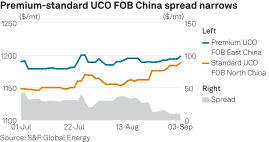
Chris Chen, managing director of Apeiron Bioenergy, said successful collection markets combine clear government direction, penalties against improper disposal and economics that allow collectors to pay generators competitively.
He cited the tax support previously available to Chinese UCO exporters as an example of a mechanism that improved margins for collectors and allowed more value to be passed to restaurants.
EPR needs measurable input and output
The panel broadly supported an EPR framework but differed on how it should operate, as EPR could not function without reliable data on how much edible oil enters the food system and an agreed ratio for how much UCO should subsequently emerge.
An effective framework would register or authorize all collectors, including smaller informal operators, rather than limiting participation to a small group of large companies. Digital records could then provide a clearer picture of collection volume, location, quality and destination.
Sushil Vaishnav estimated that EPR could increase formal UCO inflows by at least 20%.
