Agriculture, Energy Transition, Refined Products, Biofuel, Sugar, Renewables, Jet Fuel
September 29, 2025
India risks falling behind Brazil as molasses feedstock regulations cloud ethanol-based SAF ambitions

HIGHLIGHTS
India's ethanol surplus could support aviation decarbonization
Regulatory uncertainty around sugarcane feedstocks hinders SAF scaling
Addressing feedstock policy, certification key to unlocking AtJ potential
India could leverage its abundant ethanol surplus to support international aviation decarbonization, but regulatory uncertainty around sugarcane-based feedstocks poses a key hurdle to scaling sustainable aviation fuel , according to Atul Mulay, president-bioenergy at Praj Industries.
"By 5% in 2030 for international flights, if associations like [the Indian Sugar & Bio-energy Manufacturers Association] go to the government and say yes, we have the opportunity and a huge surplus of alcohol available, then 10%-12% blending can be made from that," Mulay said Sept. 25 at the International Conference on Bioenergy and Technologies in New Delhi. "But the hurdle in India is B- and C-heavy molasses as well as sugar syrup. We can learn from how Brazil has achieved its own sugarcane-based SAF."
"We have surplus ethanol available in India, and [alcohol-to-jet] acceptance globally is very good," he said.
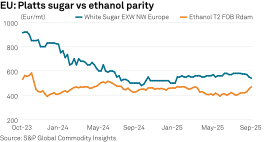
Molasses and sugar syrup bottlenecks
Mulay cautioned that India's ethanol feedstock base remains constrained by policy volatility.
"B-heavy and C-heavy molasses as well as sugar syrup could be viable for SAF, but the hurdles in India are significant," he said. "We can learn from how Brazil has achieved certification for its sugarcane-based SAF."
India has repeatedly restricted the use of sugarcane juice, syrup, and molasses for ethanol production during years of tight sugar supply, complicating long-term SAF planning. As of 2025, 61% of India's ethanol comes from B-heavy molasses, 20% from sugar syrup and just 2% from C-heavy molasses, industry data shows.
These feedstock shifts make it difficult to achieve the consistency and traceability required for the ISCC CORSIA, the international standard for SAF production.
By contrast, Brazil has successfully secured multiple certifications for sugarcane ethanol. Raízen became the world's first ethanol producer to obtain ISCC CORSIA Plus certification in 2023, while São Martinho followed in 2024 with Low Land Use Change Risk certification. Brazil's ProBioQAV program also provides clear SAF blending mandates, starting at 1% in 2027 and rising to 10% by 2037.
UCO volatility and AtJ's advantage
Mulay said India's growing focus on used cooking oil for HEFA-based SAF is constrained by cost volatility.
"Most OMCs have started adding capacity to co-process [used cooking oil]," he said. "But when they began, the rate was Rs 65–70/liter. Now it has reached Rs 210/liter. That vulnerability will remain. By contrast, AtJ feedstock – ethanol – is going to be continuously available. The customer impact of AtJ is not going to be high."
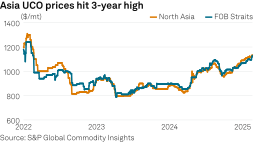
UCO prices in Asia have surged to near 3-year highs as tight regional supply meets growing demand from US buyers and Chinese sustainable aviation fuel producers, though market participants are cautious that scheduled plant maintenance and delays in China's SAF export approval process could create price uncertainties ahead.
Platts assessed UCO FOB North Asia at $1,135/mt and UCO FOB Straits at $1,125/mt on Sept. 18. Those represent the highest prices since UCO FOB North Asia was assessed at $1,150/mt back on Sept. 20, 2022, while UCO FOB Straits was at $1,130/mt on Sept. 19, 2022.
The increase in UCO FOB Straits prices has been driven by demand from US buyers, while UCO FOB North Asia prices are supported by demand from domestic SAF plants in China.
Scaling ethanol and SAF readiness
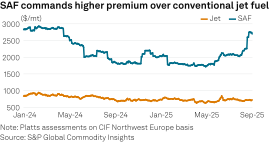
India's ethanol blending program has advanced rapidly, with blending rising from 12% in ESY 2022-23 to nearly 20% in April 2025, government data show. The program has saved over Rupee 1.26 trillion ($15 billion) in crude imports and added Rupee 1.07 trillion ($13 billion) to farmer incomes.
However, India currently lacks a commercial-scale AtJ facility, with only pilot projects underway. Industry estimates suggest it takes about 3.5 years to commission an AtJ plant, meaning commercial volumes would not be available until around 2030 even if policies are finalized in FY2026.
To move forward, experts say India must stabilize ethanol feedstock policy, invest in commercial AtJ capacity, and secure ISCC CORSIA certification to access international SAF markets.
"India has the advantage of abundant ethanol and low carbon intensity compared with global peers," Mulay said. "But unless we fix the feedstock and certification issues, we will fall behind Brazil and others in tapping this opportunity."
Platts, part of S&P Global Energy, assessed Asian fuel ethanol unchanged day over day at $636.33/cu m CIF Philippines on Sept. 29, following movement in US futures.
Platts assessed grade B ethanol price unchanged day over day at $633/cu m CFR Ulsan for cargoes arriving over Nov. 28-Dec. 28, following the indicative value at around $630/cu m and below offer at $640/cu m amid limited market activity.

Editor: