Agriculture, Pesticides, Rice
September 26, 2025
INTERVIEW: Pakistan set for record rice exports despite floods: REAP chairman
By Ayushi Baloni and Tanya Rana
HIGHLIGHTS
Pakistan expects record rice exports despite climate shocks
Africa, Iran expected to remain key buyers of Pakistani rice
Pakistan remains competitive supplier of non-basmati globally
Pakistan is on track to achieve record rice exports this year despite climate shocks and regional competition, as the country's production outlook remains strong and exporters expand into new markets, Malik Faisal Jahangir, Chairman of the Rice Exporters Association of Pakistan (REAP), said in an interview Sept. 24.
"Even with about 10% of Punjab's rice crop damaged by floods, our overall planted area has increased by 20% year over year," Jahangir told Platts, part of S&P Global Energy. "This means that total output will still exceed last year's of 9.72 million metric tons, keeping supply ample and allowing Pakistan to remain competitive in global markets."
He emphasized that effective irrigation management and precautionary measures taken by the government helped limit the damage, ensuring that supply remained ample despite temporary setbacks.
On structural challenges faced by farmers, Jahangir said: "Last year, heatwaves ... caused significant harm. REAP, alongside the agriculture departments of Punjab and Sindh, has worked to introduce better technology and raise awareness among farmers. Adoption of improved seed varieties and conventional practices that minimize pesticide use has helped Pakistan maintain compliance standards, especially for Basmati exports. Despite weather shocks, resilience is improving, and this year's harvest is expected to be strong."
Export surplus
Pakistan has set a target of 8 million mt of rice exports for the fiscal year (July-June) 2025-26, according to REAP.
This marks a significant increase from exports in FY 2024-25, which totaled 5.82 million mt, a 3.5% decline compared to the previous year, data from the Pakistan Bureau of Statistics showed.
"With total production expected at around 11 million mt and domestic consumption at 2 million-2.5 million mt, we will have an exportable surplus of nearly 8 million mt," Jahangir said.
However, external projections paint a slightly different picture. The US Department of Agriculture forecasts Pakistan's rice production for marketing year 2025-26 at 9.8 million mt, while S&P Global Energy estimates it at 9.35 million mt, both notably lower than REAP's projections.
"Pakistan does not plan to carry forward large stocks. Our focus is on strong demand in Africa, the Middle East, and other regions, ensuring timely shipments and maximizing our competitiveness."
Price dynamics
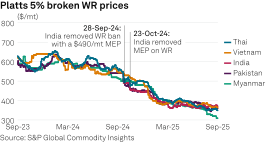
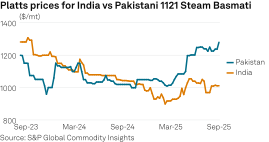
Addressing recent Platts rice price assessments, Jahangir said: "Prices did rise temporarily in August-September due to crop delays and weaker market sentiment, but Pakistan remains the most competitive supplier of non-basmati rice globally. For 5% white rice, prices could ease to around $335/mt FOB, which would further strengthen our position. Basmati prices are expected to soften and fall below $1,000/mt FOB once supply improves. Pakistani Basmati continues to enjoy a global premium due to its superior quality compared to Indian varieties," he said.
Africa remains a focal point for Pakistani rice exports.
"East Africa, in particular, has been a priority. Many exporters have established offices, warehouses, and distribution networks there. Ghana has shown keen interest and could become a major buyer," he said. Jahangir also highlighted strong prospects in Iran, which has indicated that 70% of its rice import requirements will be met through Pakistani supply. Afghanistan continues to buy, though payments and legal channels remain a challenge. He added: "Indonesia is expected to return to the market due to its structural import needs, providing another opportunity for Pakistan."
The European Union's strict compliance requirements have shaped Pakistan's export strategy.
"Pakistan's basmati has long been recognized for its quality. Unlike India, which has faced criticism for high pesticide use, we have ensured certain chemicals are not applied to our crops. This makes Pakistani basmati more compliant with EU standards," Jahangir said.
Last year, Pakistan exported 365,000 mt of rice to Europe compared with India's 165,000 mt.
"The ongoing GI dispute with India is noted, but we are confident in Pakistan's historical and cultural ownership of basmati," he added.
Global challenges
While Pakistani exporters are broadly competitive, Jahangir acknowledged challenges such as smuggling into Afghanistan and Iran, which inflate domestic prices and distort the market. Payment bottlenecks with these countries also remain a concern.
"Despite these challenges, Pakistan's strong production and exportable surplus provide a strategic advantage," he said.
With India re-entering the global rice export market, Jahangir said: "Competition has increased, but Pakistan's position remains strong due to established relationships and the perception of better quality, Jahangir said. Our exporters remain agile, focusing on Africa, the EU, and the Middle East. Over the long term, Pakistan will continue to play a major role in global rice supply."
Both Indian and Pakistani rice exporters have expressed confidence in the quality and heritage of their basmati rice, which has led to disputes and differing perspectives within international trade organizations.

Editor: