Agriculture, Rice
September 25, 2025
Thai rice prices hit 8-year low as key buyers stay away
By Tanya Rana and Chirag Aggarwal
HIGHLIGHTS
Thai 5% rice prices sink amid weak demand, currency pressure
Philippines, Indonesia stay away, hitting Thai rice exports
Thai rice undercuts India, Vietnam but Myanmar remains cheapest
Thailand's 5% broken white rice prices have plunged to their lowest levels in over eight years, weighed down by sluggish international demand and a weakening Thai Baht, market sources told Platts Sept. 25.
The sharp drop comes as key buyers like the Philippines and Indonesia remain absent from the market.
If prices keep falling, buyers may delay purchases while exporters face tighter margins.
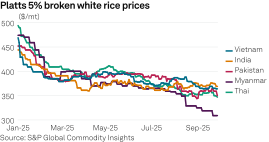
Platts, part of S&P Global Energy, assessed Thai 5% broken white rice prices at $347/mt FOB Sept. 25, down $9/mt week over week and $8/mt month over month. This marks the lowest price level since March 29, 2017, further squeezing margins for exporters.
Thai 5% WR prices are currently among the lowest in Asia on Sept. 25, trading at a discount of $3/mt to Pakistan, $17/mt to Vietnam, and $22/mt to India. However, Myanmar remains the cheapest origin, with 5% WR rice trading at a $38/mt discount to Thailand, Platts data showed.
Early August, the Philippines, one of the world's largest rice importers, decided to suspend rice imports for 60 days from Sept. 1 to support domestic farmers impacted by falling prices during the harvest season.
As per the Thai rice exporters association, Thailand exported 161,358 metric tons rice to the Philippines during January-July 2025, a decline of 47.4% from the previous year during the same period.
Meanwhile, Indonesia, which was Thailand's top rice export destination in 2024 with 1.33 million mt, has not imported any rice so far in 2025. The country is prioritizing self-sufficiency policies aimed at boosting domestic production and reducing reliance on foreign imports.
A Bangkok-based seller said, "Local prices are falling slightly, but demand remains very low. Many traders and buyers are cautious, as they already hold expensive stocks at destination markets. Hopefully, prices don't drop too much further."
Adding to the exporters' woes, the Thai Baht weakened by 1.07% against the US dollar over the past week, making Thai rice more affordable in US dollar terms. While currency depreciation typically enhances export competitiveness, traders say the benefit is being outweighed by poor global demand and high inventories across major destination markets.
"There is still some demand from South Africa and Yemen to fulfill their quantities, but buyers seem to prefer waiting for now," said another seller dealing in the parboiled rice segment, based in Bangkok.
A trade source from Bangkok said, "It is still very quiet. Clients believe prices may continue to fall, so they are hesitant to buy. Demand is very slim at the moment."
This wait-and-watch appears to be widespread, with many buyers reluctant to commit amid expectations of continued price declines.
Indian rice exporters are also reporting a similar slowdown. "Indian rice export demand is very quiet because of overstocks at destination, plus more cargo already on the water and at load ports. We expect some activity only once the new crop comes out by mid-October," an Indian rice seller said.
Another rice supplier from India noted that there is currently no demand at all for Indian rice.
Meanwhile, Thailand is forecast to export 7.2 million mt of rice in the marketing year 2024-25 (January-December), down 27% year over year, according to Energy data.
Looking ahead, it will be intriguing to observe market developments following the conclusion of the Philippines' two-month import ban in November. Buyers' decisions to either return to the market or maintain their hold could significantly influence Thai 5% WR prices in the coming months.

Editor: