September 05, 2025
EU shrimp imports reach record H1; India eyes bigger share
By Tanveen Kaur and Elvis John
HIGHLIGHTS
EU shrimp imports surge 14% in H1 2025
Indian exporters eye EU as lucrative option amid US tariffs
EU changing preferences for value-added shrimp present opportunities
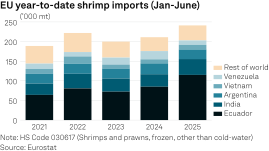
The EU's appetite for shrimp is surging. Imports touched 241,193 mt in the first half of 2025, up 14% from the same period last year, according to Eurostat trade data.
The increased imports cement the bloc's position as a vital market at a time when the global shrimp industry is bracing for a trade realignment following US tariffs on major shrimp-exporting countries.
India, the second-biggest shrimp exporter globally and the biggest supplier to the US, is being squeezed out of the market by punitive tariffs. According to a note by Crisil Ratings, majority-owned by S&P Global, dated Aug. 29, India's shrimp exports are set to fall 15-18% this fiscal year after the US raised duties to an effective 58.26% from Aug. 27.
Export revenues could decline 18-20% year on year, while operating margins are projected to shrink to a decade low of 5.0-5.5%, the note added.
As Indian exporters eye non-US markets to expand and strengthen their position, the EU has emerged as a lucrative option following its strong performance in H1.
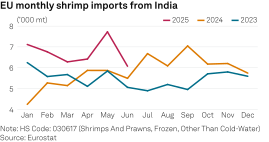
India's shipments to the bloc totaled 40,382 mt in H1 2025, up 27% year on year. Its share of EU imports rose to 16.7%, consolidating its position as the bloc's second-largest supplier.
Meanwhile, Ecuador expanded its shipments by 35.5% to 115,054 mt, while capturing nearly half of the EU market.
Though favorable macroeconomic conditions and its position as a premium market make the EU more appealing to exporters, market participants point out supply glut and rigid quality compliance norms as headwinds.
Purchasing power advantage
Underlying the EU's resilient demand in the first half of the year is its consumer profile.
World Bank Group data shows the bloc's GDP per capita at $43,145 in 2024, while its GDP per capita on a purchasing power parity basis stood at $62,434.
Both measures sit far above the global averages of $13,673 (GDP per capita) and $24,248 (PPP), as per the data, underscoring the EU's affluent consumer base.
World Bank Group also reported that GDP per capita growth for the EU improved from 0.1% in 2023 to 0.9% in 2024, pointing to a steady, if modest, expansion in household purchasing power.
That economic edge translates directly into food demand patterns. According to a June 6 report by S&P Global Energy, global GDP growth -- particularly GDP per capita -- is a far more reliable driver of protein consumption than population changes.
Adding to the momentum, the dollar's slide earlier this year enhanced the euro's buying capacity, making shrimp purchases more attractive for European importers.
Market access and changing consumer preferences
The EU is a mature market with very high standards for sustainability and food safety, with a strong preference for specific shrimp grades.
Ecuador's strength lies in head-on, shell-on (HOSO) shrimp, a grade well aligned with traditional European demand. But the South American supplier lags behind Asian rivals in peeled and value-added categories.
Market participants point out that the European demand patterns are slowly shifting from traditional raw HOSO shrimp to peeled and value-added shrimp.
One Mumbai-based trader noted that "Q1 2025 saw a sharp increase of value-added shrimp imports of about 30%." The trader also said that HoReCa is driving the value-added shrimp consumption in northwestern and southern Europe.
Market participants said that the changing consumer preferences could be of advantage to Asian suppliers like India, which can provide larger volumes of peeled and value-added shrimp at a competitive price.
Though there are concerns over higher inventory levels, the general sentiment for the EU market is "cautious optimism," the trader noted.
"The EU has the capacity and demand to absorb more volumes from India, especially in value-added shrimp, but growth depends on compliance with EU quality standards and sustainability credentials, while maintaining competitive prices," a second trader said.
K. N. Raghavan, secretary general of the Seafood Exporters Association of India, told Platts that less than 10% of its export basket comprises value-added products, but greater emphasis on this segment could open access to new markets and deliver stronger margins.
Diversification, not displacement
Still, the EU cannot fully replace the US market for Indian exporters. In 2024, India shipped 248,642 mt of frozen shrimp to the US, compared with just over 80,000 mt to the EU, according to Ministry of Commerce data.
Even with potential growth, increased regulatory and logistical hurdles continue to slow shipments and add costs. Market dynamics also vary as the product formats in demand across Europe differ sharply from the US preferences, requiring adaptation.
Competition will be intense as Ecuador is expanding processing capabilities to increase the output of peeled and value-added shrimp.
"While Ecuador is currently unable to fully capture India's market share, it is investing in enhancing its processing capabilities," said Max Bouratoglou, Seafood and Aquaculture analyst at Energy.
India's expansion in Europe will likely remain selective, reflecting differences in product preferences, regulatory requirements, and competitive dynamics with established suppliers like Ecuador.
