Agriculture, Grains
August 29, 2025
Middle East adopts risk-based grain import strategy post-Black Sea shock: Golden Wheat CEO

By Lalita AVD
HIGHLIGHTS
Buyers diversify supplies to reduce Black Sea dependence
Ukraine continues redirecting grain flows to Middle East, Africa
US tariffs indirectly raise grain import costs for Middle East
Grain demand outlook steady in key Middle Eastern markets
The Russia-Ukraine war has significantly reshaped grain procurement strategies in the Middle East, prompting many buyers to adopt flexible, risk-based approaches to avoid overreliance on a single origin, Malak Al Akiely, CEO of Golden Wheat for Grain Trading, said in an interview with Platts on Aug. 27.
"Countries like Jordan, Egypt and Lebanon used to rely heavily on Black Sea wheat," she told Platts, part of S&P Global Energy, before the conflict disrupted supplies and pushed global prices higher, forcing buyers to reconsider their sourcing strategies.
To mitigate these risks, "we have diversified our sources, increasingly turning to origins like Romania and, more recently, France," said Malak.
Spot purchases and short-term contracts have become key tools for buyers aiming to stay agile amid uncertainty. "In Jordan, the government and millers are maintaining higher stock levels and working to reduce exposure to any one origin," she said. "We are also diversifying suppliers to deal with uncertainty and keep supply lines stable."
While these adjustments come with logistical and cost challenges, importers see it as necessary to navigate volatility in global grain markets. Malak believes that a potential peace deal between Russia and Ukraine could bring much-needed relief to grain importers in the Middle East.
"A peace agreement would help resolve some of the logistical bottlenecks we have been dealing with and bring down freight insurance costs. Right now, there are premiums on top of premiums -- a deal would likely ease that burden," she said.
While such a development may not lead to a sharp drop in prices, it would stabilize grain flows and allow the market to recover, Malak said. "But the biggest takeaway for us is that we cannot go back to relying on just one origin. Diversification and stronger investment in grain storage infrastructure are now essential."
Ukraine's MENA grain flows
Ukrainian grain exports have been increasingly redirected toward the Middle East and North Africa, a trend that began even before Ukraine's free trade deal with the EU expired June 5, 2025.
"We were already seeing a steady flow of Ukrainian grain -- particularly wheat, and to some extent corn -- into the Middle East and parts of Africa, even before the EU trade deal expired," she said. "Much of it is being transported via the Danube and through ports like Constanța in Romania."
Malak said this shift is driven by both the region's high demand and the logistical advantages offered by nearby Black Sea trade routes. "It is a natural outlet." With strong demand and transit times as short as eight days, Ukraine is well-placed to supply MENA efficiently.
Recent shipments of Ukrainian wheat have already arrived in the region, underscoring that the shift is not speculative but already underway. "We have received Ukrainian wheat in recent cargoes. It is happening, and I believe it is only going to grow."
Platts assessed Ukrainian wheat 11.5% FOB Black Sea at $230/mt on Aug. 28, down $1/mt day over day.
US tariff pressure
US agricultural tariffs have raised costs and tightened grain supplies for Middle East importers by distorting prices and shifting trade to Latin American and European suppliers, despite the region not importing directly from the US.
"Definitely, on certain agricultural products, it is creating the effect," Malak said. "We do not face the direct impact; we face the indirect impact. So, definitely, a higher cost, tighter supply, more competition for cargoes to get."
Rerouted global trade flows have forced Middle Eastern buyers, who depend heavily on imports for domestic consumption, to change sourcing and freight strategies, disrupting shipping patterns and increasing logistical complexity.
"The ripple effect is not direct, but real -- and it will touch us definitely," Malak said.
Demand outlook
Grain demand in key Middle Eastern countries remains largely stable, but governments are adjusting procurement strategies due to high prices, logistical challenges and efforts to boost domestic resilience, according to Malak.
In Jordan, grain demand has held steady, supported by a strong strategic reserve position. "We currently have a minimum 12-month reserve for wheat, which puts us in a comfortable position," Malak said. "Because of this, Jordan has not booked any new grain shipments in the past two months, especially as prices have remained high."
She said Jordan is continuing to invest in expanding its strategic grain storage infrastructure, a move aimed at increasing long-term food security.
In Egypt, the world's largest wheat importer, consumption remains stable, though shifts in government strategy could impact future procurement. "There is some uncertainty around the new government grain company and how it will operate, which could affect buying patterns," Malak said.
Mostakbal Misr is currently Egypt's state-owned grain purchasing company, having replaced GASC in early December 2024.
Turkey, while more self-sufficient in terms of grain production, still imports significant volumes for its milling sector. "Turkey continues to import wheat primarily for flour production, which it reexports," she said.
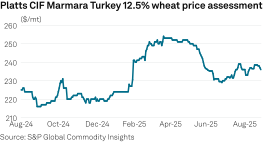
Turkey's annual grain imports fluctuate significantly from year to year, influenced by changes in domestic production and government policies. According to the US Department of Agriculture Foreign Agricultural Service, Turkey attache, the country's wheat imports in marketing year 2025-26 (June-May) are projected to reach 10.25 million mt.
For Iran, demand has been growing due to population increases and domestic consumption needs. However, international sanctions continue to complicate both the financing and sourcing of grain. "The demand is there, but sanctions remain a key barrier," Malak said.
According to regional media reports, Iran may need to import 4.5 million mt of wheat this Iranian calendar year (March 21, 2025-March 20, 2026).
