Agriculture, Oilseeds
August 27, 2025
US tariffs on India to shift crude flows, possibly widening Russian price discounts
By Kate Winston and Sambit Mohanty
HIGHLIGHTS
Russian crude exports to India slip
US crude exports to India climb
India may shift purchases to Middle East
India is expected to continue buying Russian crude despite the additional 25% tariffs the US imposed Aug. 27, but it may still taper its purchases enough to shift trade flows, and widen price discounts for Russian crude, analysts say.
On Aug. 27, the US doubled its tariffs on Indian goods to 50% in response to India's continued purchase of Russian oil.
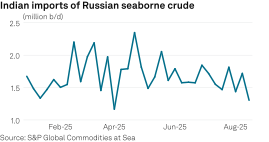
As of the week starting Aug. 20, Indian imports dropped to 1.304 million b/d, down from 1.718 million the week prior and down from 1.943 million b/d the year prior, according to S&P Global Commodities at Sea data.
So far in August, Russia has exported 1.5 million b/d of crude to India, down from 1.6 million b/d in July and 1.8 million b/d in May, CAS data shows.
And US crude exports to India have risen, averaging 402,000 b/d so far in August, up from 161,000 b/d in July, CAS data showed.
US President Donald Trump has pushed to get India to buy more US crude. In February, Trump said the two countries had "reached an important agreement on energy" that would result in more US crude exports to India.
"Overall, for the market, it will likely drive Russian crude discounts higher and blends cheaper, being slightly bearish," Rachel Ziemba, a senior adviser for Horizon Engage, told S&P Global Energy.
Despite tough talk from the Indian government about continuing to buy Russian crude, businesses are likely to hedge and look for some other supplies, Ziemba said.
India's state-run refiner Indian Oil Corp said Aug. 18 it would continue buying Russian crude despite new sanctions.
India will buy a little bit less Russian crude, and buyers like China will demand cheaper prices from Russia, Ziemba said. The combination of these trends and the Ukrainian drone attacks on Russian refineries will increase the amount of crude on the markets, she said.
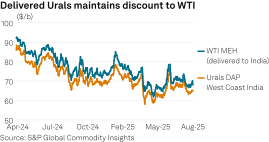
Urals delivered into India was assessed by Platts at a $2.60/b discount to Dated Brent Aug. 27, unchanged on the day but down from a $1.80/b discount on July 22. Urals remains at a discount to WTI delivered into India from the US.
Platts is a unit of S&P Global Energy.
OPEC decision
The big question is whether OPEC will use its new production quotas, Ziemba said. If it does, it will be bearish for markets, but if not, a relative status quo could continue, especially as US production eases, she said.
So far, only Saudi Arabia and the UAE have increased output significantly to take advantage of higher quotas. OPEC+ countries with quotas produced 380,000 b/d below target in July, according to a Platts survey.
But Ellen Wald, president of Transversal Consulting, said the tariff could end up boosting oil prices. "It is possible that the tariff will increase crude oil prices slightly if India cuts back on Russian crude oil purchases significantly and increases its imports from other sources."
One senior official at a leading state-run Indian refinery said that India's purchases of Russian oil are purely driven by commercial considerations. "If today, the market flips and we get a better deal from the US or any other crude supplier, for that matter, we will buy from them."
David Goldwyn, the chairman of the Atlantic Council Global Energy Center's Energy Advisory Group, echoed this point, arguing that if Russian crude remains sufficiently discounted, India will continue buying it.
But if India does cut down on purchases of Russian oil, it could increase its consumption of Middle Eastern crudes of similar quality since Iranian and Venezuelan crude is off limits due to US sanctions, Goldwyn said.
"The net effect will be to provide greater quantities of discounted Russian crude to China, while Western companies will likely face higher prices to access Middle East crude supplies."
The EU has introduced a floating pricing mechanism for the Russian crude price cap with an initial threshold of $47.6/b, set to go into effect in early September. The G7 $60/b price cap will remain in place. In 2026, the EU will also impose an import ban on products made from Russian crude.
For now, the Trump administration is only targeting this type of tariff on India, not China, Turkey, or other importers of Russian crude, much less European and Japanese importers of Russian gas, Goldwyn said.
"This is essentially a bullying tactic intended to force India to make asymmetrical trade concessions," he said.
But Richard Rossow, the chair on India and emerging Asia economics at the Center for Strategic and International Studies, argued that more tariffs could be coming.
"I can easily imagine China facing similar pressure if the current trade talks do not progress or fall short of President Trump's expectations," he said.
