Agriculture, Rice
August 15, 2025
South American rice exports continue to grow as US exports shrink

By Iara Lima
HIGHLIGHTS
Uruguayan producers rapidly increased market share in Mexico, capturing 22% in Q1
US price production forecasts downgraded; 5.4% drop in 2025-26 season expected
US Q2 rice exports down 26%, losing market share in Mexico to South Americans
The rice market in the Western Hemisphere could be on the brink of a significant restructuring as South American countries, particularly Brazil and Uruguay, are poised to increase their export volumes significantly. This potential shift comes as the US grapples with adverse weather conditions that have severely impacted its rice production in 2025.
In the second quarter, South American rice exports grew by 24% to 923,371 mt, compared with Q2 2024, while US exports during the same period shrank by 26% to 745,642 mt, according to GTA Connect data on Aug. 15.
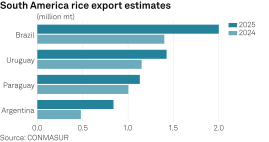
Argentina and Uruguay, while smaller producers, where the drivers to the overall increase in South American rice output. Argentina's rice exports are expected to almost double from 2024 to 900,000 mt in 2025, while Uruguay is projected to export approximately 1.4 million mt, a 24% increase from 2024, according to South American association Conmasur.
Market share shifts
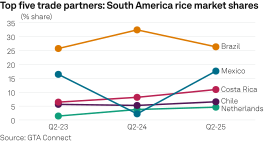
The shifting dynamics in the rice market are evident in the evolving export figures to key destinations. For example, in Mexico, where the US has historically been a dominant exporter, South American countries are rapidly increasing their presence. In the past year, Brazil has expanded its exports to Mexico, capitalizing on competitive pricing and favorable trade agreements within the region.
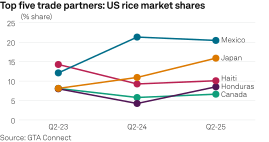
In Q1 2024, the US held 90% of the Mexican rice import market, by Q1 2025 this figure declined to 38% as South American producers enhanced their market share. Uruguay's market share in Mexico increased to 22% from 4% during the same period, according to GTA Connect data. Brazil and Argentina are expected to capture a combined market share of around 35% in Mexico by the end of 2025, according to sources. This shift highlights the growing competitiveness of South American rice in international markets.
US rice market under pressure
The US rice industry is facing a challenging year, with production forecasts downgraded due to climatic disruptions. Excessive rainfall in the Mississippi Delta, the primary rice-growing region led to a reduction in yields, the US Department of Agriculture lowered the US rice area to the smallest since 2022-23, as of June, the USDA reported that US rice plantings for the 2025-26 season where at 2.684 million acres, marking a decline of approximately 8% from the 2024-25 season and exports for the 2025-26 season were predicted at 4.1 million mt, a 4% drop from 2024-25, according to S&P Global Energy analysts. USDA reports that rice exports are projected to decline to approximately 3.1 million mt, marking a decrease of 5.4% from the previous year.
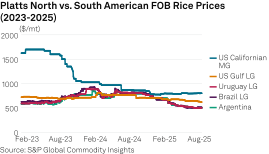
The adverse weather conditions have not only affected production levels but have also driven up domestic prices. The season-average farm price for long-grain rice is expected to rise to $12.50 per hundredweight, reflecting tighter supplies and increased competition from international markets. Consequently, US farmers are facing mounting challenges, exacerbated by a record-high level of rice imports as the US seeks to supplement its domestic supply.
South American production on rise
In contrast, South American rice producers are experiencing a surge in production. Brazil, the continent's largest rice producer, is projected to produce approximately 12 million mt in the 2025-26 season, buoyed by favorable weather and an expansion of planted area. Uruguay is also witnessing a rebound, with production levels forecast at around 1.7 million mt, according to the results of a Conmasur meeting in Paraguay in May.
Argentina and Paraguay, while smaller exporters, are also contributing to the overall increase in South American rice output. Argentina's rice production has grown 35% to around 1.5 million mt in 2025, while Paraguay recently experienced its largest harvest ever at 1.3 million mt.
Policy shifts, competitive advantages
The rise of South American rice exports can be attributed to several factors, including favorable trade agreements and supportive government policies. Brazil has eliminated import tariffs on certain rice classes, facilitating easier access to key markets. Argentina has also removed export taxes on paddy rice, enhancing its competitiveness. Additionally, both countries benefit from the Mercosur trade bloc, which promotes tariff-free trade among member nations, further boosting export volumes.
In contrast, the US faces challenges related to stricter sanitary standards and trade barriers, such as the 25% tariff on Mexican imports, complicating trade relationships with key partners. The US Trade Representative has highlighted the need for reforms to address these barriers, but the effects of such changes may take time to materialize.
The depreciation of local currencies in South America since the beginning of the year has also played a significant role in enhancing export competitiveness.
"The export parity on raw material advanced, driven by the devaluation of the peso," said an Argentina-based source.
As of mid-2025, South American countries are well-positioned in terms of export growth, primarily driven by favorable climatic conditions, supportive trade policies and competitive pricing due to currency depreciation. The US rice sector, while historically dominant, faces significant challenges from adverse weather and increasing competition.
"We evaluated Uruguayan exports in July," the Argentinian source said. "They increased by almost 20% compared to the consolidated volume in the first 5 months of 2024. Mexico played a decisive role, and Brazil regained prominence. For the first time in the cycle, the reality of sales and the plan aligned."
