Agriculture, Energy Transition, Biofuel, Renewables
August 05, 2025
UK bioethanol industry urges SAF mandate reform amid ethanol, SAF plant shutdown threats

HIGHLIGHTS
US trade deal allowing duty-free ethanol import threatens UK bioethanol industry: RFTA
Urges UK to amend SAF mandate to allow domestic crop-based ethanol for aviation fuel
Ethanol plant closures risk disrupting supply chains for animal feed, CO2, future SAF projects
The Renewable Transport Fuel Association has urged the UK government to urgently amend its sustainable aviation fuel mandate to allow British-made crop-based bioethanol to qualify for use, warning that failure to act could deal a fatal blow to the country's domestic bioethanol industry.
In a statement issued on Aug. 4, the RTFA said UK-produced ethanol -- now displaced from the road fuel market due to a new trade deal with the US -- should be permitted for use in SAF production via the alcohol-to-jet pathway, as part of the existing cap on SAF made using hydroprocessed esters and fatty acids.
"Crop-based ethanol should become eligible for the SAF mandate when it is no longer required for decarbonising road transport. We are now in this situation," RTFA Chief Executive Gaynor Hartnell said. "We're calling for the mandate to be amended to allow either HEFA or UK crop-based AtJ SAF to meet the HEFA cap."
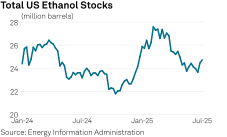
Trade deal undermines ethanol sector
The call comes in the wake of the UK-US trade agreement, which came into effect on June 30 and includes a duty-free quota for 1.4 billion liters of US ethanol roughly equal to the UK's entire domestic market.
As a result, UK producers such as Ensus and Vivergo Fuels are facing severe losses and potential closures.
Both companies have been sounding the alarm for months, warning that the tariff-free access granted to US ethanol has rendered British production economically unviable.
Vivergo's 420 million liter-per-year plant in Hull has already received its final wheat delivery, with plans to shut down operations by Sept. 13 if no government support materializes.
Mandate fit for the moment?
The UK introduced a 2% SAF mandate this year, with a cap on SAF derived from HEFA mainly made from waste fats and oils, intended to drive investment into alternative production pathways due to global feedstock limitations.
The RTFA argued that domestic ethanol should be recognized as one such alternative.
A 2021 government strategy paper hinted at this direction, stating that a decline in road fuel demand would free up feedstocks like ethanol for aviation fuel production -- a shift the RTFA now says must be codified in policy.
"This presents us, and UK industry, an opportunity to push forward the transition of feedstocks currently used for road fuel to other sectors," the document said.
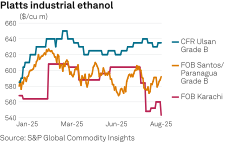
Industry on the brink
The UK's two major ethanol producers are both under intense pressure.
Vivergo Fuels, owned by AB Foods, has set a closure deadline of mid-September, citing losses of $3 million per month and a lack of feedstock purchases since June.
Ensus, owned by CropEnergies, is also considering closure and has been up for sale since December 2024 after reporting a GBP19.86 million loss in 2024.
Both companies have engaged in ongoing crisis talks with the UK government, requesting GBP150 million in short-term aid and policy changes, including SAF mandate reform to salvage their operations.
The looming closures threaten more than just ethanol output.
Both plants are key suppliers of byproducts such as animal feed and CO2, the latter of which has faced nationwide shortages in recent years. The knock-on effects could ripple across the UK food, agriculture, and industrial sectors.
SAF ambitions at risk
Market experts said the SAF mandate is not just about environmental targets, it is increasingly linked to industrial policy and energy security.
The closure of domestic ethanol plants could also jeopardise future SAF projects, such as the GBP1.25 billion Meld Energy SAF plant planned for Saltend Chemical Park, adjacent to Vivergo's facility.
Meanwhile, international projects are progressing. US-based LanzaJet, which recently launched the world's first commercial-scale AtJ SAF plant, has received planning approval for a 100 million liter/year facility in Wales, although that project has yet to reach a final investment decision.
Platts, part of S&P Global Energy, assessed the European SAF-jet fuel spread at $1,306.1/mt on Aug. 5, up $17.74/mt day on day.
Editor: