Agriculture, Rice
July 29, 2025
Myanmar B1, B2 broken rice prices hit 5.5-year low amid sluggish demand

HIGHLIGHTS
Subdued demand from destination markets amid high inventory
China preferring A1 & A2 rice over B1 & B2
Milled rice output for MY 2025-26 at 12 million mt: USDA
Myanmar B1 and B2 broken rice prices have fallen to a 5.5-year low due to weak international demand and a shift in buyer interest toward India, market sources said on July 29.
Platts, part of S&P Global Energy, last assessed Myanmar B1 & B2 broken rice price at $264/mt FOB FCL on July 25, down $5/mt week over week, $10/mt month over month and $125/mt year over year. The price for Myanmar B1 & B2 broken rice last fell to this level on Jan. 31, 2020, at $262/mt FOB FCL.
Currently, Myanmar B1 & B2 rice prices are also the lowest among other Asian origins, with a $65/mt discount to rice prices in Thailand, a $68/mt discount to rice prices in India, and a $61/mt discount to rice prices in Pakistan and Vietnam, Platts data showed.
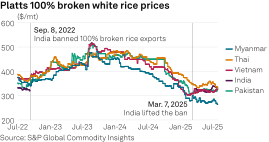
"The lack of purchases from the Philippines and Indonesia is contributing to the decline in prices," a Singapore-based trader said. "Chinese demand will shift to Pakistan."
Chinese buyers have shifted their preference from B1 & B2 broken rice to hard-cooking rice varieties with a high amylose content, which is essential for noodle preparation, primarily favoring A1 & A2 varieties. "To me personally, China prefers A1 & A2 type over B1 & B2 these days," a Yangon-based exporter commented.
Additionally, India has been catering to a huge amount of demand since the ban on 100% broken white rice exports was lifted in March 2025. With ample rice reserves, India can effectively handle large demands while remaining competitive in pricing.
Despite Myanmar being the most competitive in FOB prices for broken rice among Asian countries, higher freight rates are limiting demand, as Myanmar is less competitive when comparing CFR prices to other regions, particularly India.
"India sold its rice reserves at a very low price, so many buyers moved to a cheaper market," another Yangon-based exporter said. "Now Myanmar's export depends on only overseas trade."
Meanwhile, Myanmar's milled rice output for marketing year 2025-26 (January-December) is expected to increase 100,000 mt year over year to 12 million mt, according to the US Department of Agriculture. The increase in production is due to an increase in average field yield, although the area sown is expected to decrease slightly.

Editor: