Agriculture, Livestock, Meat
July 11, 2025
USDA raises beef import projections amid looming tariff, retaliation risks
By Shivam Prakash and Sergio Alvarado
HIGHLIGHTS
Tariffs on Brazil could slow beef imports in 2H 2025: analyst
Retaliations could impact beef exports; China’s purchases slowed in 2025
Pork output falls in Q2 2025, but projected to rise in 2026: USDA
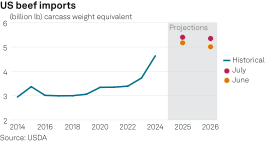
The US Department of Agriculture on July 11 revised its outlook for US 2026 beef imports to 5.35 billion lb, down 0.5% year over year but up 6.47% from its June estimates amid analysts' expectation of tariff-risk to purchases, while projecting 2026 pork imports at 1.14 billion lb, down 2.24% over the year.
The USDA also increased its projection for 2026 beef exports to 2.56 billion lb, down nearly 6% on year but 3.84% higher month over month, citing increased production, while pork exports project to a 0.4% increase over the year to 7 billion lb, according to the World Agricultural Supply and Demand Estimates report.
The USDA's beef import projection for 2025 rose 3.66% month over month to 5.37 billion lb, up 16% year over year.
"Beef import forecasts for 2025 and 2026 are raised on recent trade data, with the increased pace of imports expected to continue through the end of 2026," the USDA said.
"I do agree with raising import levels for both 2025 and 2026, but there remains some pretty significant risk around both years' imports," said Caleb Hurst, beef market analyst for S&P Global Energy. "The remainder 2025 has risk now that Brazil is facing additional 50% tariff rates on top of the All-other Countries Quota' tariff, which could slow the level of imports in the back half of 2025."
"Though levels from Brazil are still expected to outperform year-ago levels in the back half of 2025," Hurst added.
Between January and May, the US imported a combined volume of 214,540 mt of beef from Brazil, an increase of 112.7% compared to the same period in 2024, according to the US Department of Agriculture's Global Agricultural Trade System.
Notably, US purchases of Brazilian beef in the first five months of 2025 nearly matched the total imports of 215,577 mt in 2024, according to GATS.
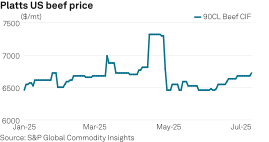
Platts, part of S&P Global Energy, assessed 90CL beef CIF US at $6,724/mt, or $3.05/lb, for a 30- to 60-day shipment period July 10, compared with $6,548/mt, or $2.97/lb, June 12, the date of the previous WASDE report.
Tariff-retaliation risks to exports
The USDA's beef export projection for 2025 rose to 2.728 billion lb, up 0.7% from the June estimates, but down 9.3% compared to the previous year. "Beef exports are raised on recent trade data," the USDA said.
"I don't necessarily agree with raising exports for 2025 or 2026," Hurst said. "We only saw 4 million lb traded to China in May, and don't believe that we will see any significant increases coming on that front for the remainder of 2025 with the US plant delistments to China still not resolved."
"Additionally, with both Japan and South Korea now potentially facing tariffs of 25% starting Aug. 1, there becomes some risk for reciprocal tariffs, which would likely limit the flow of beef to those countries," Hurst added.
Higher feedlot, strong demand push beef output
The USDA projects 2026 beef production at 25.88 billion lb, down 1.42% on year, 2.13% higher from the June estimates.
"Higher expected feedlot placements are expected during the second half of 2025, as strong demand for beef supports feeder cattle prices," the USDA said.
"The forecast assumes cattle imports from Mexico remain banned for the duration of the forecast period due to the presence of New World Screwworm," the department added.
For 2025, the USDA sees output declining 2.94% on year to 26.25 billion lb, down 0.64% from the department's June estimates. "Beef production is lowered on a slower pace of slaughter and reduced dressed weights," the USDA said.
"The production increases in the back half of 2025 and into 2026 are likely unwarranted," Hurst remarked. "Due to the continued closure of the US-Mexico border and continued heifer retention efforts in the back half of 2025, which will continue to limit production and, as a result, exports in 2026."
The department projects ending stocks at 570 million lb in 2026, up 3.6% month over month, but below the projection of 580 million lb in 2025.
Total consumption in 2026 is projected at 28.67 billion lb, 0.86% lower on year, while consumption in 2025 is seen rising 0.7% on year to 28.92 billion lb, the USDA said.
Pork production raised on increased slaughter
The USDA raised its 2026 pork output projection to 29.49 billion lb, up 1.56% year over year and 0.45% higher than the June estimates.
"Pork production is raised as higher expected pig crops during the second half of 2025 are expected to result in higher slaughter in the first half of 2026," the USDA said.
Meanwhile, pork output in 2025 is seen rising about 1% on year to 28.01 billion lb as "lower production in the second quarter of the year is more than offset by higher expected dressed weights and slaughter in the second half of the year."
The department projects 2025 pork exports at 6.97 billion lb, down 2.13% on year, but a marginal increase of 45 million lb from the June estimates citing recent trade data.
Pork imports in 2025 are projected at 1.15 billion lb, a decrease of 2.9% over the preceding year and an increase of about 1% over the month.
Similarly, pork ending stocks are projected at 435 million lb in 2026, increasing from the 425 million lb in 2025 projection.
Total consumption in 2026 is projected at 22.62 billion lb, up 1.87% on year, while consumption in 2025 is seen increasing 1.6% on year to 22.2 billion lb, the USDA said.

Editor: