Agriculture, Energy Transition, Refined Products, Biofuel, Renewables, Jet Fuel, Gasoline
July 10, 2025
INTERVIEW: Malaysia must prioritize key SAF feedstocks to scale up market, NAICO Malaysia CEO says

HIGHLIGHTS
Focus on select SAF feedstocks for a credible, scalable ecosystem
Aims to develop green aerospace ecosystem from design to aircraft disposal
Targets domestic, regional markets with domestic production using local feedstock
Malaysia must avoid "trying to take everything at one go" and instead focus on a select set of sustainable aviation fuel feedstocks to build a credible and scalable ecosystem, National Aerospace Industry Corporation Malaysia's CEO, Ts. Shamsul Kamar Abu Samah told Platts.
"We need to be firm on certain major feedstocks that Malaysia can really focus on," he said. "It doesn't make sense, and it cannot be sustainable, to attempt developing all feedstocks at once."
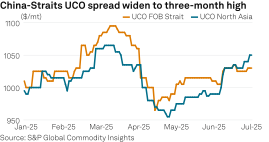
Used cooking oil, palm waste and forestry residues have all been identified as viable SAF feedstock options for Malaysia, but logistical and classification hurdles remain. Abu Samah emphasized that beyond production, Malaysia must also work toward establishing clear standards, especially for UCO, to ensure its credibility as a SAF precursor.
Beyond Europe: Regional SAF strategy
While much attention is paid to compliance with the EU's CORSIA and Fit for 55 mandates, Abu Samah said Malaysia's SAF strategy must serve domestic and regional markets as well.
"This agenda is not only for European countries; it's also for the long-term survivability of our industry," he said, pointing to the need to supply SAF for domestic and Southeast Asian nations' routes, even in the absence of mandates.

Book and Claim, but not just that
On Book and Claim mechanisms -- an increasingly discussed solution to address traceability and cost concerns in global SAF uptake -- Abu Samah said NAICO Malaysia supports the concept, but warned against tunnel vision.
"The real technology must play its role. We're looking beyond 2030, aiming for decarbonization by 2050. We want Malaysia to become a hub, not just of feedstock export, but a center of excellence in SAF production for the region."
Asked how Malaysia's identity as a major feedstock exporter could evolve, Abu Samah pointed to a shift in industrial strategy under the country's latest Industrial Master Plan 2030 and i-ESG under MITI.
"It's not our ambition to only export feedstock. What we intend to do is add value -- to produce SAF domestically using Malaysian materials. We need high-quality investment and stronger collaboration with local talent."
Malaysia is already attracting SAF-linked investment from companies in China, Japan, Europe and the Middle East, he added.
Abu Samah acknowledged that the SAF price gap remains a major hurdle for uptake in a price-sensitive region. "We must find a price point that is acceptable for airlines, producers, and the flying public. This conversation must start now, openly and collaboratively."
He warned that if SAF stakeholders fail to align on long-term pricing mechanisms, "it will not happen" at the necessary scale.
Platts, part of S&P Global Energy, assessed Asia SAF-Jet Fuel Spread at $1,101.44/mt on July 9, up 86 cents/mt day over day.
No economic target yet, but first refinery is coming
Although NAICO Malaysia does not yet have national SAF production or revenue targets, Abu Samah said the first SAF refinery is expected to come online by the end of 2025, while other pilot and demonstration projects are in the pipeline.
Looking ahead, he sees the MyAERO symposium platform evolving into a more targeted industry dialogue. "We need to move to the next phase: deeper engagement between seller and buyer, supported by people who actually fly."
NAICO Malaysia, a government agency under the Ministry of Investment, Trade and Industry, spearheading national-level aerospace development, is also tasked with sustainable aviation mandated under the Malaysian Aerospace Industry Blueprint 2030. "Our ambition is to develop a green, environmentally friendly aerospace ecosystem, from design through to aircraft disposal," Abu Samah said.
The agency's role extends beyond SAF production to strengthening green technologies across aerospace design, logistics, and manufacturing. NAICO Malaysia launched the Malaysia Aerospace Centre of Excellence, collaborating with universities and global industry players to foster talent and supply chain development, facilitating research, all the way toward decarbonization of the aviation industry.

Editor: