Agriculture, Energy Transition, Refined Products, Biofuels, Renewables, Jet Fuel
May 11, 2026
Uzbekistan Airports signs deal with Allied Biofuels for 2030 SAF supply

Editor:
HIGHLIGHTS
Deal for SAF, e-SAF supply from $6.1 bil biorefinery
Biorefinery to produce 422,440 mt/year
Uzbekistan Airports said May 8 it signed a memorandum of understanding with Allied Biofuels for the supply of sustainable aviation fuel and e-SAF, starting in 2030, providing the first disclosed offtake framework for a $6.1 billion integrated biorefinery that would rank among Central Asia's largest clean energy infrastructure projects once fully operational.
The nonbinding agreement was for SAF and e-SAF supply from an Allied Biofuels facility expected to produce 160,400 mt/year of SAF, 257,000 mt/year of e-SAF and 5,040 mt/year of renewable diesel at full capacity, the companies said May 8 in a statement.
The project is one of the region's most significant clean-fuel initiatives, positioning Uzbekistan as an emerging hub for sustainable aviation in Central Asia, Allied Biofuels said in the statement.
The 2030 supply target aligns with the first scheduled increases under the EU's ReFuelEU Aviation regulation, which requires 6% SAF blending with a 1.2% e-SAF sub-mandate, and with the UK SAF Mandate, which requires 10% SAF with a 0.5% power-to-liquid sub-target. The timing positions Allied Biofuels to serve both domestic demand through Uzbekistan Airports and potential exports to European markets as mandate compliance requirements intensify, the company said.
The airport offtake agreement follows Allied Biofuels' October 2025 signing of land and water resource agreements.
The project received further momentum when Plug Power signed a binding agreement to supply up to 2 gigawatts of GenEco proton exchange membrane electrolyzers, marking one of the largest electrolyzer supply deals announced in 2025.
Also, in November 2025, Allied Biofuels signed an MOU with India's Praj Industries to develop an ethanol refinery producing 293,700 mt/year of 95% ethanol from sorghum, serving as the upstream anchor for the integrated complex.
Production infrastructure
The facility is expected to operate using a 4.45-GW renewable energy system supported by 1,600 megawatt-hours of battery energy storage and 2.4 GW of electrolyzers for green hydrogen production. The e-SAF production pathway will use green hydrogen combined with sustainable carbon sources to produce a synthetic fuel that meets aviation specifications, according to the statement.
Uzbekistan has earmarked around 4 GW of solar power across 5,500 hectares to supply electricity for the electrolyzer complex, alongside an initial $820 million investment commitment from regional authorities.
A final investment decision is targeted for Q4 2026, according to previous company statements.
The project is expected to source agricultural residues and waste oils from Uzbekistan and Kazakhstan for bio-based SAF routes. At the same time, synthetic SAF output will rely on captured CO2 and green hydrogen. The Khorezm location, positioned along trade corridors linking Central Asia with Turkey, the UAE and China, could enable Uzbekistan to emerge as a regional SAF export hub once certification and offtake agreements are in place, according to previous statements.
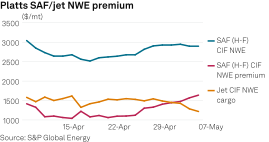
Platts, part of S&P Global Energy, assessed Sustainable Aviation Fuel HEFA-SPK FOB Straits at $2,485/metric ton May 8, unchanged from May 7, tracking adjacent market information.
The SAF FOB Straits premium was assessed at $1,315.75/mt over the Platts Jet Kero FOB Singapore forward curve (MOPS) May 7, up $245.75/mt from the week before.
Platts assessed FOB China SAF prices at $2,460/mt on May 6, following Platts' decision to launch daily neat sustainable aviation fuel HEFA-SPK FOB China price assessments, effective May 4.