Agriculture, Grains
May 08, 2026
ASIA WHEAT APRIL ROUNDUP: Shaky start to planting in Australia; Black Sea competes into Asia

By Vivien Tang
Editor:
HIGHLIGHTS
Australia wheat prices climb on currency, planting woes
Bullishness expected as growers raise price expectations
Asia turns attention to Black Sea as Argentine exports thin
Australia's winter crop planting kicked off in April to varying concerns across multiple states as growers retreated from the market, funneling bullishness into Australian old-crop wheat prices, which were also supported by strength in the Australian dollar, according to multiple Australian and Asian trade participants.
Pests, weather concerns plague winter crop
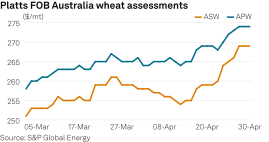
Australian Premium White wheat ended the month at $274/metric ton April 30, up $8/mt since the start of the month April 1, while Australian Standard White wheat rose $11/mt to $269/mt during the same period, based on price assessment data from Platts, part of S&P Global Energy.
Prices have continued to climb, tracking strength in the Australian dollar, on top of a seasonal downturn in grower selling as the 2026-27 marketing year (October to September) winter crop planting kicked off in April, said several Australian and Singapore-based grains traders.
While areas in the south and west are sowing into moisture, ongoing dryness in northern New South Wales and Queensland has tightened available grain for exports out of the East Coast, as growers opt to retain old crop as a hedge against potentially lower wheat production in the next season, said Asian container exporters. The same sources added that more competitive bids from cattle feedlots also drew grain away from exports.
While weather concerns are far less prevalent in Western Australia, lower wheat acreage is anticipated for MY 2026-27, due to its lower profitability compared to other winter crops in the current marketing year, as well as its relatively higher fertilizer requirements, according to Australian trade sources. This was echoed by the Grain Industry Association of Western Australia in its latest crop report April 17, Platts reported.
Pest concerns are also rising in Western Australia and South Australia, where high mice numbers have been reported alongside increased activity of locusts in South Australia, according to Asian trade sources, local news reports and the Department of Primary Industries and Regions of South Australia.
Weather and pest concerns aside, additional bullishness is anticipated from the supply and prices of diesel and fertilizer, which faced trade flow disruptions due to the Middle East war, which will likely feed into higher price expectations from growers on both old and new-crop sales, said a Perth-based trade source.
Black Sea begins to ramp up competition, Argentina retreats on tight capacity
Regionally, Asian buyers have maintained decent forward coverage for Canadian Western Red Spring wheat, with most buyers looking at July to August shipments, according to Southeast Asian traders.
Inquiries for Australian wheat have been centered on June to August shipments, with stronger interest observed toward the end of April as some buyers covered their shorts for late Q2 and early Q3 shipments, said Asian grains traders.
Traders added that tightening shipping capacity for Argentina – driven by soybean meal and corn exports – has also made its wheat exports less attractive for late Q2 shipments, alongside thin liquidity for the 11.5% protein milling wheat grade relative to the 10.5% protein.
With Asia's coverage window moving closer to the second half of 2026, traders also reported rising interest in Black Sea new crop offers, with 11.5% protein wheat from Ukraine and CVB ports offered about mid-$280s/mt CFR for two-disports in bulk shipment, though general bidding ideas were below $280/mt CFR.
Containerized Black Sea wheat also gained traction in Southeast Asia, with 11.5% wheat offering between low to mid-$270s/mt across June to August shipments in April, partially driven by heavy old-crop supplies from the 2025-26 marketing year (July to June), according to several European and Southeast Asian trade sources.
Rising corn prices could incentivize more interest in feed wheat in the near term, said several Asian feed grains traders. Feed corn prices to South Korea have risen $10/mt since the start of April to $274/mt CFR May 4, based on Platts price assessment data, narrowing the feed wheat-corn spread to about $5-$10/mt for the most competitive wheat origins.
What's next in Asian wheat markets?
- Beyond pest and weather issues, concerns remain over Australia's production of high-protein wheat in the next season, as an El Nino event later in the year may worsen already-dry conditions in the typical production regions of northern New South Wales and Queensland, according to two other Australian trade sources.
- Australian wheat is expected to become less competitive as the demand coverage window moves into the third quarter, with Black Sea wheat expected to take center stage, thanks to a strong carryout and no major concerns over the new-crop harvest.
