Agriculture, Biofuels
April 29, 2026
India pushes for E100, E85 gasoline blends as industry backing faces ecosystem lag
By Samyak Pandey and Rishab Joshi
Editor:
HIGHLIGHTS
India adds E85, E100 as recognized transport fuels
Industry welcomes policy; but no vehicle runs blends
Ethanol capacity exceeds demand by 4.5 mil kiloliters
India's draft amendment to the Central Motor Vehicles Rules, formally incorporating E85 and E100 gasoline blends as recognized primary transport fuels, has drawn broad industry welcome, but some market participants remain cautious.
The gazette notification outlines provisions for E85, a 85% ethanol gasoline blend, and the similarly named E100 blend, which would enable vehicles to run on nearly pure ethanol.
The Ministry of Road Transport and Highways issued GSR 313(E) in the Gazette of India Extraordinary, No. 289, on April 27, proposing targeted amendments to Rule 115 of the Central Motor Vehicles Rules, 1989.
The notification lists six categories of technical changes across sub-rules that affect every vehicle weight category covered by India's emission testing framework. Some commercial changes include:
- E100 added alongside E85 in emission testing column headings, meaning every vehicle category from light passenger cars to heavy commercial vehicles now has E100 as a recognized fuel type in the testing tables.
- Gazette annexure designated specifically for E100 vehicles, replacing the previous reference to "Annexure S for E100 vehicles" in Rule 115E sub-rule 4 -- this is the dedicated type-approval compliance annexure that the All India Distillers' Association calls the "Identity Card" for E100, providing the legal testing pathway for manufacturers to homologate E100-capable vehicles.
- B100 replaces B10 in the biodiesel, formally recognizing pure biodiesel as the reference blend standard.
- E20 formally embedded in the gasoline column heading -- changing [(E10)/(E)] to [(E10)/(E20)], aligning emission testing framework with the mandate India has already achieved.
- GVW threshold raised from 3,000 kilograms to 3,500 kg, extending the scope of updated emission norms to a wider range of commercial vehicles.
The draft also includes a push for hydrogen-blended CNG vehicles.
The consultation period lasts 30 days from the gazette publication date, ending around May 27, when objections and suggestions will be closed.
Industry welcomes move, with caveats
AIDA said the draft was "the most significant policy shift since the start of the Ethanol Blending Program."
AIDA's President Vijendra Singh said legal recognition of E100 as a primary fuel "has provided the distillery industry with the long-term certainty needed to scale up production. We are now ready to power India's transport sector independently of foreign oil."
AIDA's Deputy Director General, Bharati Balaji, said with a national fossil fuel import bill of Rupees 2.2 trillion and the Ethanol Blended Petrol program having already saved Rupees 170 billion in forex, the push to E100 "represents a shift in wealth from foreign oil producers to our own agricultural heartland."
Vijay Nirani, founder and managing director of Trualt Bioenergy, said the amendment is a "fundamental transition" in regulatory philosophy.
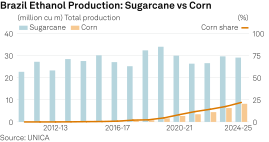
He drew a direct parallel with Brazil's ethanol journey, adding that India "enters this phase with a distinct advantage in scale, policy alignment and an already established robust ethanol ecosystem."
However, the market was skeptical of a swift change.
"There is no vehicle at the moment," a Maharashtra-based ethanol buyer said.
"This will happen but will take three to five years, and if supported with policy, then more capacity may come in to support the goal," the ethanol buyer said.
"It's good in the national interest but will take some time."
The comment cuts to the heart of India's E85/E100 challenge: the policy architecture for high-blend ethanol fuels is being assembled faster than the vehicle ecosystem required to burn them.
CK Jain, president of the Grain Ethanol Manufacturers Association, pointed to the demand signal the notification sends upstream.
"Higher ethanol blends such as E85 and E100 will significantly enhance demand for surplus grains, thereby strengthening farm incomes and creating a more resilient agri-value chain," he said.
Surplus math behind policy
The notification arrives amid an acute supply-demand mismatch in India's ethanol industry.
Installed ethanol production capacity has reached 19.9 million kiloliters/year, against OMC procurement of only 11 million-12 million kiloliters annually under the E20 mandate, leaving 4.5 million kiloliters of capacity idle and financial stress accumulating across distilleries operating well below rated throughput, according to the Indian Sugar & Bio-Energy Manufacturers Association.
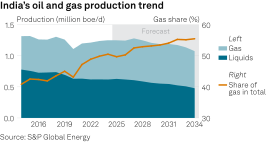
The Middle East conflict has sharpened the case for energy security.
Most of India's oil and gas imports pass through the Strait of Hormuz -- from Iraq, Saudi Arabia, the UAE, Kuwait and Qatar -- and have faced substantial disruption for almost two months now.
An interministerial panel comprising officials from the ministries of petroleum, heavy industries and food has been constituted to evaluate surplus ethanol activation, weighing increased blending mandates, flex-fuel vehicle uptake, ethanol cookstoves as an LPG substitute and exports, with recommendations potentially due before the November supply year start.
CAFE-3 friction limits commercial impact
The gazette's changes establish the legal foundation for E100 type approval. Whether that foundation translates into OEM production decisions depends almost entirely on a separate regulatory question still unresolved.
The ISMA has urged the government to reinstate the Volume Derogation Factor for FFVs under draft Corporate Average Fuel Efficiency-3 norms to 1.5, after the Bureau of Energy Efficiency's final draft cut the parameter to 1.1 -- a 27% reduction in the compliance incentive for automakers producing FFV models.
FFVs face tax rates of 18%-40% depending on configuration, compared with 5% for electric vehicles -- a taxation disparity that industry groups argue penalizes the most commercially scalable low-carbon fuel pathway available to India today.
