Refined Products, Agriculture, Energy Transition, Jet Fuel, Biofuels, Renewables
April 28, 2026
Indian airlines warn closure risk as ATF hits 60% of total costs on crack spike

Editor:
HIGHLIGHTS
ATF prices surge due to Middle East conflict
SAF adoption window narrows before 2027 rule
ATF crack differential surges to $132.59/barrel
India's top air carriers are "on the verge of closing down or stopping operations" as the Middle East conflict pushes aviation turbine fuel costs to 55%-60% of total operational expenses, up from a prewar norm of 30%-40%, the Federation of Indian Airlines said in a letter released April 28.
The war between the US, Israel and Iran, now in a tenuous ceasefire, has driven the ATF crack differential to $132.59/barrel, nearly eight times the pre-conflict range of $11-$18/b, in conditions the FIA described as "completely non-operatable" in a letter to Samir Kumar Sinha, secretary of India's Civil Aviation Ministry, dated April 26.
The FIA, which represents Air India, IndiGo and SpiceJet, warned that "any ad hoc pricing or irrational increase in ATF price will result in insurmountable losses for airlines and will lead to grounding of aircraft, resulting in cancellations of flights."
Cost shock
The trigger is a Rupee 73-75/liter spike in ATF prices for overseas operations since the outbreak of the US-Israel war with Iran at the end of February, which has effectively closed the Strait of Hormuz to routine product flows and sent global jet fuel prices surging.
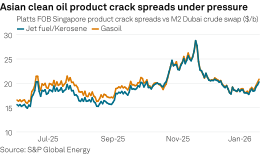
Oil marketing companies implemented a partial, staggered domestic ATF increase of 25% to about Rupee 15/liter on April 1, with Civil Aviation Minister Ram Mohan Naidu saying international routes would bear the full market-aligned price.
The FIA said this split has created a "severe imbalance in domestic and international operations," distorting route economics and making several overseas routes "completely unviable."
ATF priced on the MOPAG benchmark plus premium has risen from $87.24/b before the conflict to a high of $260.24/b, a 295% increase, and is "currently trading at $235.63/b, significantly higher than March 2025 pricing," according to the FIA. The underlying driver, the group said in its letter, is not crude alone: Dated Brent has moved from $72/b to $118/b, but the crack differential, the refinery margin on converting crude to jet fuel, has exploded as well.
"Since the crack spread is nothing but the margins of refinery for converting crude into ATF, with no significant increase in refining costs, which can correlate and justify such exorbitant crack spread, this represents pure additional margin/profit for oil companies, the FIA said.
Compounding the ATF price shock, the FIA flagged that the rupee has depreciated to its record low levels in six years," adding a currency translation burden on top of the fuel price spike. The group also noted a secondary contagion effect: "Local suppliers have also started approaching airlines for revision of costs due to revision in the rates of polymers, petrochemicals and other ancillary products."
Structural factor amplifying price spike
The FIA specifically flagged high refining margins, or crack spreads, as keeping ATF prices elevated even as global crude softens.
Refinery margins have surged disproportionately, the body said, preventing airlines from benefiting from any easing in the crude component of their fuel bill.
The current tax structure worsens the burden because the 11% central excise duty is levied as a percentage of ATF price, meaning the duty quantum rises automatically as ATF prices rise, creating a compounding effect on airline cost, the FIA said.
The FIA's three immediate relief asks are the following: temporary suspension of the 11% excise duty on ATF for domestic operations; reinstatement of a "crack band" pricing mechanism, a cap on the refinery margin component of the ATF price formula, which previously existed but was discontinued; and reduction of VAT in key aviation hubs.
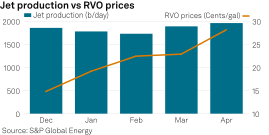
The crack band asks is technically significant.
When last in operation, the mechanism set an upper and lower bound on the jet crack spread applied in ATF pricing, shielding airlines from refinery margin spikes above the cost of crude.
The FIA argues that a crack drives the current price dislocation spread anomaly, not crude itself — making the mechanism directly relevant to the present crisis.
Globally, the Middle East war's impact on aviation fuel markets has been severe. Wholesale jet fuel prices in Europe averaged $1,521/metric ton in March, about 97% higher than the prewar average in February, and the Amsterdam-Rotterdam-Antwerp hub's jet fuel and kerosene stocks fell to 597,000 metric tons in the week ending April 16, their lowest since April 2020 at the height of the pandemic-demand collapse.
Lufthansa Group announced the cancellation of 20,000 short-haul flights through October, equivalent to about 40,000 metric tons of jet fuel demand reduction. Cathay Pacific cut about 2% of total passenger flight frequencies from mid-May to the end of June. United Airlines, which saw its Q1 2026 fuel bill hit $3.04 billion, a $340 million year-over-year surge, trimmed 5 percentage points from its planned capacity schedule for the rest of 2026.
India's situation, however, has a dimension that sets it apart from its global peers: the crisis is arriving just as the country's nascent sustainable aviation fuel ecosystem is coming online, creating a difficult policy and commercial paradox.
SAF paradox
SAF currently trades at 2.8-3X the price of conventional jet fuel globally.
The threshold at which airlines can meaningfully scale voluntary SAF uptake is about 1.5X ATF price, a level that requires substantial additional production volume to reach and one that ATF's current price spike has done nothing to improve in relative terms, because both ATF and SAF benchmarks have risen in tandem.
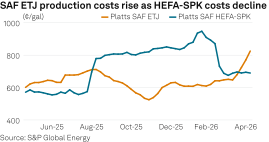
Platts, part of S&P Global Energy, assessed the FOB Singapore jet fuel/kerosene cargo at $185.12/barrel April 27, down from the postwar peak of $242.71/b March 30, but still within a rangebound high. Since the start of March, jet fuel prices have averaged $199.26/b, more than double the $83.13/b average during the same period last year.
Against this backdrop, IOC Panipat refinery, the country's first ISCC CORSIA-certified SAF facility, is set to begin commercial production and deliveries to Air India as early as July, marking India's first operationalization of a domestic SAF supply chain ahead of the CORSIA mandatory phase starting in 2027.
The SAF FOB Straits premium was assessed April 28 at $1,017.50/metric ton over the Platts Jet Kero FOB Singapore forward curve (MOPS), up $66.75/mt from April 27.
Platts SAF (HEFA-SPK) CIF Northwest Europe was assessed at $2,674.75/mt on April 28. Considering freight costs of $150-$170/mt, the FOB Straits netback was $2,504.75-$2,524.75/mt.
