


Agriculture, Energy Transition, Refined Products, Biofuels, Renewables, Jet Fuel
April 28, 2026
Singapore Airlines maintains SAF plans, grows routes despite fuel shock
By Mia Pei and Wanda Wang
Editor:
HIGHLIGHTS
Fuel costs at 30% of spending April-Dec
SIA hedges 47% of Q4 fuel requirements
Singapore jet supply up from South Korea
Singapore Airlines Group said it remains committed to adopting sustainable aviation fuel and is expanding capacity along certain Europe and Asia-Pacific routes despite the fuel cost shock.
"The SIA Group remains committed to the adoption of sustainable fuels. We continue to engage different SAF suppliers while exploring diverse sourcing models for a resilient SAF supply chain in the long-term," an SIA spokesperson told Platts, part of S&P Global Energy, April 27.
The spokesperson highlighted the group's commitment to achieving its net-zero carbon emissions target by 2050 through a multi-pronged approach, including investing in new-generation aircraft, enhancing operational efficiency, and adopting low-carbon technologies such as SAF.
While the Singapore government has delayed the implementation of the SAF levy by six months amid the Middle East war, the voluntary SAF procurement trial involving SIA and its low-cost peer Scoot has continued as planned.
Fuel cost pressure
Singapore's SAF levy and target delay came as regional airlines weighed squeezed margins with lower-carbon fuels, which carry a premium over fossil jet fuel.
DBS Group Research wrote in an April 10 note that while underlying travel demand remains intact, regional airlines' pricing and capacity adjustments are unlikely to fully offset fuel inflation, "pointing to a period of sharp margin compression across the sector."
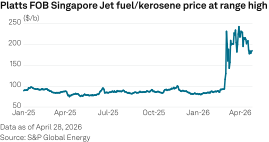
For SIA, fuel costs accounted for around 30% of the group's expenditure in the nine months ended Dec. 31, 2025, making it the airline's single largest cost item, its spokesperson said, noting that jet fuel prices have more than doubled since late February amid the Middle East conflict.
Platts assessed the FOB Singapore Jet fuel/kerosene cargo at $185.12/barrel April 27, down from the post-war peak of $242.71/b March 30, but still within a rangebound high. Since the start of March, jet fuel prices have averaged $199.26/b, more than double the $83.13/b average during the same period last year.
Unlike some airlines that reintroduced fuel surcharges during previous oil rallies, SIA said it does not impose one. Instead, SIA and Scoot have raised fares across the network, though the adjustments only partially offset higher fuel costs.
About 47% of expected fuel requirements for the fourth quarter of fiscal year 2025-26 (April-March) and 41% for the first quarter of FY 2026-27 were hedged, helping cushion volatility, according to SIA.
Capacity adjustments
While several global airlines have cut capacity or trimmed outlooks due to fuel shocks, SIA said it continues to adjust its network in response to demand and is adding flights to several major markets, after canceling flights to Dubai and Jeddah since Feb. 28.
The carrier is adding supplementary services between Singapore and London Gatwick from March 31 to Oct. 24, in addition to existing Gatwick and Heathrow services, bringing the total London frequencies to as many as six flights daily during the period, said the spokesperson.
SIA will also deploy the Airbus A380 on one Melbourne service during the Northern Summer 2026 season, begin daily Hangzhou flights in June, and launch daily flights to Western Sydney International Airport in November, increasing capacity to meet travel demand.
SIA's low-cost unit Scoot is also increasing frequencies to destinations including Changsha, Okinawa, Phuket, Vienna, and several Indonesian cities, while launching new services to Belitung and Pontianak.
Air hub supply
The update comes as Singapore Changi Airport, a key Asian air hub, continues to post strong traffic while South Korean jet supply fulfilled prompt availability.
In March, the airport's passenger traffic stood at 6.1 million, up from February's 5.5 million and from the same month last year's 5.6 million.
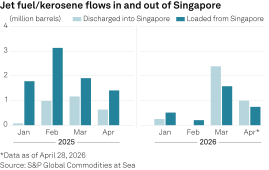
Meanwhile, the jet fuel/kerosene discharged into the air hub stood at 2.39 million barrels in March, with 49% from South Korea, up from zero in February and from 1.16 million barrels in March 2025, according to S&P Global Commodities at Sea data.
The region's jet fuel buying for May eased following the tender sale of 600,000 barrels of jet A-1 fuel from South Korean refiners last week, Platts reported April 23.
Cash differentials for spot jet fuel cargoes thus eased. Platts assessed the FOB Singapore jet fuel/kerosene cargo cash differential at plus $13.71/b to the Mean of Platts Singapore jet fuel/kerosene assessments at the 0830 GMT April 27 Asian close, notching the sixth consecutive session of decline and a seven-week low; the last low was registered at $8.90/b March 11.
Nonetheless, fresh buying interest may support market tightness, as Indonesia's Pertamina sought a second round of purchases for 400,000 barrels of May-loading jet A-1 fuel cargoes, bringing the total sought via the spot tender for May to 1.4 million barrels, Platts reported April 28.
