Agriculture, Grains
April 15, 2026
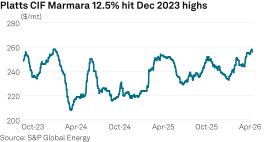
CIF Marmara wheat prices surge to Dec 2023 highs amid Middle East war, soaring freight

Editor:
HIGHLIGHTS
Freight rates drop to $43/mt from $56/mt peak
Turkey forecasts record 23 million mt harvest
CIF Marmara wheat prices have surged to December 2023 highs amid the Middle East war, but traders are now closely monitoring declining freight rates as buyers push for lower prices.
Platts, part of S&P Global Energy, assessed CIF Marmara 12.5% protein wheat at $256/metric ton on April 15, a $17.50/mt premium to the Platts Milling Wheat Marker. Price pressure remained driven by logistics and war-risk, with freight costs easing from a peak of $56/mt last month to $43/mt on April 15.
"Demand is too limited because of high freight prices," one Turkey-based buyer said.
Market participants were also tracking the ruble's strengthening to January lows of Rb75/$1, amid a thinning pool of sellers willing to quote at current foreign-exchange levels. Importers were primarily seeking higher-protein wheat, such as 13.5% and above, at a $5/mt premium to 12.5% protein, while lower-protein wheat was available from state stocks, which are expected to be sold until the June harvest.
Turkey is forecast to harvest a record wheat crop, with estimates reaching 23 million mt for the 2026-27 season and imports projected at 4-5 million mt, a decrease of over 2 million mt from the current season, market participants said. Early weather conditions are favorable, though market participants remained cautious about April and May rainfall. There was an ongoing debate about whether the government would reintroduce import restrictions if the crop exceeded expectations, following measures enacted from June 2024 to March 2025.
"We cannot know for sure until harvest," one Turkey-based trader said.
Rising fertilizer costs are a growing concern for both yield and farm economics, especially for the 2027 crop if no new support measures are implemented. Producers are calling for direct government support to offset increasing input costs, and market participants expect the state to set a high procurement price to encourage wheat planting and maintain supply. Urea prices have risen from Turkish lira 25/kilogram before the war to Turkish lira 29-30/kg in March, with some farmers already covered and others still exposed to further increases.
Flour exports
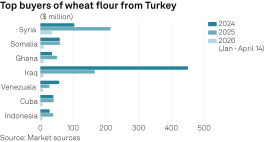
Turkey's downstream flour market has faced a weaker outlook, with exports slowing as more countries opt to import wheat directly and expand their own milling capacity.
Iraq, once a leading buyer of Turkish flour, has reduced its purchases, while Syria has become a key destination. Market participants expect annual flour exports to drop to about 2 million mt in 2026, with capacity utilization falling to 45%. Flour exports totaled 3 million mt in 2024, 2.3 million mt in 2025, and 359,351 mt as of April 14, 2026, down 14% compared with the same period in 2025, according to lineup data from market sources.