Agriculture, Energy Transition, Refined Products, Biofuels, Renewables, Jet Fuel, Vegetable Oils
April 03, 2026
INTERVIEW: Rising diesel costs squeeze Malaysian biofuel feedstock logistics
By Aditya Kondalamahanty and Ck Quick
Editor:
HIGHLIGHTS
Industry faces 40%-60% diesel costs, tighter freight regulations
Domestic SAF uptick drives competition for feedstocks
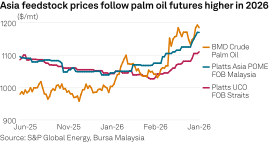
Platts POME FOB Malaysia price rise 9% MOM
Rising diesel prices, driven higher by conflict in the Middle East, are increasing logistics costs and complicating the collection of palm oil mill effluent and used cooking oil for biofuel feedstock exports, Malaysian feedstocks supplier Gamalux Sdn Bhd's Chief Commercial Officer Amila Kamarudin told Platts, part of S&P Global Energy, in an interview.
Transporters have increased quotes by 40% to 60% in recent months, citing not only higher diesel prices but also rising tire and maintenance costs, Kamarudin said. "It's a lot actually... I spoke to those not from the palm oil industry like marine, ports, logistics — they all face the same situation," Karamudin said.
POME is a byproduct of palm oil extraction and is about 90–95% water, containing residual oil, fatty acids, soil particles and suspended solids. It has several sustainable uses, including fertilizer, biogas production and, increasingly, as a feedstock for biofuels.
Under the EU's Renewable Energy Directive, POME is classified as an "advanced" biofuel feedstock. This status has helped drive demand, though traceability concerns have persisted, with cases of fraud and mislabeling clouding the market in recent years.
Driven by the RED incentives, the EU's POME oil imports increased fivefold from 2020 to 2023, according to official EU data. Inflows rose to about 600,000 metric tons in 2024, up 20% year over year, according to S&P Global Energy CERA.
Karamudin said that a recent change in Malaysia's truck-loading policy has complicated logistics. In 2025, Putrajaya introduced stricter cargo limits for freight trucks based on axle configuration and overall Gross Vehicle Weight. Currently, the most common three-axle truck with a 40-foot trailer is restricted to a maximum load of 28 mt, down from 40 mt previously, which adds to inefficiencies, according to the company's executives.
Malaysia is the world's second-largest palm oil producer after Indonesia and is now the largest supplier of POME following Indonesia's ban on exports of unrefined POME to secure feedstock for its domestic biodiesel mandate.
The Indonesian export ban has boosted demand for Malaysian POME cargoes, widening the price gap between the two countries to about $100/mt, Karamudin said.
Buyers in Asia, including South Korea and Japan, are also sourcing refined POME from Malaysia, underscoring market diversification. "The HVO and SAF producers cannot use crude form... they need clean cargo, refined, because of their technology," Karamudin said.
Pricing amid volatility
Gamalux Sdn Bhd pegs its product prices to Bursa Malaysia's crude palm oil futures contract, widely known as FCPO, a benchmark Karamudin said provides transparency and stability in volatile markets.
"We follow the FCPO because it reflects the broader palm oil market, and it gives buyers and sellers a common reference point," she said. While the Malaysian Palm Oil Board has begun publishing domestic UCO prices, the company maintains that futures remain the key reference for export contracts.
Despite cost pressures, demand remains strong from European and US producers of sustainable aviation fuel, who are seeking waste-based feedstocks to meet decarbonization targets. Italy is among the company's EU markets, while Spain and the US are also active buyers.
SAF push
Malaysia is also expanding its domestic SAF industry, with one plant already operating and another expected to come online in the country's south by 2028.
"We see interest from EU and US SAF makers, and Malaysia is also moving forward with its own SAF initiatives," Karamudin said, adding that feedstock scalability remains the biggest challenge.
Competition for limited, high-quality feedstocks could intensify as domestic SAF plants start production, she said.
Malaysia aims to produce nearly 1 million mt/year of SAF by 2028, supported by two domestic facilities, Plantation and Commodities Minister Johari Abdul Ghani told the upper house of parliament in December 2025.
Hong Kong-based EcoCeres already operates a SAF plant in Malaysia with a capacity of 350,000 mt/year, while state-owned Petronas is developing a second facility with a capacity of 650,000 mt/year, expected to be completed by 2028.
Platts assessed POME FOB Malaysia at $1,170/mt April 2, up 8.9% month over month.
