Agriculture, Grains
March 23, 2026
Australian wheat prices hit multi-month highs amid diesel, fertilizer supply squeeze

By Vivien Tang
Editor:
HIGHLIGHTS
ASW hits 20-month high of $259/mt
Diesel tightness drives internal freight higher
Grower sales dwindle amid input cost concerns
Australian wheat prices hit multi-month highs on March 20, driven by rising internal logistics costs and subdued grower sales amid widening concerns over diesel and fertilizer supply security during the Middle East conflict, several Australian and Asian grains trade sources told Platts, part of S&P Global Energy.
Australian Standard White with no protein guarantee, or ASW1, rose $4/mt day over day to a 20-month high of $259/mt FOB Kwinana on March 20, while Australian Premium White, or APW, rose $2/mt day over day to a 16-month high of $265/mt, price assessment data from Platts showed.
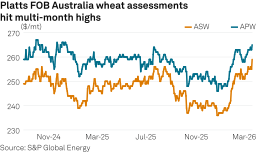
The Middle East conflict has sent both crude oil and fertilizer prices soaring, and the Australian wheat market has been feeling the pinch in the form of higher input prices and domestic logistics costs, said several Australian grains traders.
Two Australian grains traders said that while growers generally had sufficient fertilizer for winter crop planting, they were worried about fertilizer availability for later applications.
Growers could also potentially favor less fertilizer-intensive winter crops such as barley if fertilizer prices continue to rise amid a drawn-out conflict, according to two Asian grains traders.
Meanwhile, concerns over diesel availability are also rapidly mounting, affecting everything from the operation of farming machinery to domestic grains transport, as well as export freight, said several Australian and Singapore-based grains traders.
"Farmers are very concerned about diesel. A lot of them have storage on [their] farm, [and] so have been buying all they can to fill their storage. They want to ensure they have enough for seeding if things get worse," said a Perth-based trade source. "I can understand why the farmers are doing what they are doing; they are so reliant on diesel that they feel they are safer to have it than not. I guess time will tell if it's an overreaction or not."
A Victoria-based grains trader said on March 20, "Replacement costs [on wheat] are up $4/mt or so today. Within Australia, moving grain is more expensive on both rail and truck." "While it's possible to pass on some of the higher costs to growers, that can only happen if the growers are actually selling, and they're not keen sellers."
Another Singapore-based grains trader said, "Grower selling is almost at the end of the marketing season, and whatever is left is in the growers' hands now. Reckon they will hold onto it until the next planting and weather period, notwithstanding that the cost of production will increase with the current situation in the Middle East."
Australian wheat prices will also likely see ongoing support from a strong currency, said multiple Australian wheat market participants, with the Australian dollar breaching the 70 US cents mark in February 2026, a level not seen since January 2023.
