Agriculture, Livestock, Meat
March 16, 2026
EU pork exports to slump in 2026 as ASF, China tariffs trigger restructuring: USDA

HIGHLIGHTS
EU pork exports fall 9% to 2.75 mil mt in 2026: FAS report
Spain ASF outbreak redirects 500,000 mt into EU
Production drops to 21.6 mil mt amid farm exits
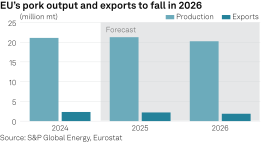
EU pork exports are forecast to fall to 2.75 million metric ton carcass weight equivalent in 2026, from 3.03 million mt in 2025, as African swine fever-linked restrictions on Spanish pork, Chinese tariffs on selected EU supplies and weaker farm margins force restructuring across the bloc's swine sector, according to the USDA Foreign Agricultural Service semi-annual report.
The report on March 13 also projected EU pork production at 21.60 million mt CWE (carcass weight equivalent) in 2026, down from 21.95 million mt in 2025, while total slaughter is seen falling to 224 million head from 229 million.
The report also projected EU pork production at 21.60 million mt CWE in 2026, down from 21.95 million mt in 2025, while total slaughter is seen falling to 224 million head from 229 million head.
The USDA said the downturn follows a sharp reversal in market conditions late in 2025, when carcass prices fell below the five-year average after pork output outpaced domestic demand. That pressure was then amplified by additional Chinese antidumping duties on selected EU pork and the detection of ASF in wild fauna in Spain, which the report said will have implications throughout 2026.
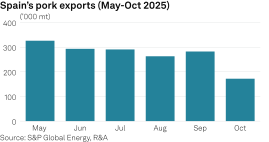
The most immediate effect is on Spain, where third-country restrictions on pork exports account for about 400,000-500,000 mt CWE, or roughly 10% of Spanish production. While key markets including the EU, China, the UK and South Korea have accepted regionalization, Spanish product blocked from other destinations is expected to be redirected into the EU domestic market, intensifying competition and weighing on carcass prices, particularly in Central Europe.
The report said the biggest production and slaughter cuts in 2026 are expected in Western Europe, notably Spain, the Netherlands, Denmark and France. It added that deteriorating margins are accelerating consolidation, with less efficient farms expected to exit as producers struggle to remain profitable after the late-2025 price drop.
On the supply side, EU swine inventories are forecast to fall to 124.2 million head at the end of 2026, from 127 million head a year earlier, while the pig crop is projected to decline to 227 million head from 230 million head in 2025. USDA said the lower stocking of weaned piglets, combined with accelerated slaughter, already pushed inventories down in 2025 and will continue to pressure output this year.
Despite the weaker export outlook, the report said relatively low pork prices should continue to support domestic consumption, especially in Central and Southern Europe, where pork remains a core protein and tourism and foodservice demand are supportive. EU human pork consumption is forecast at 18.95 million mt in 2026, compared with 19.02 million mt in 2025, according to the report's balance sheet.
USDA said other EU suppliers will only be able to replace part of the gap left by Spain on third-country markets. Denmark, the Netherlands, Germany, Poland and Italy can only partially fill the shortfall, while specialty products such as cured hams will be especially difficult to substitute, the report said.
2025 price collapse
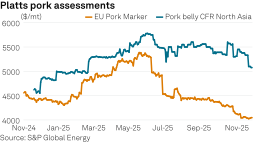
Throughout 2025, EU swine farmers maximized herd utilization to take advantage of initially low feed prices, leading to an unexpected surge in slaughter rates across Spain, Poland and Germany. However, this production peak collided with weakening export demand, causing prices to crater in the final quarter of the year.
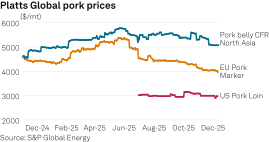
In Flanders, Belgium -- a key regional benchmark -- the price of a weaned piglet collapsed from Eur62.50 ($71.84) in April 2025 to just Eur10.50 by year-end. Similarly, pork carcass prices fell from Eur1.60/kg in June 2025 to Eur0.90/kg by mid-January 2026, well below the estimated Eur1.50/kg required for farmer profitability.
Consumption outlook
Domestic consumption within the EU remains a rare bright spot, supported by the lower retail prices resulting from the carcass price crash. However, this uptick in local demand is insufficient to offset the double hit of reduced export volumes and high production costs.
For the remainder of 2026, the market is expected to remain in a state of "corrective contraction," with further consolidation likely as smaller producers exit the market due to sustained negative margins, the report said.
China was the top destination for EU pork in 2025, accounting for about a quarter of shipments at 1,069,909 mt, followed by the UK at 856,102 mt, the report said. Other key importers were South Korea (262,882 mt), Japan (256,731 mt), Vietnam (180,275 mt), the US (107,927 mt), Australia (87,440 mt) and Taiwan (77,934 mt), with the rest of the world taking 1,399,151 mt, an EU report said.
EU exports came under pressure at the start of 2026 after China imposed import tariffs of up to 19.8% for the next five years, while expected rising competition from Brazil in global meat markets.
Platts, part of S&P Global Energy, assessed CFR North Asia pork belly stable at $4,600/mt on March 13, unchanged from March 12, with no disproving information.

Editor: