Agriculture, Meat
March 14, 2025
Brazilian supply constraints drive up North Asian chicken leg prices
HIGHLIGHTS
Japanese demand drives Brazilian boneless leg prices higher
Exports to Japan fall 21% from November to February
Labor crisis in Brazil affects chicken processing efficiency
North Asian chicken leg prices surged to an all-time high on March 12 wherein Platts, part of S&P Global Energy, assessed CFR North Asia chicken leg prices at $2,300/mt on the day.
Since the assessment was launched on June 3, 2024, prices have risen 12%, or $250/mt, marking a record peak.
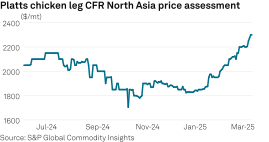
The price increase is primarily attributed to strong demand from Japan for Brazilian boneless chicken legs (200 g and up), driven by supply constraints in Brazil, according to Japanese market sources.
Additionally, sources indicate that offer prices for Brazilian boneless legs (200 g and up) to Japan have increased to $2,400/mt CFR for shipments scheduled between April and May, reflecting a $100/mt rise from March to April shipments. Similarly, offer prices to Busan, South Korea, have climbed to approximately $2,350/mt CFR for the same shipment periods, representing a $150/mt increase from previous shipments.
Declining Brazilian exports and strategic adjustments
This surge in Brazilian offer prices coincides with declining export volumes in February, sources said. The drop in exports of boneless legs to Japan began in November 2024, when the CFR North Asia assessed price hit its lowest level of the year at $1,705/mt on Oct. 9, 2024. At that time, sources indicated that high stock levels in Japan were putting downward pressure on ex-works prices, which in turn affected import prices from Brazil.
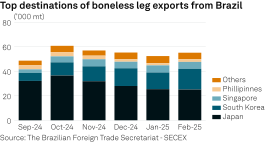
To address this, Brazilian suppliers have adopted a strategy to manage stock levels and stabilize export prices by diversifying their export destinations for boneless legs to include South Korea, Singapore, and the Philippines. They are also focusing on the bone-in leg markets, such as the Brazilian domestic market, as well as countries in West Africa and the Americas.
Export volume trends and labor challenges in Brazil
As a result, Brazil's export volumes to Japan decreased from 31,828 mt in November 2024 to 25,061 mt in February, a 21% decline, according to the Brazilian Foreign Trade Secretariat, or SECEX. In contrast, exports to South Korea increased by 4,748 mt during the same period, representing a 39% increase.
Additionally, the increase in Brazilian offer prices is linked to a labor availability crisis in the chicken processing industry. Sources indicate that the historically high quit rates in the manual labor sector, which began in December 2024, have driven up costs and decreased efficiency in the production of deboned cuts.
"The primary solution is to invest in additional machinery, but importing and installing this equipment will take time due to the current high demand for deboning machinery," a source noted.
Labor costs in Brazil have increased 12% over the past 12 months, according to the Brazilian Agricultural Research Corporation, or Embrapa, the second highest cost increase after genetics.
Impact on Japanese market prices
Furthermore, Japanese importers have expressed concerns regarding the possibility of declining inventory levels, which has intensified Japanese demand for Brazilian chicken boneless legs and contributed to upward pressure on domestic cash market prices.
By mid-March, Japanese domestic cash market prices for imported boneless legs (200 g and up) and sized boneless legs have risen approximately 14% month over month, reaching Yen 435/kg ($2.93/kg) and Yen 445/kg ($3.00/kg), respectively.