Agriculture, Energy Transition, Oilseeds, Biofuel, Grains, Carbon
February 04, 2026
Brazil audit finds 60% soy in biodiesel has irregularities in RenovaBio certification
By Gabriela Brumatti and Monique Murer
HIGHLIGHTS
Strengthening monitoring of deforested areas is essential
CBIO market faces price swings and lacks stable framework
An audit carried out by Brazil's federal audit office, TCU, and published on Jan. 28 shows that 60% of the soybeans used in biodiesel production have irregularities in their anti-deforestation certification under the national biofuels policy, RenovaBio.
The analysis shows that only 40% of biodiesel produced by soybean plants certified under the CBIO decarbonization‑credits market can be verified -- through satisfactory certification -- to be sourced without any deforestation. In comparison, 70% of corn‑based ethanol and 85% of sugarcane ethanol meet the same deforestation‑free standard.
"It is observed that, especially for soybeans and corn, the volume of eligible certifications has not reached levels that can give society confidence that the raw materials used are indeed produced in areas that comply with the program's rules," the audit report said.
In response to the TCU report, the Brazilian Association of Vegetable Oil Industries, or Abiove, told Platts, part of S&P Global Energy, on Feb. 3 that it is monitoring the audit developments, and reaffirmed that the RenovaBio program applies strict sustainability criteria, including the Brazilian Forest Code's "most restrictive compliance standard."
In a written statement, the association said these criteria "guarantee that the program delivers the expected environmental benefit at the lowest economic cost to society, preserving the competitiveness of the Brazilian energy matrix."
Suitability criteria
The RenovaBio regulation prohibits biofuel feedstocks from rural properties that cleared forest after Dec. 26, 2017. However, the audit report notes that tracing the supply chain of certain grains -- which have long shelf lives and are easy to store and transport -- is difficult, making it challenging to identify non‑compliant sources.
Already announced investments to expand biofuel production capacity, the expected increase in mandatory blending of these inputs into fossil fuels and the continued expansion of Brazil's agricultural frontier further complicate the situation, according to the report. The TCU said that strengthening monitoring of deforested areas is essential; otherwise, RenovaBio's positive effects could be neutralized.
The report states that between 2020 and 2024, the program retired about 150 million CBIOs, equivalent to about 150 million metric tons of CO2 avoided through the substitution of fossil fuels with biofuels.
"This celebrated environmental achievement could be completely annulled by the deforestation of just 1 million hectares of the Cerrado or 300,000 hectares of Amazon rainforest," the report said.
Abiove said CBIO issuance already meets stringent efficiency and sustainability standards, including chain‑of‑custody via mass‑balance accounting, traceability and eligibility.
The association emphasized that preserving legal certainty and regulatory predictability of the program "is essential for meeting the goals of the Paris Agreement," and pledged to continue monitoring the issue.
Price volatility
The TCU audit covering July 2020 through November 2025 found that biodiesel made up 15% of the CBIO market, ethanol generated 84% of decarbonization credits and biomethane accounted for the remaining 1%.
The investigation finds that, beyond certification issues, the CBIO market suffers from asymmetries and price volatility that disadvantage participants, and notes that Brazil's CBIO market still lacks a regulatory framework to ensure stability.
Because liquidity is overwhelmingly compliance‑driven, the market remains largely confined to credit generators and obligated buyers, according to TCU interviews with fuel distributor representatives. These stakeholders warn that overly aggressive targets and persistent mismatches between supply and demand can trigger outsized CBIO price swings, calling for more conservative targets and the introduction of "guardrails" to improve price predictability.
The court also links price volatility to compliance behavior, noting that high CBIO prices and thin distributor margins can lead to delayed or partial compliance and drive more companies toward litigation, such as injunction requests, when non‑compliance metrics worsen, according to the report.
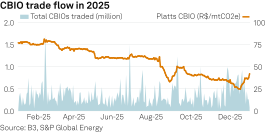
During 2025, CBIO prices fell, and trading volume rose toward the end of the year as the deadline set by Brazil's National Agency of Petroleum, Natural Gas and Biofuels, or ANP, approached.

Editor: