Agriculture, Grains
February 04, 2026
Black Sea market hits 3-month high amid bad weather, logistics challenges

HIGHLIGHTS
Russian winter wheat regions face extreme cold, disrupting supply
Mounting logistical bottlenecks delay vessel loadings
The Black Sea wheat market surged to its highest level in three months, driven by mounting concerns over severe weather and logistical bottlenecks.
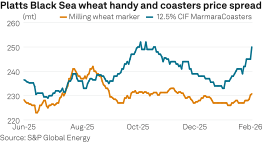
Platts, part of S&P Global Energy, assessed the Milling Wheat Marker at $230.75/mt on Feb. 3, the highest since Nov. 18, as cold temperatures and disrupted transportation weighed on market sentiment.
Key Russian winter wheat regions are facing extreme cold, with temperatures expected to plunge to minus 30 C.
"There is so much bad weather and no cash flow for farmers," said a Russia-based exporter, highlighting the potential impact on winter wheat production and the reluctance of farmers to sell. CPT bids ranged from Rb15,000 to Rb15,700/mt ($196-$205/mt). The recent strength of the ruble, which hit Rb75/$1 last week, has compelled exporters to reduce local purchase prices to maintain margins.
Russian wheat was assessed at a $1.25/mt premium to the MWM at $232/mt on Feb. 3, while Ukrainian wheat was assessed at $228/mt, a $2.75/mt discount to the MWM, widening its spread against Russian 12.5% wheat to $4-$5/mt, the highest since November.
Logistical challenges continue to mount, with vessels at Russian ports now experiencing loading delays of seven to 15 days. Demand for high-protein Black Sea wheat remains steady, particularly during the Ramadan season, as buyers seek alternatives to low- and mid-protein wheat from the Southern Hemisphere.
Despite the recent three-month rally, Black Sea wheat prices have fluctuated around $6/mt since September, under pressure from currency volatility, margin constraints, ongoing logistical disruptions -- including Russian strikes on Ukrainian ports -- and robust import demand from major buyers such as Egypt and Turkey. Recent tender activity has also supported prices, even as global supply remains ample.
The only significant price spike, since the wheat season started in July, occurred in August, when the MWM hit $242/mt amid harvest delays and sluggish exports tightened supply. Prices later retreated and did not recover to those levels, reinforcing the broader theme of heavy supply competition.
"Logistics is the talk of the market," said a Turkish broker at the World Global Grain and Pulses Forum in Dubai. Coaster shipments into Turkey have been particularly affected, with vessel shortages and delays along the Kerch Strait extending the CIF Marmara spread to the MWM to $19.25/mt, the highest since October. Shipments from Azov to Marmara now take two weeks to a month, compared to the usual 10 days, with February trades reported at $251/mt and the spread to 13.5% protein wheat at $3/mt. "There are no vessels to load," said a Turkish seller, citing limited market offers.
European wheat markets have also been volatile, influenced by the euro's strength against the dollar since mid-January. Romanian and Bulgarian traders have pointed to strong demand since the start of 2026, with some sellers already securing deals for upcoming months. The CVB 12.5% market was assessed at $236/mt on Feb. 3, a $6.75/mt premium to the MWM, with 11.5% CVB wheat at a $2/mt discount to 12.5%.
Looking ahead, exporters are closely watching the 2026-27 crop, anticipating that a larger harvest could intensify supply competition from the Black Sea region, despite short-term adverse weather and logistics challenges.

Editor: