Agriculture, Meat, Dairy, Livestock
January 20, 2026
US lean beef trimmings import prices rise on China demand, tight supply

HIGHLIGHTS
Tight US supply as cow/bull slaughter falls 2.8% on year
Domestic 90s trim hits highest level since mid-October
Imported lean beef trimmings CIF US prices climbed 2% in the week ended Jan. 16, supported by heightened demand from China for Australian and New Zealand beef.
Prices were up during the week as "China has made a big push to secure as much volume as possible from Australia and New Zealand before the safeguard quota," an importer said. "More demand has pushed asking prices up, but has pulled people off the market."
Platts, part of S&P Global Energy, assessed 90CL beef CIF US at $7,981/mt, or $3.62/lb, Jan. 16, for a 30- to 60-day shipment, compared with $7,826/mt, or $3.55/lb, Jan. 12.
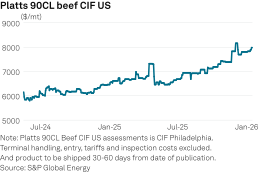
Amid strong prices, the US lean beef trimmings import market was subdued on Jan. 16 and Jan. 20, as many participants shifted into long-weekend mode.
"[The lean beef trimmings import market is still] absolutely dead," another importer said. "With a three-day weekend, it is very quiet so far this week."
In the US domestic spot market, 90s trim remained above $400 per hundredweight this week, reaching its highest weekly average since mid-October as soup and stew season approaches, said Caleb Hurst, S&P Global Energy CERA analyst for cattle and beef.
Related content: Australian beef exporters adapt as China caps imports, shifts global trade flows
Cow, bull slaughtering fall
In the US supply side, for the first three weeks of 2026, 302,000 head of bulls and cows -- the main source of lean trims -- have been slaughtered up to Jan. 17, down 2.8% from the same period in 2025, according to the latest data from the US Department of Agriculture in its Daily Livestock and Poultry Slaughter reports.
The last weekly slaughter figure was up 3.7% from the previous week, 15.7% from the previous six-week average, but down 2.8% from the same week in 2025 and 2.5% from the same week in 2024.
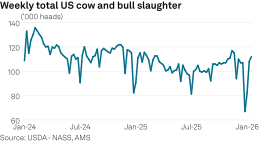
"Both the dairy and beef cow herds are anticipated to show modest growth on the 2026 January 1 Inventory report, so even if culling rates remain the same in 2026, non-fed harvest is expected to increase by 3.1%," Hurst said on his last Weekly Beef Update report.
"The [dairy cow slaughter] week-over-week increase reflects continued producer responsiveness to near-term economic signals, including favorable cull cow values and ongoing herd management decisions following year-end," Katherin Mera Rosas, senior economist for S&P Global Energy CERA, said on her last Weekly Dairy Update report. "The latest data continue to support the view that culling remains economically responsive and controlled, not indicative of a structural liquidation cycle."

Editor: