Agriculture, Energy Transition, Refined Products, Biofuel, Renewables, Jet Fuel, Carbon, Vegetable Oils, Naphtha
January 20, 2026
Bio-naphtha, SAF economics drive interest in waste-carbon palm oil substitute as feedstock race intensifies: Lanzatech CEO

HIGHLIGHTS
Bio-naphtha, chemical co-products crucial for scaling SAF
Waste carbon palm oil substitute emerges as new feedstock
Airlines, carbon credits key for viable SAF economics
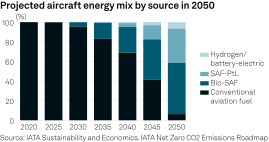
Efforts to decarbonize aviation cannot rely solely on sustainable aviation fuel, and balancing fuel and chemical production will be crucial to improving project economics and scaling low-carbon pathways, LanzaTech's CEO Jennifer Holmgren said in an interview with Platts.
LanzaTech is pivoting to bridge the widening gap in SAF feedstocks by developing a synthetic palm oil substitute that could unlock a new, deforestation-free route to the hydroprocessed esters and fatty acids pathway.
One emerging route under development could reshape both dynamics: converting recycled carbon into palm oil-range molecules that can serve as feedstock for bio-naphtha, specialty chemicals and potentially the HEFA pathway for SAF.
"One of the things we've been working on is with a partner in the cosmetics sector," Holmgren said. "Palm oil is a critical raw material due to its many useful properties. However, the global dependency on palm oil has resulted in extensive deforestation, biodiversity loss, and significant CO2 emissions, highlighting the urgent need for sustainable alternatives. Finding a sustainable alternative to palm oil would enable more feedstock for making SAF and other products in refineries."
LanzaTech is working with Germany's Fraunhofer Institute for Interfacial Engineering and Biotechnology and cosmetics company Mibelle Group to convert recycled carbon ethanol -- produced from captured CO2 -- into palm oil-like fats using yeast fermentation. The molecules replicate the functional properties of palm oil and could ultimately be processed via existing HEFA infrastructure.
"The yeast eats the ethanol and makes palm oil-range molecules," Holmgren said. "It's still early and in the scale-up stage, but it could become a very good feedstock for HEFA."
Three-year visibility on scale, economics
Holmgren said LanzaTech expects to gain clarity on scalability and commercial economics within the next three years, aided by early demand from higher-value chemical markets.
"Cosmetics is a strong early market because its volume requirements align well with initial production," she said. "That allows us to work our way down the cost curve so the later volumes can serve fuels."
If successful, the pathway could offer a new route to bio-based naphtha and SAF feedstocks without relying on conventional vegetable oils or used cooking oil, which are increasingly constrained by sustainability concerns and supply competition.
Palm oil's high yields, long shelf life and thermal stability make it a suitable feedstock for many sectors, including HEFA SAF.
SAF cannot scale without chemicals
Holmgren stressed that the industry's focus on SAF should not come at the expense of chemicals and materials, which remain essential to both decarbonization and financial viability.
"About 30% of a barrel goes into materials and chemicals," she said. "We're never going to decarbonize if we only decarbonize aviation, marine and power."
She argued that bio-naphtha, bio-acetone and other chemical streams should be viewed as structural co-products rather than optional add-ons.
"The petroleum industry uses every carbon atom in the barrel," Holmgren said. "That's exactly what the bio industry needs to do."
Speaking to Platts, part of S&P Global Energy, Holmgren said gas fermentation and carbon recycling technologies offer a structurally different pathway from incumbent thermocatalytic approaches, particularly as SAF markets grapple with feedstock scarcity, rising costs and policy uncertainty across regions.
"Biology is extremely selective," Holmgren said. "It can take a very inhomogeneous resource -- waste -- and convert it into one product. That's fundamentally different from thermocatalysis, which needs large, centralized refineries and produces multiple streams."
Waste carbon as a distributed feedstock
LanzaTech's core platform converts industrial waste gases, gasified municipal solid waste, or MSW, agricultural residues and captured CO2 into ethanol, which can then be upgraded into SAF via the alcohol-to-jet, or ATJ, pathway or used as an intermediate for chemicals.
Holmgren said this selectivity allows projects to be deployed in a distributed manner, closer to waste sources, rather than relying on large, centralized refineries that require uniform feedstocks.
"In a world where waste is distributed, biology makes sense," she said. "People have moved past the skepticism. They're starting to understand the value."
In Asia, the opportunity is particularly strong due to abundant agricultural residues, MSW and growing industrial emissions, although Holmgren cautioned that success depends on local infrastructure, including gasification capacity for solid wastes.
"India and Southeast Asia have significant biomass availability, and in many cases, it's already aggregated because supply chains exist," she said. "We're working with local partners and indigenous gasification solutions in the region."
Circul Air, Dragon, Speedbird
LanzaTech has been advancing its "Circul Air" concept, which integrates waste-to-ethanol production with downstream SAF conversion, creating an end-to-end circular carbon pathway.
This approach complements flagship UK projects such as Project Dragon and Project Speedbird, which Holmgren described as "twin" ethanol-to-SAF developments backed by strong policy support and airline participation.
"Dragon's ethanol-to-SAF pathway is coming along very well, with significant UK government support," she said. "Speedbird is at the same stage -- feed development and late-stage engineering -- and includes British Airways as an investment partner."
Having airlines as equity participants and offtakers is critical for project bankability, Holmgren said.
"You simply won't get infrastructure funding without offtakes," she said. "When an airline invests, it sends a very strong signal to the market."
Beyond airlines: carbon matters
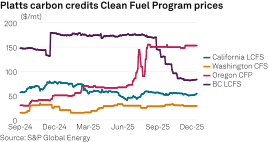
While airlines remain the primary SAF buyers, Holmgren emphasized the growing importance of corporate carbon credit demand in making SAF economics viable.
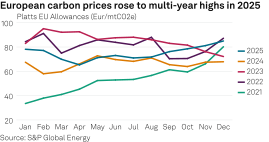
"SAF is still too expensive," she said. "When companies like Microsoft or Deloitte take on the carbon credits, it allows the effective SAF price paid by airlines to come down. They're critical to success."
She added that robust carbon markets are foundational not only for SAF but also for green hydrogen deployment.
"If I had to prioritize, I'd choose carbon markets," Holmgren said. "Everything else, including hydrogen, rises from that."
India: integrating carbon recycling with ethanol
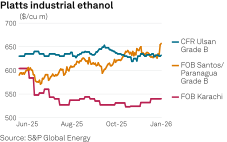
Holmgren pointed to India as a particularly strong market for carbon recycling, given its expanding ethanol production under the E20 program and government support mechanisms such as viability gap funding.
"Around 40% of the carbon entering sugar fermentation leaves as CO2," she said. "We can capture that CO2, combine it with hydrogen and make more ethanol. That's a perfect opportunity for India."
She called for policy alignment between ethanol blending mandates and emerging SAF targets, stressing that governments must provide long-term, technology-neutral support.
"You're not going to build a $100 million plant with policies that change every two years," she said. "Policy certainty ensures commitment from investors and industry."
Balanced decarbonization: fuels, chemicals
Holmgren also pushed back against narratives that pit SAF against bio-based chemicals, arguing that deep decarbonization requires both.
Governments, she said, should encourage integrated value chains that maximize carbon utilization, much like the petroleum industry does today.
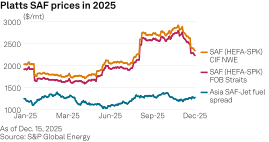
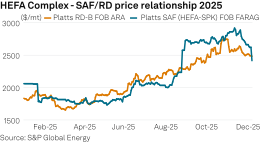
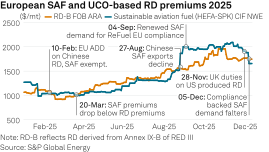
Platts last assessed the SAF (HEFA-SPK) FOB FARAG outright price up 1.9% week over week at $2,310/metric ton on Jan. 15, despite a lack of buying interest observed in the market, as jet FOB FARAG levels rose $59.25/mt.
The SAF premium to Jet barges fell $20/mt over this period, closing at $1,540/mt, with CIF cargoes remaining at a $10/mt premium.

Editor: