Agriculture, Meat
January 15, 2026
Philippines lifts ban on Polish pork, opening Southeast Asian market amid EU oversupply

HIGHLIGHTS
Philippines reopens market for Polish pork amid EU oversupply
Move seen as demand cushion, market stabilization tool
Access to Southeast Asia offers outlet for EU surplus
The Philippines has officially reopened its market to Polish pork and pork products, recognizing the regionalization system for African swine fever (ASF), Poland's Agriculture Ministry and the Polish Meat Association said Jan.14.
The decision comes after months of negotiations led by the Polish Meat Association, with support from the Chief Veterinary Inspectorate and the Ministry of Agriculture and Rural Development. It allows exports from Polish regions free of ASF, effectively granting Polish producers access to a fast-growing Southeast Asian market.
The Philippines is a real 'demand cushion' for Poland with falling pork prices, but it is not an easy or quick market. It is more of a market-stabilization tool than a price silver bullet," Witold Choiński, president of the Polish Meat Association, said.
The opening provides a timely outlet for EU surpluses, as falling domestic prices and intense intra-EU competition have pressured bulk pork products such as ham, shoulder, and trim. "Exporting outside the EU is becoming necessary, even with lower unit margins," said Witold,
Polish officials noted that EU market surpluses and intense competition have made domestic sales increasingly unprofitable, prompting the need to diversify exports. Falling prices in the bloc have particularly pressured bulk products such as ham, shoulder, and trim.
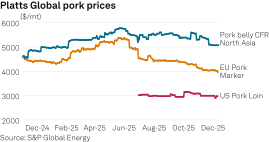
With a population of around 122 million, the Philippines is the world's sixth-largest pork importer and its largest fresh meat market, with pork accounting for roughly half of all consumption. ASF outbreaks among local pig herds have also increased demand for imports.
Polish pork exports to the Philippines totaled approximately Eur67 million in 2024, up 63.5% year-on-year, making it the second-largest Southeast Asian market for Polish food products after Vietnam. Key competitors in the market include Brazil, the United States, France, and the Netherlands.
Agriculture Minister Stefan Krajewski called the market opening "very good news for breeders at the start of the year," adding that bilateral agreements on veterinary health certificates underpin the export framework.
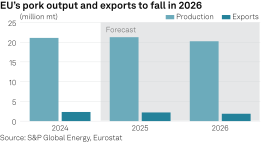
Poland's domestic pork market is seeing weaker prices amid abundant production, with slaughter volumes in 2024 reaching 1.9 million tons, roughly 9% of EU output. Access to Southeast Asia provides an alternative route for balancing supply, particularly given the decline in absorption capacity within traditional EU export destinations.
In Belgium, domestic pork belly prices fell sharply in the week ending Jan. 5, closing at Eur327/100 kg—a week-on-week decrease of Eur16, according to the European Commission.
This move followed earlier price spikes in November and December, as supply recovered and outpaced short-term demand.
Platts is part of S&P Global Energy.

Editor: