Agriculture, Meat
January 08, 2026
Brazilian poultry exports soar in December after China lifts ban

By Augusto Neto
HIGHLIGHTS
Brazil's poultry exports surge 17.5% in December
China resumes imports after lifting bird flu ban Nov 7
Low Chinese demand keeps export prices subdued
Brazil's poultry exports in December 2025 totaled 510,893 metric tons, up 17.5% from the previous month and a 13.9% increase from December 2024, according to data published Jan. 6 by Brazil's foreign trade agency SECEX.
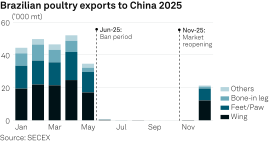
The rise in exports, which includes fresh and processed poultry products, reflected the resumption of shipments to China following a six-month ban due to a bird flu outbreak in Rio Grande do Sul. China reopened its market to Brazilian poultry on Nov. 7..
Brazilian exporters anticipated that the resumption of shipments to China would help reduce the surplus of chicken cuts, including wings and feet. During the ban, these products were sold in the local market or shipped to other countries at lower prices.
China is Brazil's largest trading partner for poultry. In 2024, China accounted for 10.6% of Brazil's exports, totaling 561,099 mt.
In the first four months of 2025, prior to the bird flu outbreak, China's share of Brazilian chicken exports remained significant, accounting for 10.3% of all exports during this period, reaching 192,359 mt.
According to SECEX, the main cuts exported to China include chicken wings, bone-in legs, and chicken feet. In the first quarter of 2025, China bought 61% of Brazil's exported wings, 54% of its paws and feet, and 22% of its bone-in legs.
During the ban period, Brazilian exporters tried to diversify by exporting wings to Hong Kong, the Philippines and Singapore, and shipping chicken feet to African countries and the Philippines. However, these products were sold at lower prices compared to those paid by China.
Resumption of shipments did not restore price levels
Despite the initial optimism of exporters regarding the resumption of imports by China, most packers said that Chinese purchases in November and December did not meet expectations.
Exporters expected that prices for the chicken cuts most popular in China would increase once imports resumed and therefore set their offer for new trades at the same price levels as before the ban. However, Chinese importers made lower bids than expected, showing weaker demand.
Brazilian exporters offered chicken middle joint wings at about $5,400/mt in November. However, importers only bid around $4,000/mt. Currently, the trade price for this cut ranges between $4,000/mt and $4,200/mt CFR China, according to an exporter.
"We are only now starting to see the possibility of an increase in the export price of chicken wings to China," the source added.
For grade A chicken feet, initial offers were around $3,000/mt, but actual trade prices are lower at around $2,700/mt CFR China. Nevertheless, even though export prices are lower than expected, they are still profitable, an industry participant said.
"It's better to sell chicken feet to China at lower-than-regular prices than to sell to other markets at even lower prices," the source added.
For chicken bone-in legs, offers started at about $1,400/mt, but importers only bid between $1,000/mt and $1,100/mt CFR China. Another exporter said it is not worthwhile to sell whole legs to China, since the Brazilian domestic market pays more, and export prices to African countries are also competitive.
A Brazil-based trader said that Chinese importers are making fewer bids because poultry production in China is increasing, while domestic consumption is declining.
"The Chinese economy is weak, and consumption is shrinking," the trader said.
Although Chinese purchases in the last two months were lower than expected, the Brazilian Association of Animal Protein stated that the return of Chinese imports had a positive impact on poultry exports in 2025.
"In a short period, China has already imported 21,200 mt," said Ricardo Santin, president of the association.

Editor: