Agriculture, Biofuel, Oilseeds
January 02, 2026
COMMODITIES 2026: Biodiesel, feedstocks to seek stability amid blend uncertainty, tariff risks
HIGHLIGHTS
Market sees possibility of a less volatile year for price, demand
Stable soybean harvest and B15 continuity supports outlook
Biodiesel chain should benefit from beef tallow use in 2026
This is part of the COMMODITIES 2026 series, where our reporters bring you key themes that will drive commodities markets in 2026.
After facing mandatory blending changes, price volatility, and disruptions in tariff policies and trade flows in 2025, Brazil's biodiesel and feedstocks markets are expected to experience greater price and demand stability in 2026, market participants told Platts.
Beef tallow, an increasingly important feedstock for the biofuel industry, is expected to strengthen its position in the domestic market after expanding its share in 2025 following US tariffs on Brazilian exports that curtailed foreign trade.
For the biodiesel industry, expectations of less volatility are supported by forecasts of a robust soybean harvest in the country and the continuation of the 15% blend into diesel at least through the first half of 2026, according to market sources.
Blending mandate and market sentiment
The mandatory increase in biodiesel blending, which provided an upward pressure on the biofuel and feedstocks prices in 2025, is not expected to be the same driver in 2026.
Despite the Fuels of the Future law predicting a gradual increase in biodiesel blend into diesel of 1 percentage point in March of each year until it reaches 20% in 2030, market participants remain skeptical that the increase will materialize in 2026.
"The deadline for completing the higher blend feasibility studies is July/August, and while an increase in the first half of the year seems unfeasible, it seems very unlikely in the second half, with the elections," a biodiesel distributor said.
Market participants also said election years tend to limit policymakers' willingness to approve measures that could increase fuel and food prices.
"In an election year, it is much more difficult to pass a blend increase, mainly because of the inflationary impact," a major diesel distributor said.
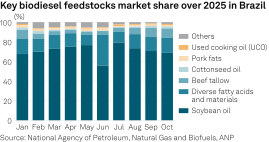
The blend increase from 14% to 15% (B15) was postponed from its initial deadline and implemented in August amid concerns about inflation. Although belated, the mandated change helped absorb the additional beef tallow for the biofuel, which had become more readily available due to export restrictions.
Beef tallow vulnerable to US tariff policies
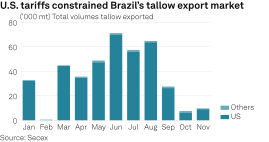
During the first half of 2025, buoyed by export margins well above domestic levels, nearly half of Brazil's beef tallow production was exported. In June, exports reached a record 71,068 mt, of which 70,004 mt were shipped to the US, Brazil's main destination for the product.
That trend reversed on July 30, when the administration of US President Donald Trump announced a 50% tariff on a range of Brazilian imports, including tallow. With exports effectively stalled, shipments fell sharply, reaching just 7,510 mt in October.
Lower exports, coupled with the B15 mandate, made animal fat more attractive to the domestic biodiesel market. While mills consumed around 40,000 mt of tallow in the first half of the year, consumption more than doubled in October and November, accounting for nearly 10% of the total biodiesel feedstock mix.
Market participants expect conditions seen in the second half of 2025 to persist into early 2026. Although cattle slaughter rates are forecast to decline in line with the livestock cycle, biodiesel producers are expected to continue benefiting from tallow volumes that would otherwise be exported, particularly as prices remain below those of soybean oil.
Still, hopes for a recovery in the export market remain. Brazil's President Luiz Inácio Lula da Silva recently signaled optimism about a potential new round of tariff rollbacks, following exemptions granted by Trump to certain Brazilian products on Nov. 20.
Participants said a full revocation of tariffs would likely reopen export channels, reduce domestic availability, and shift the market back toward conditions seen in the first half of 2025 -- supporting higher prices.
Pricing mechanisms
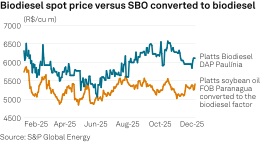
Biodiesel and feedstock prices fluctuated sharply in 2025 in response to changes in blending policy, tariffs, and broader market dynamics. In 2026, however, with B15 expected to stay in place, tariff conditions largely defined, and ample soybean oil availability, prices are expected to stabilize.
"Our expectation is that the soybean oil crush margin in December will still be slightly negative but will improve in January and become much more positive from February onwards," said a biodiesel producer, considering a record soybean harvest to begin in the first quarter of 2026.
As a result, market participants expect less fluctuation in the spot market and in the bimonthly fee levels in contract negotiations, in contrast with 2025, when prices at times swung by more than Real 300/cu m between periods.
Platts is part of S&P Global Energy.

Editor: