Metals & Mining Theme, Maritime & Shipping, Non-Ferrous
August 19, 2025
COMMODITY TRACKER: 4 charts to watch this week

By Staff
Singapore's LNG bunker sales are in focus, while market observers expect US corn prices to fall amid a healthy supply outlook. S&P Global Energy reporters and editors are also monitoring South Korea's move to integrate its petrochemical facilities with refining complexes, and the lithium market's response to supply dynamics.
1. Singapore's LNG bunker fuel sales to stay robust
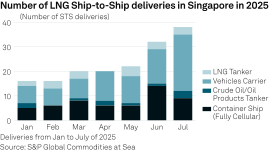
What's happening? Singapore's July spot LNG bunker fuel trades rose, driven by newly built car carriers bunkering at the port. LNG ship-to-ship bunkering activity recorded a total of 38 deliveries in July, of which 60.6% were to car carriers, according to S&P Global Commodities at Sea data. LNG marine fuel sales increased 16.9% year over year to 244,200 mt in the year's first half, with monthly volumes hitting a record 55,350 mt in June, according to the Maritime and Port Authority of Singapore.
What's next? LNG bunker fuel prices in Singapore, the world's largest bunkering port, averaged $14.266/Gj over January-July, compared with marine fuel oil 0.5%S bunker at $12.855/Gj, data from Platts, part of S&P Global Energy, showed. Although prices are likely to remain supported due to persistent geopolitical tensions worldwide, and Singapore's July bunker fuel sales fell about 3.9% year over year, demand is expected to stay robust in 2025, reflecting a strong global orderbook for LNG-powered ships and Singapore's sustainable shipping push.
2. South Korea's integration strategy for petrochemicals
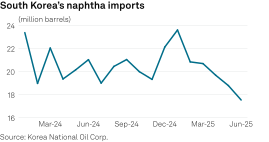
What's happening? South Korea is addressing challenges in its petrochemical industry by promoting the integration of petrochemical facilities with refining complexes. Yeochun NCC, the third-largest ethylene producer, narrowly avoided default with loans from DL Chemical and Hanwha Solutions. The Ministry of Trade, Industry and Energy is advocating for vertical integration to improve feedstock economics amid oversupply and competition from China. In H1 2025, local refiners produced 144.8 million barrels of naphtha, while imports totaled 121.1 million barrels, down 3% year over year.
What's next? The South Korean government is preparing to announce a policy on petrochemical industry restructuring later in August. This initiative aims to enhance the competitiveness of domestic companies by integrating refining and petrochemical operations, allowing access to cheaper feedstock. As the second-largest petrochemical exporter in Asia, South Korea's strategy includes prioritizing domestic sales of naphtha over exports to support the local sector. The government emphasizes public-private collaboration and warns companies against exploiting the situation without contributing to restructuring efforts. Success hinges on collective action for long-term industry sustainability.
3. Brazilian H1 lithium spodumene exports fall 73%
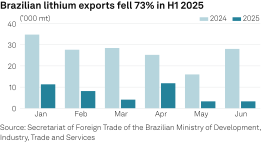
What's happening? Brazil's total lithium spodumene exports fell 73% in the first half of the year compared to H1 2024 amid bearish sentiment that lowered global negotiations. Brazil exported 41,746 mt of spodumene, a mineral used primarily as a source of lithium, over January-June. This was down from 160,256 mt over the same period in 2024. The lithium market is currently facing challenges due to a surplus and slower-than-expected demand.
What's next? Sigma Lithium, a major Brazil-based spodumene lithium producer, has highlighted a 32% increase in output in 2025 amid an adaptation of its commercial strategy to match the seasonality and volatility of market prices. Several participants have reported a different rhythm for the company to close transactions in 2025. Some suggest changes in the quality of the material, while others indicate the company is offering small quantities of spodumene, anticipating higher prices.
4. Asian corn prices hit near 5-year low
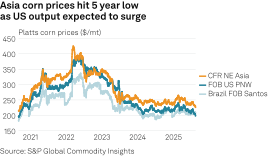
What's happening? Asian corn price sank to a near 5 year low Aug. 13, following a bearish US Department of Agriculture WASDE report released the previous day; the 2025-2026 US corn crop projection of 16.74 billion bushels far exceeded expectations. CFR Northeast Asia closed at $226/mt Aug. 13, the lowest since September 2020, based on Platts data. The plunge in prices drove strong demand in South Korea for US PNW cargoes.
What's next? Market participants anticipate further declines in US corn prices due to the massive supply outlook. Buyers in Asia are expected to continue seeking competitively priced US corn, especially as South American prices remain elevated from strong domestic demand and currency effects.
The WASDE report's surprise is likely to shift trade flows further, with Vietnam and other Asian importers eyeing US origin for upcoming arrivals, especially for the October-December arrival period. If US corn production meets or exceeds forecasts, global prices could remain under pressure, potentially reshaping trade patterns and prompting sellers to lock in deals before further declines.
Reporting and analysis by Atsuko Kawasaki, Surabhi Sahu, Gwen Teo, Philip Vahn, Anne Barbosa, and Edward Low
