May 14, 2026
Cement and clinker freight volatility and trade flow shifts: 4 key takeaways from Intercem Jakarta

By Jia lun Ong
Editor:
With freight markets in flux, energy costs elevated and decarbonization pressures mounting, the cement and clinker industry is navigating a more complex operating environment compared to previous years. Buyers are reassessing sourcing strategies, producers are focusing on cost control and fuel flexibility, and contract structures are becoming shorter and more dynamic.
Against this backdrop, the Intercem Conference in Jakarta April 14-16 brought together producers, traders, shipbrokers and end-users from across the world and served as a platform for market participants to exchange views, build relationships and reposition for the months ahead.
Insights shared during the conference reflect not only current pricing dynamics but also the strategic adjustments market participants are making in response to evolving risks. Here are the key takeaways:
1. Freight volatility reshapes cement and clinker trade flows
Freight volatility has become a key driver of delivered cement and clinker prices, increasingly outweighing FOB fundamentals in many regional markets. Ongoing disruptions linked to Middle East tensions have led to fluctuations in vessel availability and voyage economics, making CFR negotiations more challenging across Asia and Africa.
"We can still agree on FOB levels, but CFR negotiations have become much more difficult due to freight uncertainty," an Asia-based trader said told Platts during the event. Platts is part of S&P Global Energy.
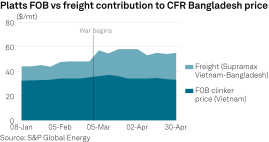
Platts data reflects the growing impact of freight on delivered pricing. While FOB Vietnam clinker prices were relatively stable at $33-34/mt between late February and end-April 2026, Supramax freight rates from Vietnam to Bangladesh rose from around $11-14/mt in January-February to as high as $24/mt in late March and early April. As a result, CFR Bangladesh clinker prices increased from around $44-48/mt before the escalation in Middle East tensions to as high as $58/mt despite softer FOB levels.
Higher landed costs have started to weigh on buyer appetite in import-dependent markets such as Bangladesh. Market participants noted that some buyers were delaying purchases or reducing cargo commitments while waiting for clearer freight direction and improved vessel availability.
"Local buyers are struggling to accept these price levels," a Bangladesh-based importer said. "Producers are also facing elevated raw material and logistics costs, but passing the increases through the supply chain remains difficult."
2. Southeast Asia emerges as key swing supplier
With constrained exports from the Middle East, buyers are increasingly diversifying supply sources toward producers in Southeast Asia, particularly Vietnam and Indonesia. This has reinforced the region's role as a key swing supplier into major import markets such as South Asia and Africa, while also reshaping traditional trade flows.
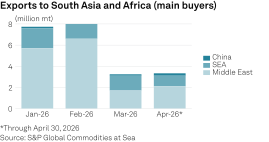
According to S&P Global's Commodities at Sea data, Middle East cement and clinker exports to South Asia and Africa fell from 6.6 million mt in February to 1.7 million mt in March, before rebounding to 2.1 million mt in April. Over the same period, exports from Southeast Asia remained comparatively stable at around 1.0 million-1.4 million mt per month, while Chinese exports increased from zero in February to 230,000 mt in April.
"Middle East supply gaps are being filled by Southeast Asia," a Singapore-based trader said at the event.
The shift has intensified competition among Asian exporters, with freight economics increasingly influencing trade competitiveness and cargo flows. Interest from African importers was also evident during the conference, as buyers were actively seeking to diversify supply sources.
"I attended Intercem Jakarta primarily to broaden my import base, particularly looking at alternative suppliers such as Vietnam and Indonesia," a South Africa-based buyer said.
3. Alternative fuels and cost control create competitive divergence
Producers are increasingly differentiated by their cost structures, particularly their ability to use alternative fuels such as plastic waste or solar power instead of coal.
Several sources told Platts that in countries like Japan and South Korea, some producers were relatively insulated from rising coal prices compared with producers in other regions, helping to preserve export competitiveness and pricing flexibility despite broader cost pressures.
"Our fuel mix gives us more stability. We're not as exposed to coal spikes," a Northeast Asia trader said.
Related content: How price transparency is reshaping global cement and clinker trade
4. Contract structures shift toward shorter tenures
A structural shift in contracting behavior is emerging, with market participants increasingly moving away from annual agreements toward shorter-term quarterly or half-yearly contracts, according to several Asia-based traders and producers. The change reflects heightened uncertainty surrounding freight costs and pricing volatility, as both buyers and sellers seek greater flexibility in rapidly changing market conditions.
Several traders noted that buyers were becoming more cautious about committing to long-term pricing exposure, while sellers were also adjusting contract structures to preserve pricing flexibility.
"Buyers are shifting to more quarterly resets to manage volatility," a Southeast Asia-based trader said.
