Electric Power, LNG, Natural Gas
April 03, 2026
INSIGHT CONVERSATION: Muhammed Aziz Khan, Summit Group
By Surabhi Sahu
Editor:
As escalating Middle East hostilities and disruptions in the Strait of Hormuz rattle commodity markets, including natural gas, countries that rely on regional supplies, including Bangladesh, are seeking options to fend off shortages.
Muhammed Aziz Khan, chairman of Summit Group, spoke with S&P Global Energy Platts Editorial Lead Surabhi Sahu about the present geopolitical risks shaping the global LNG landscape and impacting the country's LNG supply and outlook. Khan also shared Summit's growth plans, including the company's entry into the country's data center market.
The Summit Group, headquartered in both Dhaka and Singapore, is among the largest Bangladeshi infrastructure conglomerates. The company has business interests in communication, trading, energy, power and shipping.
What is your outlook for Bangladesh's LNG imports in the future?
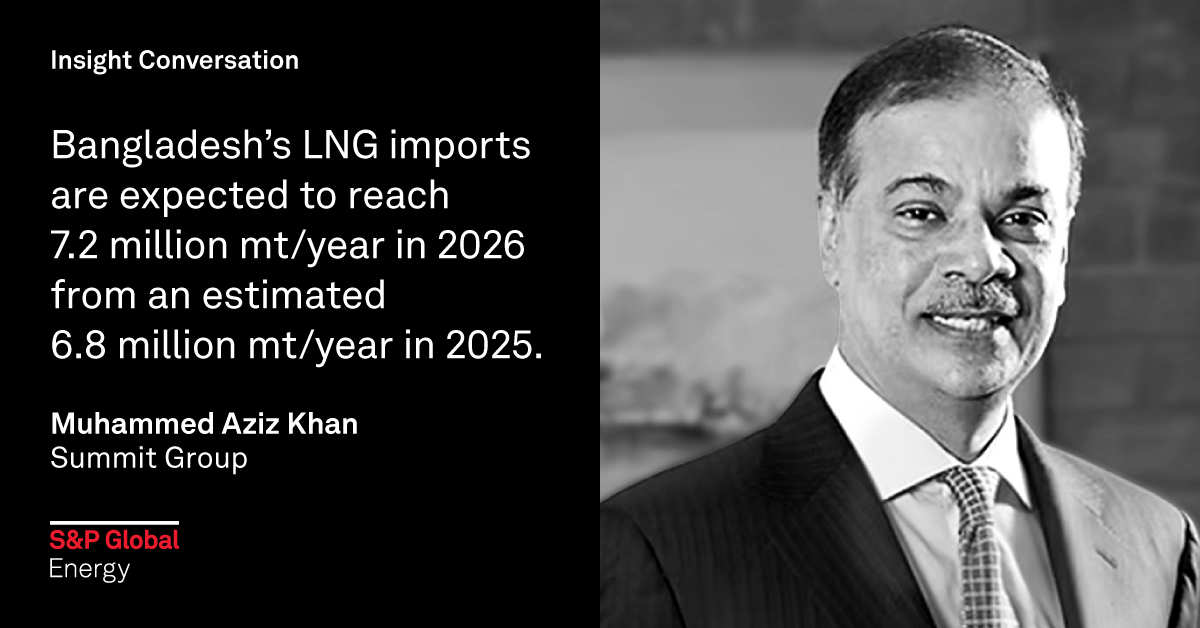
I believe that LNG and its related infrastructure are essential to meet the country's growing energy needs. Bangladesh's LNG imports are expected to reach 7.2 million metric tons per annum in 2026 from an estimated 6.8 million mt/year in 2025. The country's LNG imports could even reach 15 million mt/year in the coming years, with a 6%-7% gross domestic product growth.
Bangladesh has secured a lower tariff rate with the US under a trade deal signed in February. Bangladesh's lower tariffs compared to some neighboring countries give it an edge over other competitors. So, the foreign currency situation is expected to continue improving, accelerating the country's economic growth.
Looking at the situation in the Middle East, how do you see geopolitical risks shaping global LNG markets and prices?
The Iran war has reminded the world once again that LNG is not only a commodity but a "geopolitical market".
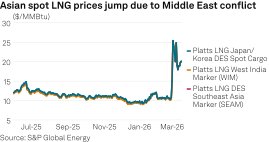
A developing country , Bangladesh has had to buy spot LNG for as high as approximately $23/MMBtu.
The market is being shaped in three ways. First, there is now a much larger security premium in LNG prices. Second, buyers are rediscovering the value of long-term contracts and diversified origins. Third, physical availability matters as much as price, because when shipping routes are threatened, even a buyer willing to pay more may not get the molecules on time. This is why geopolitical risk today is setting both the floor and the volatility of LNG prices.
How is the Middle East war impacting Bangladesh's LNG and gas supplies?
Bangladesh is highly exposed. It imports LNG through two operational FSRUs [floating storage and regasification units] with a combined regasification capacity of about 7.5 million mt/year, and imported 109 LNG cargoes in 2025, costing about $3.88 billion. It also relies on imports for roughly 95% of its energy needs. That $3.88 billion can easily become $7 billion plus, which the country can ill afford.
The immediate effect of the war has already been severe. Qatar suspended long-term LNG deliveries to Bangladesh under force majeure. On the liquid fuel side, Bangladesh has adequate diesel and Heavy Fuel Oil (HFO) to meet approximately one month of demand. Thereafter, the high prices that Bangladesh will require to pay will harm the country's macroeconomics and may cause stagflation.
How can the country tide over gas shortages or meet its energy needs in the current geopolitical landscape? What is Summit's role in situations like this?
Bangladesh must first stabilize the current situation through immediate measures. The government should prioritize the use of electricity, gas and oil for power generation, essential industry and agriculture, while introducing strict rationing where necessary. Taxes on imported energy LNG, coal, diesel and fuel oil should be temporarily removed to reduce procurement costs. At the same time, prices must gradually reflect real market conditions to discourage wasteful consumption.
Operationally, Bangladesh should urgently build strategic fuel inventories. Agencies such as Bangladesh Power Development Board and Bangladesh Petroleum Corporation could rent under-utilized private storage terminals and stockpile heavy fuel oil, diesel and coal while supplies remain available.
In the longer term, Bangladesh must strengthen energy security through diversification. This includes sourcing LNG from multiple regions beyond the Strait of Hormuz, expanding regasification capacity, and encouraging private and foreign investment in energy infrastructure.
Equally important are imports of green electricity from neighboring countries, particularly hydropower, and accelerating offshore gas exploration in the Bay of Bengal.
Companies such as Summit can contribute by investing in diversified LNG supply, additional infrastructure and regional energy partnerships that make Bangladesh's energy system more resilient.
Privatization is key to securing foreign direct investment, LNG import, energy oil import and distribution infrastructures may be a first step toward that. Huge investments are necessary for the country to eradicate poverty and transform into a developed nation.
Summit Group presently operates one of the two FSRUs in the country. How is Summit planning to grow its LNG business?
Last year, Summit's FSRU completed its 250th ship-to-ship transfer operation. During the 2024-2025 financial year ending June 30, 2025, the terminal supplied approximately 13% of the country's total gas demand, playing a vital role in ensuring Bangladesh's energy security.
Since its commissioning in April 2019, Summit LNG Terminal has received about 35 million cu m of LNG and supplied approximately 785,549,295 MMBtu of regasified LNG to the national gas grid, the company shared in a statement on Nov. 30
The Summit Group also aimed to build Bangladesh's first onshore LNG terminal at Matarbari Island in the Bay of Bengal on a build, own, operate and transfer basis. However, the plan has been delayed due to the abolition of the Quick Enhancement of Electricity and Energy Supply (Special Provisions) Act, 2010, which was repealed by the government in 2024.
The implementation of the onshore terminal could now occur in two forms in the future -- either through an international tender or a government-to-government contract. So, if an international tender is launched, we will participate in it. However, if it is a government-to-government contract, then we will only be able to receive services from the terminal owned by the government of Bangladesh
Summit had also been awarded a contract to build the country's third FSRU and its second FSRU to meet increasing energy demand. However, in 2024, the Bangladesh government canceled the FSRU project, and Summit is contesting the cancellation. The FSRU project is currently under judicial review
Summit is targeting Bangladesh's data center market. What factors are prompting Summit's foray into this segment?
Bangladesh and Summit are uniquely positioned with excess electricity capacity for the next few years. The country's recently enacted Personal Data Protection Ordinance, 2025, is also expected to stimulate demand for domestic data centers.
The Group will leverage its subsidiary, Summit Technopolis Hi Tech Park, or its vacant land alongside the power plants and the river, to build its first large-scale facility in Dhaka. The Group currently has approximately 350 MW of capacity that could be dedicated to data centers, positioning it as a hyperscaler. The company is in the process of laying optical fibers from Bangladesh to Singapore, with the work seeing slight delays due to regulatory hurdles in Bangladesh. However, I am hopeful that those hurdles will be overcome, and subject to government permissions, Summit can build its first data center in about 18 months.
Summit is also open to strategic partners who bring marketing expertise for its data centers. The company's development team is also exploring opportunities to import green electricity from countries such as Indonesia and Malaysia.
After the February election, what are your hopes and aspirations for the new government to develop the country's energy sector?
The hopes and aspirations are huge. Politically, a democratic and a free-market oriented governance is desirable to spur economic growth.
From my perspective, the rule of law will prevail, reposing trust in investments and in Bangladesh's institutions. Economic growth will hopefully encompass quality education, better public healthcare, strengthen other social infrastructure and retain its relevance in this changing world to also accelerate digital and AI.
Physical infrastructure is also required, including LNG terminals, ports, data transmission, roads and highways. These will create youth employment opportunities and development.
The Bangladesh Ministry of Power, Energy and Mineral Resources did not respond to inquiries sent March 18 by Platts, part of S&P Global Energy, requesting comment on the country's approach to meeting its energy needs, as well as on the canceled FSRU project mentioned in the interview. QatarEnergy did not respond to a March 18 request for comment regarding its supply of LNG to Bangladesh.
This interview has been edited for length and clarity.
