Energy Transition, Renewables, Emissions, Carbon
March 4, 2026
ET Highlights: California carbon prices hit floor, Russia scales back hydrogen plans, Australia carbon market poised for growth in 2026
Energy Transition Highlights: Our editors and analysts bring together the biggest stories in the industry this week, from renewables to storage to carbon prices.
Top story
California-Quebec carbon auction clears at floor price as supply rises
The California-Quebec first quarter 2026 carbon auction cleared at this year’s auction reserve price, falling sequentially due to increased supply, Feb. 25 data from the California Air Resources Board shows.
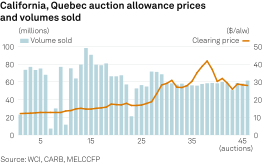
Auction 46 settled at $27.94 per allowance, a 1.34% drop on the quarter and a 4.54% drop on the year. This settlement price is the floor price for 2026 auctions.
One significant driving factor of the lower settlement price in Auction 46 is the inclusion of unsold allowances from the Q2 2025 auction, which also cleared at the floor price amid legal and regulatory challenges.
Overall allowances offered in Auction 46 increased by 5.78% on the quarter and 5.39% on the year. The current auction offered 54.9 million allowances and the advance 2029 auction offered 6.5 million. In total, this auction offered the most allowances since November 2023.
All current-year allowances were sold in Auction 46, but 218,750 advance vintage 2029 allowances were not sold.
Benchmark of the Week
$29.57/alw
Platts assessed next-December current year vintage California carbon allowances at $29.57 per allowance on Feb. 26. Allowance costs did not change much in the days after the auction results were released despite the Auction 46 settling at the floor price of $27.94/alw, in part because market participants expected this outcome.
Learn more: Platts Carbon Markets Specifications Guide
Editor's Picks: Free and premium content
SPGlobal.com
ACCU demand seen outpacing supply by 2030, 2026 issuances up to 26 mil: CER
Australia's carbon market is poised for continued growth in 2026, with Australian Carbon Credit Units issuances projected to reach between 22 million and 26 million units and a potential supply crunch later this decade, according to the Clean Energy Regulator's quarterly Carbon Market Report. The CER expects approximately 21 million-22 million ACCUs to be issued from over 600 existing projects that have previously reported, with an additional 1 million-4 million units anticipated from newly registered projects reporting for the first time.
EU carbon prices tumble as major states add to ETS reform calls
EU carbon prices have come under renewed downward pressure after key member states including Italy and Germany called for an overhaul of the bloc's emissions trading system, arguing current rules undermine industrial competitiveness. EU Allowances were trading at Eur70.23/mtCO2e ($82.71/mtCO2e) as of 1210 GMT on Feb. 26, according to Intercontinental Exchange data, down by more than 3% from the previous settlement, after having fallen to an intraday low of Eur69.33/mtCO23 at 0915 GMT.
INTERVIEW: Japan's Chubu Electric targets US, Europe, Indo-Pacific to expand renewable energy
Japanese utility Chubu Electric Power Co. is stepping up its global push into renewable energy, targeting North America, Europe and the Indo-Pacific with a suite of advanced technologies -- including geothermal, offshore wind and carbon capture -- said Hiroki Sato, senior managing executive officer and division CEO of global business. Chubu Electric, a Nagoya-based diversified energy conglomerate, aims to invest about Yen 400 billion ($2.56 billion) by 2030 in global businesses focused on decarbonized energy. Sato added that the global business division is targeting 3.5 GW of green power capacity by 2050.
ENERGY EVOLUTION PODCAST: What's holding back Europe's hydrogen ambitions?
The European Hydrogen Bank is meant to be Europe’s big enabler for large-scale renewable hydrogen production, so why did the EU’s second auction fail to deliver on its promise? In this episode of Energy Evolution, host Eklavya Gupte speaks with James Burgess, senior reporter at S&P Global Energy Platts, and Matthew Hodgkinson, senior principal analyst at S&P Global Sustainable1, who explain why so many projects withdrew from the auction process and explore what’s next for the EU’s flagship model for kick-starting the green hydrogen sector.
S&P Global Energy Core
Russia scales back hydrogen plans after sanctions hit export potential
Russia is pivoting its low-carbon hydrogen strategy toward domestic consumption, as Western sanctions close off its previous primary target market in Europe and force a dramatic scaling back of production ambitions that once aimed to capture 20% of global hydrogen trade by 2030. Four years after Russia's full-scale military invasion of Ukraine, the shift from global export ambitions to a pragmatic approach focused on building a technological foundation and niche applications at home reflects the new reality facing Russian hydrogen developers, Vladimir Poklad, head of the consulting department at Delovoi Profile, a Moscow-based audit company, told Platts by email on Feb. 18.
China's Envision ships commercial renewable ammonia cargo to South Korea
Chinese renewable energy firm Envision has completed a commercial shipment of renewable-derived ammonia, with the cargo delivered from Inner Mongolia to South Korea's LOTTE Fine Chemical, marking a significant milestone in the trade of zero-carbon fuels. The shipment originated from Envision's Chifeng facility, the firm’s renewable hydrogen/ammonia production base, which currently has the potential to produce 320,000 metric tons of green ammonia annually, with exports having commenced in the fourth quarter of 2025, according to the company.
India needs power distribution reforms amid renewable energy integration
India’s electricity distribution companies must adopt advanced digital architectures and innovative financial models as renewable power gains traction, requiring a far more resilient and efficient transmission system, industry members and heads of government bodies said. Power distribution companies — discoms — are in the spotlight as they must overcome financial losses to strengthen power distribution infrastructure, participants said at the "4th Discoms Conclave 2026" organized by the trade body PHD Chamber of Commerce and Industry.