Maritime & Shipping, Crude Oil, Metals & Mining, Agriculture, Natural Gas, LNG, Electric Power, Non-Ferrous, Rice, Meat, Biofuels
November 10, 2026
COMMODITY TRACKER: 4 charts to watch this week
By Staff
Editor:
HIGHLIGHTS
China copper import premium surges to $220/mt
India considers curbing broken rice exports
US natural gas pipeline projects accelerate
China's copper import premium hit a record high amid tightening physical supply, while India weighed restrictions on broken rice exports as prices rose. US midstream companies stepped up gas pipeline plans to meet anticipated demand and US shrimp imports increased amid elevated inventories and subdued demand.
1. China's copper import premium hits record high
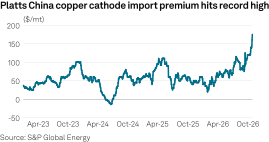
What's happening? China's copper cathode import premium rose to an all-time high of $220/metric ton over the London Metal Exchange cash price, CIF China, Nov. 6, up $100/mt, or 83.3%, from a month earlier, according to the Platts assessments from S&P Global Energy. This was the highest level since Platts launched the assessment in August 2014. The record premium reflects falling exchange inventories, reduced domestic smelter output and limited spot availability, prompting China-based consumers to turn to imported metal. Domestic Chinese spot premiums reached about 1,900 yuan/mt ($285/mt) as of Nov. 5, while copper stocks at Shanghai Futures Exchange warehouses fell 17.9% week over week to 44,612 mt as of Oct. 30, highlighting tightening physical availability.
What's next? China-based market participants are increasingly expecting a potential delay or moderation in US tariffs on refined copper imports in 2027 following the US midterm elections. The spread between COMEX and LME copper prices narrowed to about minus $85/mt as of Nov. 4, compared with a COMEX premium of about $89/mt a month earlier. A sustained reversal in arbitrage could eventually encourage some US copper inventories to be redirected to non-US markets, including China, though any redistribution would likely be gradual. Despite softer futures prices, physical conditions in China were tight, highlighting the divergence between futures and spot market fundamentals.
2. India may restrict broken rice exports amid price rise
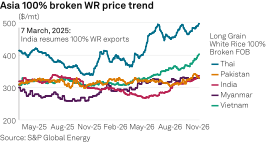
What's happening? Indian rice exporters anticipate restrictions on 100% broken white rice amid rising prices and tightened supply as demand from the ethanol and feed industries grows. Platts assessed India 100% broken white rice at $336/mt FOB Kakinada Nov. 5, up 5% month over month and 5.32% year over year. The Indian Rice Exporters' Federation warned that restrictions cannot be ruled out if domestic prices continue to rise, as international prices exceed $360/mt. A Kakinada-based exporter said a meeting with the government took place Nov. 4, during which officials indicated they are considering restrictions and want to sell rice domestically rather than export it.
What's next? India's production estimates for MY 2026-27 (October-September) are expected to be 146 million mt, down 8 million mt year over year due to El Niño's impact on crops, according to S&P Global Energy CERA. Kharif crop production is at risk of shortage due to drought in south India, Cyclone Arnab and unseasonal rains in Chhattisgarh. The Food Corp. of India will not provide rice beyond 7.2 million metric tons to ethanol market participants for this season, which requires 11 billion liters of ethanol. No fresh export restrictions have been released yet, and the Ministry of Commerce and Industry has not commented. Participants will closely monitor the government's decision as any notification would shape domestic broken rice availability, export offers and demand.
3. US midstream steps up gas pipe plans anticipating demand

What's happening? US midstream companies are accelerating natural gas pipeline projects to meet anticipated demand growth. Energy Transfer is advancing its Lake Charles LNG project in Louisiana while Kinder Morgan is expanding its Gulf Coast Express pipeline system. Williams Companies is also developing new infrastructure to support growing LNG export capacity. These investments reflect industry expectations of increases in natural gas consumption, particularly from LNG facilities and data centers. The pipeline expansions are designed to transport gas from chief producing regions like the Permian Basin to coastal export terminals.
What's next? The pipeline build-out is expected to continue through the end of the decade as LNG export capacity is projected to nearly double by 2030. Energy Transfer anticipates its Lake Charles facility will begin operations in the coming years, requiring substantial pipeline capacity. Industry analysts expect natural gas demand to rise by several billion cubic feet per day over the next five years, driven primarily by LNG exports and power generation for data centers. Companies are also planning additional compression and processing facilities to support the expanded pipeline network and ensure adequate supply to meet growing domestic and international demand.
4. US shrimp imports rise 12.6% amid inventory buildup
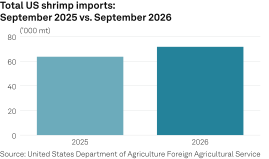
What's happening? US shrimp imports rose 12.6% year over year to 71,605.6 metric tons in September from 63,565.4 mt in September 2025, as increased shipments from Ecuador and Indonesia added to already elevated US inventories amid subdued demand, according to the USDA Foreign Agricultural Service data Nov. 4. Ecuador shipped 22,219.7 mt to the US in September, up 17.5% year over year, while Indonesian shipments climbed 50.1% to 11,151.9 mt. Combined shipments from Ecuador and Indonesia increased by about 7,037 mt year over year, accounting for most of the 8,040.2 mt increase in total September imports. Participants described the US market as oversupplied, with one importer noting more inventory in cold storage than witnessed in the past five years.
What's next? CERA forecast Ecuadorean shrimp production to increase 8.4% year over year to 1.52 million mt in 2026, while Ecuador's total shrimp exports are forecast to rise 24% to 1.74 million mt. Production is also forecast to expand in India and Vietnam, rising 7.2% and 6.5%, respectively, in 2026. However, Ecuador faces weather and operational risks following heavy rainfall, flooding, power rationing and outages, with disruptions contributing to earlier harvesting and operational difficulties. The effects of weaker growing conditions are expected to become more apparent in supply between December and February.
Reporting and analysis by Lucy Tang, Han Lu, Killian Staines, Susan Dlin, Gabrielle Holliday, Namarita Kathait and Tanya Rana.
