Energy Transition, Renewables, Emissions, Carbon
February 11, 2026
ET Highlights: Canadian renewables rise, Kapuni hydrogen project reaches financial close, European renewable PPA volumes to rebound
Energy Transition Highlights: Our editors and analysts bring together the biggest stories in the industry this week, from renewables to storage to carbon prices.
Top story
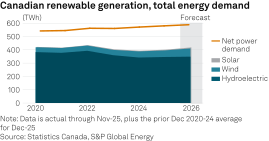
Canada adds renewable power as data centers test future demand
With wind, solar and battery storage supplying about 9.7% of Canada’s electricity demand in 2025, up from 6.95% in 2020, according to the Canadian Renewable Energy Association, industry observers Feb. 6 expressed uncertainty about whether that trend would continue in the face of surging data center demand.
“We can't predict whether this will increase, but as with electric vehicles, this share isn't just due to an external mandate; it reflects market choices," Michael Powell, the Canadian Electricity Association’s director of government relations, said about the CanREA's 2025 annual data release, "People want more renewables in the mix, and they can add energy affordably -- and that's a good thing."
CanREA estimates that wind, solar and battery storage account for more than 70% of Canada’s new electric capacity between 2025 and 2050 in both its reference and accelerated scenarios.
“Canada currently has approximately 150 gigawatts of installed electricity generation capacity, of which there are 17 GW of wind, 2.3 GW of solar and 1 GW of storage,” the group said in its report. “Over the next decade, our analysis projects that Canada will deploy 30 to 51 GW of new wind power, 17 to 26 GW of new solar power and 12 to 16 GW of new energy storage. Between 2035 and 2050, total installed capacity for all these technologies will grow by another 50% or more in the Reference Scenario, and by a further 60% in the Accelerated Scenario.”
Benchmark of the Week
C$41.75/MWh
The Alberta Electric System Operator reports that the average daily power price in January 2026 was C$41.75/MWh, a rise of roughly 38 % compared with January 2025.
Learn more: Platts Carbon Markets Specifications Guide
Editor's Picks: Free and premium content
SPGlobal.com
INFOGRAPHIC: Europe's renewable PPA volumes set to rebound as prices adjust to market realities
Signs of saturation in European power purchase agreement markets became clear in 2025, as contracted volumes fell to a six-year low, while average market prices remained significantly below the minimum required to offset project costs for new renewable assets, so-called PPA breakeven estimates. S&P Global Energy data indicates that the gap between the prices needed to get a project financed and buyers' payment willingness is shrinking again.
FatHopes completes FGE NexantECA feasibility study for integrated SAF refinery
Malaysia-based FatHopes Energy has completed an independent feasibility study for its planned integrated sustainable aviation fuel refinery, conducted by consultancy FGE NexantECA. The study assessed the technical, economic, and regulatory viability of the project, positioning it among the most competitive SAF production sites globally, according to FatHopes' statement on Feb. 5. With the study completed, the company said the project is ready to advance to the next development phase.
S&P Global Energy Core
New Zealand's Kapuni renewable hydrogen project reaches financial close; output seen in 2027
New Zealand's Kapuni renewable hydrogen project has reached financial close, marking a major milestone for the wind energy-based hydrogen initiative for transport and industrial use, developer Hiringa Energy said. At the South Taranaki site, preliminary construction and first-stage civil enabling work for wind turbines will begin this month, with renewable hydrogen production expected in 2027, Hiringa Energy added. The project will generate renewable electricity through four 6.4 MW wind turbines which will integrate with a 5 MW electrolyzer.
India's 2026-27 budget exempts customs duty on solar raw material, battery capital goods
India has proposed an exemption from customs duty on a key raw material for solar photovoltaic manufacturing and on capital goods used to produce lithium-ion batteries for energy storage, a move aimed at reducing input costs for domestic manufacturers and boosting renewable energy capacity. Finance Minister Nirmala Sitharaman proposed to cut customs duty on sodium antimonate, used in solar glass manufacturing, to nil from 7.5%; and to exempt specified capital goods for lithium-ion cell production for battery energy storage from applicable customs duties.
Dutch Porthos CCS project completes well conversion for CO2 storage
The Dutch Porthos carbon capture and storage project has completed the conversion of four former natural gas production wells in the North Sea into CO2 injection wells, reaching a milestone ahead of the start of CO2 injections planned for later in 2026, the group said in a statement on Feb. 5. The work, finished in late January, transformed wells connecting the P18-A platform to depleted gas fields located 3-4 kilometer (1.8-2.4 miles) below the seabed in porous sandstone formations, Porthos said.