


Electric Power, Energy Transition, Renewables
March 17, 2026
Regional dynamics drive South Korea’s power market shift
South Korea's power sector is shifting into a market that increasingly demands a regionalized lens, taking into account where power is generated, where it is consumed and whether the grid can bridge the gap.
The sector is traditionally discussed using national metrics, such as total demand, capacity additions and a single system marginal price. Large-scale generation assets often sit far from urban demand centers and transmission expansion has faced delays due to complex political and community dynamics. For example, Honam -- responsible for 32% of the renewable generation in 2025 -- is approximately 110 km from the semiconductor cluster and more than 200 km from a large nuclear reactor cluster in Youngnam.
As South Korea pursues ambitious renewable energy targets while tackling uneven demand growth driven by data centers and semiconductor manufacturing, regional supply-demand balances and transmission infrastructure have become central to understanding the market's trajectory.
This shift necessitates a more granular approach to understanding the market, particularly regarding regional supply-demand balances and transmission constraints, according to analysts at S&P Global Energy CERA in the latest long-term outlook for South Korea's power market.
To address this evolving landscape, CERA has implemented a zonal modeling approach in its 2025 long-term outlook for South Korea's power market. The updated model incorporates existing interregional transmission capacities and future project pipelines to capture how regional supply-demand balances, grid congestion, and curtailment would evolve through 2050. This approach provides a more nuanced view of the market, revealing insights that are not apparent from national aggregates.
Deliverability as key grid constraint
South Korea has experienced significant delays in large-scale, long-distance transmission projects, primarily due to local community opposition. For instance, the 345-kilovolt transmission project connecting North Dangjin to Shin Tangjeong started in 2003. It was supposed to be completed in 2012 but encountered several challenges and was only completed in December 2024, 21 years after construction, according to South Korea's official government briefing released in November 2024. These delays have already led to curtailment of thermal capacity on the East Coast, particularly affecting coal plants.
Compounding these supply-side challenges is the divergence in regional demand patterns driven by new structural changes to the economy. Data center deployment, particularly for artificial intelligence applications and semiconductor manufacturing expansion, is the primary driver reshaping the geography of electricity consumption, according to CERA analysis.
Regional power demand growth is expected to be most pronounced in the Seoul Metropolitan Area, with a compound annual growth rate of 1.5% between 2020 and 2050, according to CERA estimates.
By 2050, 44% of total power demand is expected to come from the capital region, up from 40% recorded in Korea Electric Power Corporation's 2024 annual power market statistics. This demand concentration, coupled with the region's limited generation capacity, underscores the critical importance of transmission infrastructure.
In constrained systems with physical limitations, the same national reserve margin can produce varying regional reliability and curtailment outcomes depending on grid infrastructure, each region's supply and demand profile and hourly and monthly seasonality.
Honam's renewable glut, Seoul's 50% deficit
According to CERA's zonal approach, regional balances are influenced by interregional transmission capacity rather than the national capacity mix itself, while not understating the importance of the overall energy mix. This is particularly important as South Korea continues to expand its renewable energy capacity, often situated in regions like Honam, with favorable conditions for renewable development but rather limited local demand due to a lack of populace and industrial base.
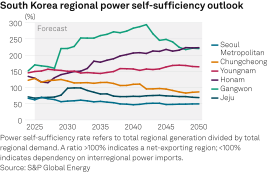
Large-scale generation assets are typically located far from urban demand centers due to siting challenges. Throughout the forecast horizon, CERA anticipates that the Seoul Metropolitan Area will maintain a self-sufficiency rate of about 50%, requiring consistent interregional power injection via long-distance transmission lines.
Implications for renewable development
Curtailment severity depends on interregional transmission capacities and demands. Understanding regional supply-demand balances and transmission constraints can help developers identify optimal locations for new projects. If Korea Power Exchange pursues locational marginal pricing to replace the current SMP scheme, it would translate into different capture prices of renewable assets depending on the region. Merchant assets without a firm offtake agreement would be exposed to spot market volatility and potentially lower revenue.
In the latest CERA long term outlook, solar photovoltaic curtailment is likely to be most pronounced in Honam, Jeju and Chungcheong in the short-term. Ahead of the 2040s, CERA expects curtailment is likely to become more severe in the Seoul Metropolitan area.
Subsea HVDC as a potential solution
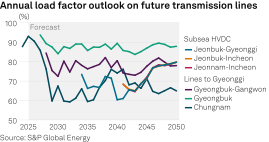
According to KEPCO's 11th Long-term Transmission and Distribution Plan published in 2025, the state utility is planning subsea high-voltage direct current transmission lines, with the first phase expected in the early 2030s to move renewable surplus from Honam to the Seoul Metropolitan Area demand center. These projects show up as high-utilization transfer corridors in the CERA model, indicating heavy usage and necessitating the project. Honam's self-sufficiency is expected to reach 223% by 2050 and, along with Gangwon and Youngnam, it will remain a major power producer, according to CERA's modeling results.
However, these transmission expansion projects face the risk of future delays and could put downward pressure on spot market participants due to price cannibalization and further curtailment caused by a lack of transmission capacity, according to the CERA analysis.
Legislative support for grid expansion
In February 2025, the National Assembly passed a special bill on power grid expansion, aiming to expedite consultation with local stakeholders. This includes a prime minister-led grid committee, a 60-day feedback period for local communities and strengthened financial compensation for landowners along transmission routes.
However, the actual impact of these measures on project delivery remains uncertain, and CERA's modeling reflects a conservative view of commercial operation dates, given the historical tendency.
What lies ahead
South Korea's power market is entering a period in which regional dynamics could increasingly shape investment outcomes, policy direction and system reliability. There is a possibility that the concentration of demand growth in the Seoul Metropolitan Area could potentially conflict with the geographic reality of where new generation assets, especially renewables, are being built, according to the latest CERA long-term outlook.
CERA's zonal modeling approach is designed to capture precisely these regional supply and demand dynamics in a timely manner. By moving beyond national aggregates and incorporating interregional transmission constraints, the model provides a framework for stress-testing assumptions about grid buildout, curtailment trajectories and price formation through 2050.
As the market evolves, this granular perspective will be essential for stakeholders seeking to navigate the risks and opportunities of South Korea's energy transition.
Further reading:
