Electric Power, Energy Transition, Renewables
March 03, 2026
Wind orders in 2025: reset, not retreat
Global wind turbine ordering activity slowed in 2025, but the headline numbers hide a more nuanced story. S&P Global Sustainable1 tracked around 140 GW of firm orders -- confirmed supply deals or framework agreements -- down roughly 20% year over year, and 60 GW of non-firm contracting activity -- typically non-binding commitments, such as conditional agreements and memorandums of understanding -- taking total recorded orders to over 200 GW.
"Despite the contraction in firm orders, this slowdown looks less like weakening fundamentals and more like the global market recalibrating after a highly concentrated surge in additions," said Indra Mukherjee, head of wind technology and supply chain research at Sustainable1.
Onshore wind dominates as offshore wind recalibrates
Onshore wind accounted for more than 90% of global orders in 2025, despite an 18% year over year decline, while offshore fell around 40%, according to Sustainable1 data.
"What we saw in offshore was not a demand shock, but a pause driven by governments revisiting auction design, permitting and delivery frameworks to improve bankability," Mukherjee said.
"The result was a selective pullback, shaped primarily by policy and timing rather than underlying demand fundamentals," Mukherjee added
Key market declines weigh on orders
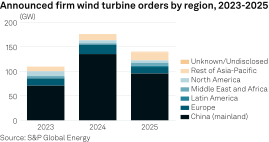
China and Europe drove most of the decline, with their orders falling from 135 GW and 19 GW in 2024 to 95 GW and 13 GW in 2025, respectively.
China's orders fell close to 30%, particularly in northern high-wind provinces, where weaker utilization and the shift toward market-based pricing under Notice 136, a new policy transitioning renewable energy projects from fixed to market-based pricing, increased revenue uncertainty.
As China's 14th Five-Year Plan (2021-25) concludes, new ordering activity in China appears more measured ahead of the next policy cycle, even as near-term build remains supported by an established project pipeline.
In Europe, orders contracted by more than 30%, according to Sustainable1 data. Stronger onshore ordering in Germany was insufficient to offset declines elsewhere, and offshore activity was notably subdued.
North America orders fell around 7%, according to Sustainable1: Canada grew 47% from 2024, while the US declined 17%, constrained by permitting friction, trade uncertainty and a stalled offshore sector.
Policy clarity drives growth
Elsewhere, growth remained robust across emerging markets. India accounted for over 60% of total orders across the rest of Asia-Pacific, Latin America more than doubled its order volumes, reaching over 2 GW. Meanwhile, the Middle East and Africa nearly tripled to 6 GW, led by Saudi Arabia's accelerated auction cadence under its national renewables program.
"Demand remained strong where frameworks were clear -- policy certainty translated directly into higher ordering activity," said Mukherjee.
OEM landscape dynamics
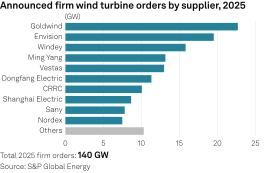
The supplier landscape reflected this uneven reset. Chinese original equipment manufacturers captured just over 80% of global orders and expanded exports aggressively.
Firm overseas orders exceeded 17 GW, roughly doubling year over year, with growth concentrated in Central Asia, Southeast Asia, India, Latin America, the Middle East and Africa, according to Sustainable1 data.
"Export exposure increasingly acted as a hedge against domestic volatility," said Mukherjee. "Chinese suppliers with the largest international order books were best positioned to offset softness in their home market."
Chinese OEMs also shaped market outcomes in several regions, from supporting record-low tender prices in Saudi Arabia to gaining share in India and securing orders for the largest turbines yet contracted in Brazil.
Western OEMs, by contrast, continued to face weaker demand, largely reflecting ongoing slowdowns in certain core markets. Among western OEMs, Vestas led contracting volumes, followed by Nordex, whose orders rose approximately 40% year over year, backed by strong performance in Europe and North America. Other suppliers remained affected by recent market reprioritization strategies and ongoing product platform challenges.
Regional OEMs, particularly in India, such as Suzlon and Inox Wind, also struggled to grow volumes as they focused on delivering an already sizable order backlog.
"For western OEMs, the challenge in 2025 was less about competitiveness and more about exposure to slower-moving core markets," said Mukherjee.
China leads turbine upscaling
Technology trends in 2025 provided the clearest forward signal. Globally, onshore orders clustered in the 5-6 MW range, but China continued to push scale faster, with average ordered rotor diameters approaching 220 meters, compared with closer to 170 meters elsewhere. Offshore orders remained centered on 14-16 MW globally, yet Chinese projects are increasingly adopting even larger machines, with rotor diameters around 260 meters.
Overall, 2025 appears less as a downturn and more as a recalibration. Ordering activity slowed where policy shifts and auction redesigns raised uncertainty, but demand remained strong where regulatory frameworks provided clarity.
In 2026, the question is not whether wind remains a growth engine for energy transition, but how quickly policy resets can translate back into orders.
Further reading: Global Announced Wind Turbine Order Tracker: February 2026
