Crude Oil, Chemicals, Refined Products
July 15, 2025
COMMODITY TRACKER: 5 charts to watch this week

By Staff
Saudi Arabia drove OPEC+ crude production in June, while Asian refiners look to diversify crude sources beyond the Middle East amid geopolitical uncertainties. Tariffs also continue to be a hot topic, with copper prices in the US hitting record levels after President Donald Trump announced a proposed 50% tariff on copper imports.
1. OPEC+ crude output surges in June...
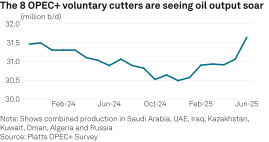
What's happening? In June, OPEC+ crude production surged by 600,000 b/d month over month, primarily driven by a 400,000 b/d increase in Saudi Arabia's output, which reached 9.54 million b/d -- the highest level in two years -- according to the Platts OPEC+ Survey. The increase came amid escalating tensions in the Middle East, particularly the Israel-Iran conflict, which raised concerns over global oil supply security, especially through the Strait of Hormuz. Despite the uptick in production, the volume of Saudi crude actually supplied to the market was just 9.35 million b/d, the kingdom said, aligning with its OPEC quota, as much of the additional crude was directed toward storage and alternative pipeline preparations. OPEC+ production was 41.79 million b/d in June, including 27.49 million b/d for OPEC and 14.30 million b/d for its Russia-led allies.
What's next? Eight OPEC+ countries implementing voluntary cuts plan to further hike quotas by 548,000 b/d in August -- the fourth successive accelerated increase -- citing a positive global economic outlook and robust market fundamentals. Yet with only Saudi Arabia seeing significant production increases, and other members such as Iraq keeping output largely flat to make up for previous overproduction, Dated Brent has remained in the low-$70s for much of July. Many analysts continue to expect a supply overhang in late 2025, which could put downward pressure on prices, once the 2.2 million b/d of voluntary cuts are fully unwound and so-called compensation plans are canceled out. The eight producers are set to reconvene on Aug. 3 to decide on September output levels, amid significant tariff-induced volatility and geopolitical uncertainty.
2. ... while Asian refiners focus on feedstock diversification amid OPEC+ hike

What's happening? Asian refiners are responding positively to the OPEC+ decision to increase crude output by 548,000 b/d in August, with countries like Japan and South Korea showing support. However, there is a strategic shift toward diversifying crude sources beyond the Middle East due to geopolitical uncertainties and economic factors. Japan's US crude imports nearly tripled in May to 189,403 b/d, and South Korea imported 18.7 million barrels, reflecting a strong preference for US grades like WTI Midland. This shift is driven by rising Middle Eastern crude prices and freight costs. The spread between WTI Midland and Murban was assessed at minus 4 cents/b on June 30.
What's next? The OPEC+ production increase is seen as a temporary relief to energy security concerns in Asia, but refiners are actively reassessing their crude slates. Asian refiners are expected to continue diversifying their supply sources, benefiting from government incentives and logistical advantages. South Korea, for instance, is considering boosting American crude purchases by 5 million to 10 million barrels monthly.
Related topic: OPEC+ Oil Quotas and Geopolitics
3. US to impose 50% tariff on copper imports from Aug. 1
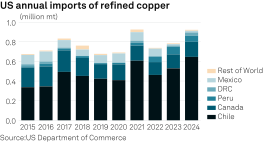
What's happening? The US will start imposing a 50% tariff on copper imports beginning Aug. 1, President Donald Trump announced on Truth Social July 9. Copper is a critical metal for various products and applications, including electronics, transportation, power transmission and distribution, building construction, and industrial machinery. Despite its significant domestic copper mining and refining capacity, the US remains highly dependent on imported volumes, with net imports accounting for approximately 44% of demand.
What's next? This move is expected to hit copper exports to the US and impact countries such as Chile, the largest copper exporter to the US in 2024. The tariff is also likely to cause sharp regional price dislocations and amplified volatility in the global copper markets, according to S&P Global Energy Metals and Mining Research team. Miners from Chile and Canada also said the duty is likely to put US markets in a tight spot as major copper producers will turn to other trade partners.
Related topic: Trump and Commodities
4. Japan's GX-ETS faces supply challenges ahead of mandatory phase
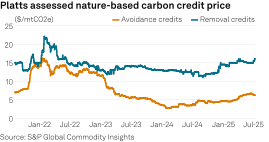
What's happening? Japan is set to transition its GX Emission Trading System from a voluntary to a mandatory framework, starting fiscal year 2026-27. Under the mandatory phase, companies will only be allowed to use JCM credits and J-credits to offset their liable emissions, the Ministry of Economy, Trade and Industry announced, effectively ruling out the use of international carbon credits from Japan's voluntary carbon market. On July 14, J-credit prices stood at Yen 6,000/mtCO2e ($40.62/mtCO2e), while VCM nature-based avoidance and removal credits were priced at $6.2/mtCO2e and $15.5/mtCO2e, respectively.
What's next? The mandatory phase of the GX-ETS could present challenges due to the limited supply and potentially high costs associated with J-credits and JCM credits. With Japan targeting a cumulative supply of 100 million mtCO2e of JCM credits by 2030, market participants expressed concerns about the feasibility of meeting these targets, as only 0.82 million mtCO2e have been issued so far. Hence, increasing private investments in project development for eligible credits will be necessary to narrow the supply gap and meet Japan's target of cutting its greenhouse gas emissions by 46% by FY 2030-31 from the FY 2013-2014 level.
5. Asia chicken markets bullish as China prepares to resume Brazilian imports
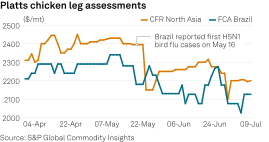
What's happening? Brazilian sellers have increased chicken prices due to anticipated exports to China, which is preparing to resume imports after an H5N1 bird flu outbreak in May. Chinese authorities have requested additional documents for review. South Korea has seen a 12% rise in prices for Brazil-origin boneless chicken legs. Some exporters canceled pre-outbreak contracts to resell at higher prices.
What's next? With China potentially reentering the Brazilian chicken import market soon, chicken prices are expected to remain elevated, according to sources. Meanwhile, South Korea is facing inventory shortages due to the one-month-long import ban on Brazilian chicken, contributing to heightened demand. Importers are bidding Brazilian boneless chicken legs at $2,500/mt CFR South Korea, while sources expect values to remain firm between $2,600 and $2,700/mt.
Reporting and analysis by Charlie Mitchell, Phil Vahn, Euan Sadden, Ivy Yin, Nabiel Hamzah and Nuo Geng Chen
