Crude Oil, Metals & Mining, Chemicals, Non-Ferrous
April 28, 2026
COMMODITY TRACKER: 5 charts to watch this week

By Staff
Editor:
Canada and South Korea streamlined crude trade procedures, while China's lithium carbonate prices reached a two-year high amid supply concerns. Ukrainian grain markets show price convergence with Turkish demand, European chemical markets soften ahead of Asian imports, and US cattle placements reach near-historic lows.
1. Canada-South Korea deal cuts tariffs on heavy crude
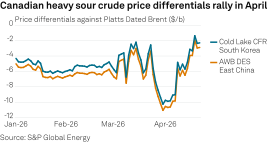
What's happening? South Korea and Canada streamlined administrative procedures to facilitate crude oil trade, reducing tariffs on heavy sour Canadian crude imports. The Korea Customs Service and the Alberta government announced simplified origin certification April 20, addressing previous documentation barriers. South Korean refiners purchased only 18,556 barrels/day of Canadian Cold Lake and Access Western Blend crude in Q, according to Korea National Oil Corp. data released April 22. In comparison, South Korea imported 551,189 b/d of US crude oil during the same period. Platts, part of S&P Global Energy, assessed delivered Pacific Cold Lake at a $1.05/b premium against Dubai, CFR South Korea, at the April 27 Asian close.
What's next? Alberta exporters can expand crude oil exports to South Korea to a maximum of 33 million barrels annually through the simplified certification process, according to Alberta Premier Danielle Smith. South Korean refiners in Ulsan, Daesan, and Yeosu are positioned to increase purchases of Cold Lake and AWB barrels as alternatives to Middle Eastern grades like Iraq's Basrah Medium and Saudi Arab Medium. The Korea Customs Service will establish a Crude Oil Supply Diversification Support Task Force to expedite spot crude trades and review support measures. Japanese refiners, including ENEOS, are also assessing Canadian heavy sour crude as a direct alternative to Persian Gulf grades.
2. China's lithium prices hit two-year high
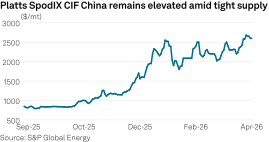
What's happening? China's lithium carbonate prices reached their highest level in over two years April 27, with Platts assessing battery-grade lithium carbonate at Yuan 177,500/metric ton DDP China, up 1.43% day over day. The Guangzhou Futures Exchange's most actively traded lithium carbonate contract rose 1.7% to Yuan 180,560/mt, marking the fourth consecutive day of gains. Supply concerns intensified following armed conflict in Mali, which supplied 9.3% of China's spodumene imports in Q1. Zimbabwe's export restrictions on lithium concentrate from late February, potential lepidolite mine shutdowns in Jiangxi province and reduced output guidance from Australian producer IGO intensified supply concerns. Platts assessed SpodIX at $2,640/mt CIF China on a 6% lithium oxide basis April 27, up $290/mt since Zimbabwe's export ban took effect Feb. 25.
What's next? Market participants expect continued price support from tight supply conditions and strengthening downstream demand during China's seasonal peak. Mali's two major lithium mines, Goulamina and Bougouni, have not reported production disruptions, though the country's escalating violence since April 25 raises concerns about future supply. Zimbabwe granted export quotas to Chinese mining companies in mid-April, though concentrate exports have not resumed. Huayou Cobalt began shipping lithium sulfate from Zimbabwe April 25, marking the country's first localized production, according to the company.
Related reading: METALS MONITOR: China's lithium prices at highest in 2 years; Canada bares C$25B wealth fund
3. Ukraine corn, wheat prices converge on Turkish demand
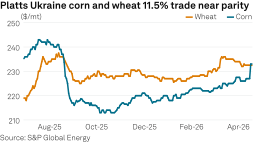
What's happening? Ukrainian 11.5% wheat and corn prices reached near parity with a 50-cent/mt spread, driven by stronger Turkish corn demand following an import quota with reduced 5% duties introduced April 17. Platts assessed Ukrainian corn FOB POC at $233/mt on April 21, up from $227/mt the previous week and the highest level in the current marketing year that began October 2025. Wheat prices fell to $232.50/mt on April 21 from $236/mt in early March, trading at a $6.75/mt discount to the Platts Milling Wheat Marker. From April 1-21, Ukraine loaded approximately 1.7 million mt of corn, with Turkey receiving 634,678 mt and Italy 217,823 mt, according to the port line-up shared by a Ukrainian trader.
What's next? Wheat prices face continued pressure from abundant supply and subdued buying interest as the market prepares for new crop arrivals in July. Wheat exports reached 10.5 million mt as of April 15, down 22% year over year, according to S&P Global Energy CERA, which forecasts Ukraine's carryout stocks at 4.6 million mt and total exports at 12 million mt for the season. CPT local prices were heard at $218-$219/mt for milling wheat and $215/mt for feed wheat for both new and old crops. Demand from destinations other than Turkey and Italy has slightly waned amid rising FOB corn prices, with shipping costs settling in the mid-$20s/mt since the Middle East war started.
4. European MMA, acrylates market weakens on import expectations
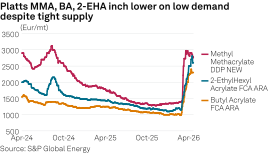
What's happening? European methyl methacrylate, butyl acrylate and 2-ethylhexyl acrylate markets showed weakening prompt demand despite tight supply, with forward sentiment softening on expectations of increased Asian imports. Panic-buying eased as buyers were largely covered for May, although prompt supply remained constrained with limited negotiation flexibility. Platts assessed the 3-30 day forward DDP Northwest Europe methyl methacrylate spot price at Eur2,754.25/mt on April 23, down Eur36.75/mt day over day. Butyl acrylate prices rose from Eur1,015/mt on March 2 to Eur2,400/mt on April 14, while 2-ethylhexyl acrylate climbed from Eur1,150/mt to Eur2,805/mt on April 17.
What's next? Market participants expect most import volumes from China to arrive in late May through June, with some delayed into July. Limited volumes from South Korea are also anticipated, primarily in smaller shipments. Forward availability expectations appear more comfortable than prompt expectations, contributing to softer sentiment beyond May. The reopening of arbitrage from China to Europe is expected to ease supply concerns and contribute to a more balanced market. European spot values have largely stalled since mid-April, with the latest butyl acrylate and 2-ethylhexyl acrylate assessments on April 23 at Eur2,300/mt and Eur2,600/mt respectively, reflecting flat to softer pricing pressure.
5. US March cattle placements hit second-lowest since 1996
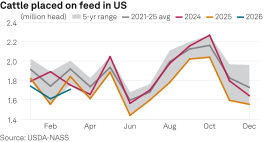
What's happening? US cattle placed in feedlots in March totaled 1.709 million head, down 7.3% from 1.843 million head in March 2025 and 10.9% below the 2021-2025 average, marking the second-lowest March placements since the series began in 1996, according to the USDA's April 17 Cattle on Feed report. Marketing of fed cattle during March totaled 1.632 million head, down 5.5% year over year and also the second-lowest for March since 1996. The number of US cattle on feed totaled 11.576 million head April 1, up 0.2% from March 1 but down 0.5% from April 1, 2025. Platts assessed 90CL beef CIF East Coast US at $8,135/mt on April 17, down 2.9% week over week.
What's next? The US has marketed fewer cattle than were placed in feedlots for the third consecutive month and for seven of the last eight monthly reports, indicating tightening supply dynamics. Analysts attribute the decline in March placements partly to weather events in February 2025 that made it difficult to move cattle to feedlots, with those cattle transitioning to March placements in 2025. Lean beef trimmings have been following non-fed slaughter levels, which remain slightly below year-ago levels. Pressure on prices is expected from improved conditions in New Zealand and Australia, with more cattle available and expectations that China will stop buying in four to six weeks. Support for domestic prices comes from lower import pace and strong demand for the grilling season.
Reporting and analysis by Gawoon Philip Vahn, Leon Wong, Oceana Zhou, Lucy Tang, Marco Loke, Vivian Iroanya, Amrutha Dileep Chingoroth, Maria-eleni Tsimeki, Baran Serdaroglu and Sergio Alvarado.
