Metals & Mining, Non-Ferrous
April 27, 2026
China's lithium prices at highest in two years on tight supply, demand growth
Editor:
HIGHLIGHTS
Mali conflict intensifies supply shortage concerns
Zimbabwe export ban keeps spodumene inventory tight
China's lithium spot and futures prices continued to rise April 27, led by expectations of tightening raw material supply and higher downstream demand in China, several China-based market sources, including producers, traders and analysts, said April 27.
Platts, part of S&P Global Energy, assessed assessed battery grade lithium carbonate at Yuan 177,500/metric ton ($25,974/mt) DDP China April 27, up 1.43% day over day, the highest in more than two years. The lithium price was last higher Sept. 15, 2023.
A similar price trend has been observed in China's lithium futures market.
The most actively traded lithium carbonate contract by open interest on the Guangzhou Futures Exchange rose 1.7%, or Yuan 3,040/mt, from the previous close, reaching Yuan 180,560 per metric ton ($26,459/mt) on April 27, exchange data showed.
China's only listed lithium futures contract has now risen for the fourth straight day, according to data.
Most of the price movement has been driven by news surrounding armed conflict in Mali, which has amplified supply-side concerns in an already tight market.
Export restrictions on lithium concentrate imposed by Zimbabwe from late February, potential license-related shutdown risks at lepidolite mines in Jiangxi province, and a significant downward revision to output guidance by Australian lithium major IGO recently have all added to supply pressure.
At the same time, downstream demand in China continues to strengthen amid a seasonal peak, according to market sources.
Supply concerns
Mali has seen a sharp escalation in violence since April 25, marked by one of the most extensive and coordinated attacks in recent years, media reports showed.
Despite its limited import share, Mali carries outsized price influence as a source of incremental supply, making disruption risks there particularly sensitive for lithium market expectations, according to market sources.
Mali has emerged as a growing source of spodumene supply for China, with the total shipments to China reaching 206,057 mt in the first quarter of 2026, accounting for China's 9.3% of spodumene imports.
| China's lithium ore mining investments in Mali | ||||
| Mine | Chinese investor | Stake share | Resources | Production start year |
| Goulamina | Ganfeng Lithium | 65% | 7.14 million mt LCE | 2024 |
| Bougouni | Hainan Mining | 47.37 million mt ore | 2025 | |
| Source: Company announcements | ||||
Market participants said they have not yet received any information suggesting disruptions to production or shipments at the two lithium mines in Mali.
Zimbabwe is yet to resume spodumene exports, although Chinese companies with mining assets in Zimbabwe have secured lithium concentrate export quotas from the government in mid-April.
In line with Zimbabwe's push to develop downstream processing, Huayou Cobalt has become the first Chinese company to achieve localized lithium sulfate production in the country. The company said April 25 that the first batch of products had been shipped, marking the project's entry into a phase of stable production.
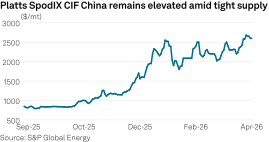
Upstream spodumene prices remained elevated, with spot-market inventories still tight. Platts assessed SpodIX CIF China at $2,640/mt on a 6% lithium oxide basis on April 27, up $40/mt day over day and $290/mt from Feb. 25, when Zimbabwe imposed a ban on lithium concentrate exports.