Agriculture, Meat
January 23, 2026
Australian beef exporters adapt as China caps imports, shifts global trade flows

Australia's beef industry is undergoing a pivotal transformation as China moved to cap Australian beef imports and impose tariffs on out-of-quota volumes.
The three-year safeguard regime, announced by China's Ministry of Commerce, took effect on Jan. 1 and is expected to disrupt established trade flows and pressure Australian exporters to recalibrate their strategies amid a shifting global landscape.
Australian beef accounted for 8.3%, 7.5% and 13.9% for 2023, 2024 and 2025 (up to November), respectively, of China's total beef imports, according to China's General Administration of Customs data.
In 2025, Australia exported 272,709 metric ton of beef to China, according to Australia's Department of Agriculture, Fisheries and Forestry data. With China's safeguard measures in place, Australia's beef exports to China will be limited to 205,000 mt in 2026, 209,000 mt in 2027 and 213,000 mt in 2028. Any volumes exceeding these quotas will incur a 55% tariff.
Quota shockwaves and market displacement
Two Australian industry sources who spoke to Platts said the quota, set well below recent trade levels, is likely to trigger a scramble among export processors to secure allocations early in 2026. They added that this could potentially exclude smaller suppliers and favor high-volume, low-value products, including trims, offal and bones.
This will affect grain-fed and premium suppliers, said one of the industry sources, who is based in New South Wales, adding that Chinese consumers are at risk of losing their regular supply of quality Australian products throughout the year.
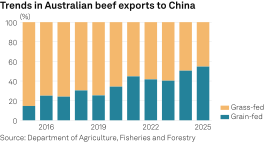
Australian beef exports surpassed 205,000 metric tons in only three of the past ten years. The new safeguard measures will disrupt long-fed programs with feeding durations greater than 150 days. These programs produce beef with higher marbling and support Wagyu supplies that rely on continuous access to the Chinese market, according to a Brisbane-based industry source.
| Year | Export Volume (mt) |
|---|---|
| 2015 | 148,222 |
| 2016 | 94,040 |
| 2017 | 110,059 |
| 2018 | 162,683 |
| 2019 | 300,133 |
| 2020 | 196,697 |
| 2021 | 148,358 |
| 2022 | 158,086 |
| 2023 | 206,193 |
| 2024 | 193,229 |
| 2025 | 272,709 |
Source: Department of Agriculture, Fisheries and Forestry.
According to an Australia-based meatpacker, overall Australian beef prices into China have risen 10%-15% compared with levels before the safeguards. Bid prices for Australian Wagyu 50CL were reported at $3.80/kg CIF China for shipments scheduled before early April. This price level was significantly higher than the traded price reported at $3.48/kg CIF China for the November-December shipment.
Strategic pivot: diversification and value focus
In response, Australian exporters are accelerating market diversification. Market shifts will be largely driven by beef type, as different markets will have specific demand. Grain-fed beef, derived from cattle that have been fed with nutritionally-balanced, high-energy rations for a specific duration in the feedlot, is anticipated to flow toward North Asian and the Middle East markets. Grass-fed beef, sourced from cattle raised exclusively on pasture, will be pushed to Southeast Asia. Branded cuts are likely to be redirected to the US and UK, the Brisbane-based industry source said.
South Korea could receive certain cuts, especially ribs, plate or BBQ-style items, the New South Wales-based industry source said.
Market shifts, however, are expected to introduce new price pressures, particularly in Japan and South Korea, where increased Australian supply could negatively impact farmers, processors, exporters and traders and particularly weigh on the processor margins, an Australia-based exporter said.
South Korean and Philippine importers expect Australian beef prices to fall due to increased supply. However, global price effects will depend on how long quotas last; early quota fulfillment may require finding new buyers, according to the Brisbane-based source.
Industry sources have also called for a supplier quota system to ensure equitable access, while the Australian Meat Industry Council is seeking agreement on quota allocation. Skepticism remains about the implementation of a quota allocation system. AMIC represents retailers, processors and smallgoods manufacturers, aiming to help maintain profitability.
US market dynamics and global price signals
The safeguard measures are poised to reverberate in the US market, where demand for Australian 90CL trimmings remains strong.
"While the USA herd is still in rebuild phase – any impact will be reduced," said the Brisbane-based source. The source added that the China safeguard currently runs to 2028, which may coincide with USA herd being back to average.
With the removal of 10% and 40% US tariffs on Brazilian beef on Nov. 15 and 20, respectively, Australia and Brazil are already competing in the US manufacturing beef sector. The Australia-based exporter noted that while Brazilian trimmings are more cost-effective, US importers continue to favor Australian beef quality. If Brazil diverts to the US market, there will be some pressure on Australia, but Brazil still faces the 26.4% out-of-quota tariff, the source added.
According to Caleb Hurst, principal protein analyst at S&P Global Energy CERA, China's decision on the safeguard measures will certainly put some pressure on pricing in the US, particularly in the back half of the year.
"I still expect strong import values relative to last year at least through the first part of Q2 in 2026 as demand remains strong and both Brazil and Australia will likely fill their quotas with China prior to sending larger amounts of excess product to the US," said Hurst. He added that another item working against prices in the back half of 2026 would be the fact that the US will likely become less reliant on imported lean beef trimmings as both the US dairy and beef cow herds saw modest growth in 2025. "So even if culling rates remain the same, we're looking at a 3-3.5% increase in lean beef production in 2026 compared to 2025 with the bulk of that increase likely to show up in the back half of the year. This downside will still be tempered by exceptionally strong demand (and growing stronger for ground beef) in 2026", said Hurst.
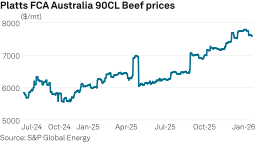
Platts, part of S&P Global Energy, assessed 90CL beef trimmings FCA Australia at $7,589/mt on Jan. 21, up 26.6% year over year, highlighting robust fundamentals.
Industry outlook
Delays in US processing plant license renewals to export beef to China could add further volatility. If US access remains constrained, quota limitation for Australian beef is likely to cause a price spike, a China-based industry source said.
With China shifting from a growth market to a volume-capped, margin-managed market, the Australian industry's ability to adapt, diversify and leverage its reputation for quality, value, reliability and customer prioritization will be critical as it navigates a new era in global beef trade.
