Refined Products, Maritime & Shipping, LNG, Chemicals, Fertilizers, Energy Transition, Fuel Oil, Bunker Fuel, Wet Freight, Renewables
November 14, 2025
INTERVIEW: Japan's MOL faces geopolitical hurdles for LNG shipping, decarbonization

By Max Lin
HIGHLIGHTS
Mounting sanction risks for Japanese shipping group
No fresh Russian businesses as Ukraine war drags on
US opposition creates obstacles for low-carbon switch
Japan's Mitsui O.S.K Lines is facing more challenges from volatile geopolitics for its LNG shipping business and decarbonization strategies, the shipping group's president and CEO, Takeshi Hashimoto, said in a recent interview with Platts, part of S&P Global Energy.
The EU sanctioned three of MOL's LNG tankers for supporting Russia's energy trade in May, but the ships were delisted in July when Brussels said they received "firm commitments" that they would not be deployed to transport cargoes from the Yamal and Arctic LNG 2 projects.
Western authorities have yet to sanction Yamal, commissioned before Russia's invasion of Ukraine, over concerns of supply disruptions. In contrast, Arctic LNG 2 is a new project sanctioned by the US and UK, and it faces trade restrictions enacted by the EU.
"Our vessels were suddenly designated as subject to sanctions, despite the fact that the vessels were carrying Yamal cargo that is not sanctioned by the EU," Hashimoto told Platts.
"Other shipping companies transporting the same Yamal cargo have not been sanctioned. This is what we thought [was] unfair ... Imposing sanctions without respecting established rules may create obstacles for international shipping and global trade," he added.
Hashimoto added the EU may believe that transporting Yamal cargo to Europe is acceptable because there is demand, but "Asia also currently has demand and needs LNG from Russia."
MOL operates more than 100 LNG tankers, of which seven are deployed to transport Yamal LNG, including three icebreaking ships designed to operate in the Arctic region, where the project is located. It also has one tanker shipping from Russia's Sakhalin 2 project in the Pacific.
However, fetching any further shipping deals with Russian LNG projects would be "out of the question," before the Russia-Ukraine war comes to a settlement, offering more clarity on sanction rules, according to Hashimoto.
Russia has exported 26.1 million metric tons of LNG so far this year, of which 12 million mt to EU countries, 6.3 million mt to China, 4.9 million mt to Japan, and the rest to other Asian countries.
The EU plans to halt Russian LNG imports from the beginning of 2027, potentially leaving Japan as the sole G7 member buying the energy product from Russia in the years to come.
If Japan were to stop purchases of Russian LNG and align itself with the West, MOL could explore opportunities in shipping to China without violating any sanctions, Hashimoto said.
"It's more and more difficult, basically ... We definitely do not want to be a part of the shadow fleet," established to transport sanctioned energy, Hashimoto added.
Decarbonization
After International Maritime Organisation member states voted to delay the adoption of Net-Zero Framework, Hashimoto said MOL could also face difficulties in its low-carbon transition to net-zero emissions by 2050.
The US has threatened supporters of the decarbonization regulation with sanctions and port fees, among other punitive measures, successfully preventing its scheduled implementation from 2028."
"As of today, commercially, economically and also technically and politically it seems to me not so easy to increase the number of zero-emission vessels," Hashimoto said. "International regulatory assistance will definitely be necessary for us to increase the number."
MOL, which has a fleet of more than 900 tankers, container ships and other types of ships -- one of the largest in the world -- generally consumes 3-3.5 million mt of oil equivalent of marine fuels. The company's bunker mix is dominated by conventional, oil-based fuels. In its fiscal year 2024-25 (April -March), its use of LNG amounted to 73,000 mt and biofuels 20,000 mt.
Aside from its LNG tankers, which can be powered by the fuel due to their propulsion design, MOL is building a fleet of at least 42 ships of other types that are capable of running on LNG, of which 15 are already in service as of March 31. It's also on the way to seven methanol-capable ships, of which five are in service and the rest are under construction. By 2030, MOL aims to have 90 ships capable of running on LNG or methanol via the two expansion projects, which can help the company reduce Scope 1 and 2 GHG by 23% from 2019 levels.
Group-wide, MOL will have 130-150 ships powered by alternative fuels or even more in a few years' time, including LNG carriers, according to Hashimoto. "However, considering the total size of our fleet, that would still be just a minority percentage."
Looking further, the company has targeted a 45% reduction in Scope 1, 2 and 3 GHG intensity from 2019 by 2035. It plans to have 130 net-zero-emission ships -- likely running on ammonia -- by the same year and has contracted for five.
"We decided to construct the series of zero-emission vessels that are using ammonia and we are determined to complete the project," Hashimoto said. "After 2030, our plan is to dramatically increase their number.
"If it will not economically make sense, we can do it for 10 vessels. But we cannot do it for 100," the executive said.
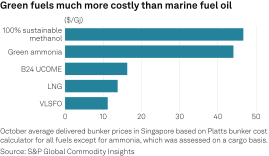
Sustainable marine fuels remain significantly more expensive than conventional fuels, and shipping companies often struggle to pass on incremental costs to their customers. Industry participants said regulations such as the IMO's NZF, designed to place a cost on maritime GHG globally, would be essential to promote their uptake.
October's average delivered bunker price for 0.5% sulfur fuel oil, the most common bunker type, was $11.17/Gigajoule in Singapore, compared with $13.77/Gj for LNG and $46/66.Gj for 100% sustainable methanol, according to the Platts bunker cost calculator. Renewable ammonia cargo prices for delivery to East Asia were $44.07/Gj.
"Quite many customers are willing to accept LNG bunker," Hashimoto said. "The next step is to maximize the utilization of ammonia and methanol -- but as of today, we cannot just rely on the cooperation from our clients."
"We definitely need the global framework, or a tax regulation," he concluded.

Editor: