


Crude Oil, Maritime & Shipping, Wet Freight
November 07, 2025
G7 tankers start to withdraw from Russian crude trades amid tighter sanctions
By Max Lin and Alec Kubekov
HIGHLIGHTS
Rosneft, Lukoil listings limit tanker opportunities
Some Greek owners find ways to stay in Russia
Secondary yuan market could emerge in China
Shipping companies using G7 maritime services retreated from Russian crude trades in October amid tightening Western sanctions, with their further withdrawal likely depending on risk appetite, according to industry data and participants.
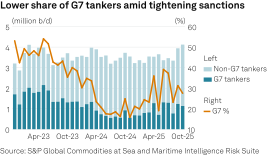
Tankers flagged, owned or operated by companies based in G7 countries and their allies, or insured by Western protection and indemnity clubs, lifted 27.5% of Russian's record crude exports of 4.1 million b/d in October, down from 31.2% in September, according to data from S&P Global Commodities at Sea and Maritime Intelligence Risk Suite.
The US, the UK and the EU in October sanctioned Rosneft and Lukoil, Russia's top two oil companies, whose combined seaborne crude exports exceeded 1.9 million b/d in the first 10 months of 2025, based on CAS estimates.
The moves, aimed at undermining Russia's war chest against Ukraine, would pose significant legal risks to tanker companies that transport oil for Rosneft and Lukoil or lift cargoes from terminals operated by them, though the US -- whose sanctions hold more sway due to the greenback's dominant current status. It provides a grace period until Nov. 21 for the existing contracts to be fulfilled.
"The implications for tankers of this coordinated wave of sanctions could be far reaching," Gibson Shipbrokers said in a note.
"Mainstream Aframaxes and Suezmaxes currently engaged in trade with Rosneft/Lukoil are likely to think twice now, with a return to conventional markets made more likely."
Price cap
Sanctions on the Russian firms came after the EU, UK, and nearly all others lowered the threshold for companies to service seaborne Russian crude exports to $47.60/b from $60/b on a free-on-board basis in early September, even as the US kept the higher cap.
The price for Urals, Russia's flagship crude grade, was $52.414/b on average in October compared with $56.535/b in September, according to data from Platts, part of S&P Global Energy.
However, CAS and MIRS data show liftings by tanker operators in Greece, Europe's top shipowning nation, rose to 23.3 million barrels in October from 19.1 million barrels in September despite Urals staying above the cap.
"Heavy-hitter Greek owners are still willing to carry Russian barrels," a Suezmax shipbroker said, as each company would have its own risk evaluations.
Russian exporters generally sell crude to their top customers in China and India based on delivered-at-place terms, sometimes via third-party traders. As the sale prices include freight costs, the exporters could list an FOB price below the cap in legal documents when freight is high.
Platts assessed the Suezmax rate for transporting 140,000 metric tons of Russian crude from the Black Sea to India's west coast at $50.71/mt on Nov. 6, and a European shipbroker said non-sanctioned ships -- which could limit legal risks for buyers -- could fetch a 30% freight premium.
The Suezmax rate for shipping 135,000 mt of non-Russian crude from the Black Sea to the Mediterranean was $18.95/mt Nov. 6, according to data from Platts.
Sanctioned trades
The non-G7 fleet, mainly composed of shadow fleet tankers operating outside of the price cap, increased its Russian crude liftings to 2.71 million b/d in October from 2.57 million b/d in September, according to CAS and MIRS data.
Russia would need to rely more on these ships going forward amid tightening sanctions, but the absolute demand for such tonnage would depend on the country's total exports, which could be curbed by the Rosneft and Lukoil listings, according to analysts.
BRS estimated the global fleet transporting sanctioned oil comprised 1,150 ships as of October, of which 78% were either sanctioned by Western authorities or operated by sanctioned entities.
With more US sanctions targeting Chinese refiners and terminals for Iranian crude imports in recent months, the shipbroker warned that "there is a risk that a secondary market will appear in China where oil sold by the sanctioned Russian companies is loaded onto sanctioned tankers, discharged at sanctioned terminals and run by sanctioned refineries" with all transactions in the Chinese yuan.

Editor: