Refined Products, Maritime & Shipping, Fuel Oil, Bunker Fuel
October 17, 2025
IMO member states delay green bunker talks by a year amid US pressure
By Max Lin and Eamonn Brennan
HIGHLIGHTS
UN agency delays regulatory talks on maritime decarbonization rules
Slim majority votes to adjourn decision on Net-Zero Framework
Uncertainty looms over shipping's fuel choices, emissions cuts
International Maritime Organization member states Oct. 17 voted to delay regulatory talks for new decarbonization rules on marine energy by a year, faced with strong opposition from the US.
During an extraordinary session of the UN agency's Marine Environment Protection Committee, 57 countries supported Saudi Arabia's motion to adjourn the discussions on the Net-Zero Framework's adoption by a year; 49 voted no while 21 abstained. A simple majority of 54 votes were needed for the adjournment.
The IMO framework was designed to place a cost on greenhouse gas emissions from bunker fuels from 2028, but the delay of talks has put the timeline and the regulation itself in serious doubt.
Some supporters of the framework voiced concerns over the postponement, which could lead to prolonged uncertainty over shipping companies' fuel choices and bunker markets.
A delegate from Brazil, which favored the framework, said ahead of the adjournment vote that a delay would be equivalent to "rejection," as many parts of its text -- like those involving timings -- could need to be redrafted in time-consuming negotiations.
"We are disappointed that member states have not been able to agree a way forward at this meeting," said Thomas Kazakos, secretary general of International Chamber of Shipping, whose members are national shipowners' associations with control over 80% of the world's merchant fleet.
"Industry needs clarity to be able to make the investments needed to decarbonise the maritime sector."
Nonprofit Transport & Environment said the delay undermines years of work on the IMO's plan to reduce maritime GHG, as the regulation could only come into force in 2030 even if adopted in a year's time based on the IMO's usual regulatory timeline.
"The issue of reducing GHG emissions from ships ... is politically contentious for many countries to the point that achieving a consensus at this stage is not possible," International Bunker Industry Association said in a statement.
"IBIA will continue to support IMO and its work, and in doing so, representing the views of the whole of the marine energy supply chain."
Contentious debate
In 2023, the UN agency's member states agreed to cut life cycle emissions from international shipping by 20%-30% by 2030 and 70%-80% by 2040 compared to 2008 levels, before a net zero close toward 2050.
This led to the formulation of Net-Zero Framework, approved by the IMO in a 63-16 vote this April despite strong pushback by the US and Middle Eastern producing countries.
But the opponents have continued to lobby against the regulation, and US President Donald Trump on Oct. 16 reiterated the country's opposition to the regulation, calling it a "global carbon tax" regime for maritime transportation that would lead to inflation.
"The United States will NOT stand for this Global Green New Scam Tax on Shipping, and will not adhere to it in any way, shape, or form," Trump said on his social media platform, Truth Social.
On Oct. 10, US Secretary of State Marco Rubio, Secretary of Energy Chris Wright and Secretary of Transportation Sean Duffy issued a joint statement that the administration "unequivocally rejects this proposal before the IMO and will not tolerate any action that increases costs for our citizens, energy providers, shipping companies and their customers, or tourists." The secretaries said they were considering a variety of retaliatory policies if the Net Zero Framework passed. Those measures could include increased port fees, sanctions, investigations into "anticompetitive practices," as well as blocking vessels from accessing US ports and LNG terminals, among others.
A White House spokesperson celebrated the IMO's delay Oct. 17.
"Radical climate activists have been intimidating countries into propping up the Green New Scam for years -- this global Carbon Tax was their latest bullying tactic that President Trump made clear the United States would not adhere to in any form or fashion," White House spokesperson Taylor Rogers said in an email to Platts. "Stopping this disastrous vote is a massive win for the American people and countries around the world that cannot afford to bend the knee to bogus climate demands any longer."
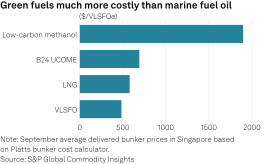
Sustainable marine fuels are currently much more expensive than conventional, oil-based fuels, but many shipping industry participants said a robust carbon price regime could prompt more green fuel production and lead to lower prices.
One of the largest biofuels groups in the US, the Renewable Fuels Association, had praised the framework in advance of the vote, with President and CEO Geoff Cooper seeing the NZF as an "enormous potential market opportunity for American-made renewable fuels." After the delay, Cooper said the group would continue to lobby US officials on behalf of the measure.
The monthly average delivered bunker price for 0.5% sulfur fuel oil, the most common bunker type, was $483.73/metric ton in Singapore last month, compared with $579.17/mtVLSFOe for LNG, $691.92/mtVLSFOe for B24 biobunker fuel with 24% used cooking oil methyl ester, and $1,897.44/mtVLSFOe for 100% sustainable methanol, according to the Platts bunker cost calculator.
Prolonged negotiations
A delegate of Saudi Arabia, which has led the opposing camp with some fossil fuel producers like Venezuela and Russia, said the reason to call for adjournment was that the IMO could not adopt the framework as "a divided house."
The Saudi motion won the backing of China, India, Panama and many others that earlier supported the framework in the April vote. Japan, Greece and Cyprus, major shipowning nations in the supporting camp earlier this year, abstained from the adjournment vote.
However, some Pacific island nations that had abstained from the vote in April have now expressed explicit support, arguing it would be better than status quo despite insufficient decarbonization effects.
"This [delay] is unacceptable given the urgency we face in light of accelerating climate change," said Vanuatu's Minister for Climate Change Ralph Regenvanu.
Most EU member states have continued to back the framework, and the European Commission said Brussels will "engage constructively with all partners" despite the postponement.
But some observers are pessimistic over the regulation's future. "Momentum appears to be fading, making agreement increasingly difficult," ING's economist Rico Luman said.
During Oct. 20-24, IMO member states will still discuss the framework's technical details during the Intersessional Working Group on Reduction of GHG from Ship as previously scheduled, which would be relevant to bunker markets if the regulation is to be adopted.
"What I am aiming is to continue the cooperation" among the member states, IMO Secretary-General Arsenio Dominguez said in a press briefing. "Geopolitics right now make it more difficult for us to address certain challenges."

Editor: