Crude Oil, Maritime & Shipping, Refined Products, Wet Freight
October 08, 2025
INTERVIEW: Uganda eyes new exploration, trading house as first oil nears

HIGHLIGHTS
UNOC plans trading arm to manage crude sales
Hoima refinery to include petrochemicals integration
Company selecting partner for Kasuruban exploration
Emerging oil producer Uganda is planning the next phase of its energy apparatus to support its first crude production in 2026, including a state-backed trading arm, petrochemicals integrations and new upstream partnerships, according to its state oil company.
In an Oct. 2 interview on the sidelines of the African Energy Week in Cape Town, Tony Otoa, Chief Corporate Affairs Officer at Uganda National Oil Company, said the East African country is on track to reach first oil in July 2026, promising to make its energy ambitions a reality after 20 years in the making.
"First oil is something that has plagued us," he said, noting years of setbacks that pushed the launch date from 2024 to 2025, and now 2026, amid fierce opposition from environmentalists and financing challenges.
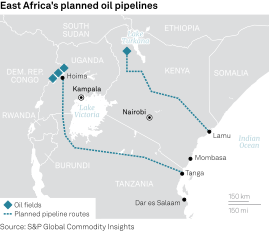
However, a funding breakthrough in March allowed the country to move ahead with its plans, which hinge on constructing a 1,400 km pipeline as an exit route for its crude. Running from Uganda's Albertine Graben basin to the Tanzanian port of Tanga, the East African Crude Oil Pipeline is now over 70% complete, Otoa said, expecting the Ugandan segment to be finished by December 2025.
Once the pipeline is up and running, China National Offshore Oil Corporation's 40,000 b/d Kingfisher field should be the first online, he said, calling it a case of "plug and play" once the infrastructure is ready. The larger 190,000 b/d Tilenga field, operated by TotalEnergies, faced more significant construction delays pending approvals for the EACOP project, but should begin its phased startup in H2 2026, the French energy major has said.
Between the two fields, production should gradually ramp up to 240,000 -260,000 b/d before hitting its peak, Otoa said. UNOC holds a 15% stake in both projects, and is currently in talks with TotalEnergies and CNOOC over how to manage its crude sales in the first years once the fields are online.
However, the company plans to eventually launch its own trading business to handle its oil, following a model used by other NOCs including Saudi Aramco and Brazil's Petrobras. UNOC is yet to confirm a launch date for its trading arm, but plans to decide on its headquarters by January 2026, Otoa said.
New exploration drive
As first oil nears, attention has turned to future production prospects.
On Oct. 6, the Ugandan energy ministry heralded a discovery in the Ngaji Basin by a UNOC-led consortium as another industry breakthrough, estimating recoverable oil reserves of about 1.2 billion barrels and around a fifth of Albertine Graben.
In the country's West, UNOC is selecting a partner to develop its Kasuruban Petroelum Exploration license, which was awarded in the country's last bid round in 2023. More than 20 companies expressed interest in an exploration partnership, Otoa said, expecting a final agreement within the year.
"Once this is done, we can then start on crazy exploration within that block. It's a huge opportunity where we could hopefully get an international partner to come along," Otoa said.
Uganda's energy ministry has repeatedly delayed plans to launch a third oil licensing round for acreage in its Moroto-Kadam, Hoima and Lake Kyoga basins, which it last slated for Q3 2025.
Downstream future
In the downstream sector, UNOC is targeting a 2030 launch date for the country's first oil refinery, which includes an adjacent petrochemicals project.
Together with UAE-based investor Alpha MBM, UNOC is developing a 30,000 b/d refinery in Uganda's Western Hoima district, which will later expand to 60,000 b/d in a second construction phase.
The complex could later be expanded again to keep pace with national fuel consumption, he said, noting recent demand growth that has maintained a rate of 5-6% per year. "Looking at the demand of refined products regionally, we could ramp up or scale up the refinery in the future," he said, estimating current consumption volumes at around 7 million liters per day (around 40,000 b/d).
When the refinery is online, UNOC plans to integrate it with a petrochemicals complex geared towards polypropylene, which will be co-located at its Kabalenga Industrial Park. It has previously shared ambitions to develop its 30 square km plot in Kabalenga into a multibillion-dollar oil and gas hub, including the refinery, a second international airport, agri-processing and fertilizer facilities, but has previously pinned hopes on finding an external partner to advance its plans.
Kenyan pipeline investment
Pending the refinery launch, UNOC is looking to streamline its fuel imports by investing in Kenyan pipeline infrastructure.
Kenya has historically provided a transit route for 90% of Uganda's fuel, offering a cost-effective pipeline network and relatively fast imports. In 2023, UNOC overhauled its import practices by agreeing its first direct trade deal with Vitol Bahrain, in a decision that bypassed Kenyan marketers and sparked a trade rift.
However, the move ultimately paid off for Uganda, Otoa said, expressing that the company has "mastered the game" and is now in a stronger position to pursue partnerships after smoothing relations with its Kenyan counterparts.
UNOC has expressed interest in acquiring stakes in Kenya's state pipeline operator, KPC, and is working to revive a pipeline expansion plan first floated over a decade ago. An Eldoret-Kampala-Kingali pipeline would extend the existing system from Kenya into Uganda and Rwanda, offering a low-cost alternative to truck logistics.
The company is currently assessing compensation costs for resettling impacted communities and hopes to fast-track plans after ministerial meetings with its Kenyan counterparts, Otoa said. It also plans to construct a 320 million liter (around 2 million barrel) oil terminal in Kampala by 2027, a project it sees as part of a wider infrastructure-building drive.
"Uganda is only working with less than 20% of our potential," Otoa said, expressing hope for new momentum in the country's budding energy sector.
By early 2026, the country will have more information on the specifications of the oil it hopes will transform its economy. Meanwhile, as UNOC deliberates over the name for its flagship crude grade, Otoa can't help but drop a potential easter egg.
"We have five amazing options," he said, sharing that most pay tribute to the country's national bird. "We have Crane Blend... there are different options. We're trying to look at something nationalistic," Otoa said.

Editor: