


Refined Products, Maritime & Shipping, Fuel Oil, Bunker Fuel
October 07, 2025
PATH TO NET ZERO: Shipping giants' green fleet faces risks amid policy uncertainty

By Max Lin
HIGHLIGHTS
Major shipping firms invest billions in alternative-fuel ships
A lack of global emissions rules risks derailing decarbonization
Failure to adopt IMO framework could disrupt transition momentum
This is the latest in a series of articles tracking the net-zero greenhouse gas emission goals of companies across various sectors, including energy, shipping, and chemicals. The previous story in the series is here.
Top shipping companies are building large fleets capable of running on low-emission fuels to kick off their decarbonization journeys, but persistent regulatory uncertainty is putting those investments at risk.
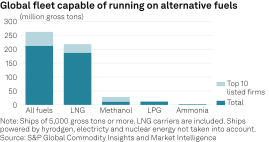
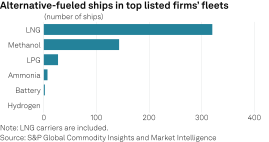
The world's 10 largest maritime transport companies by market capitalization have plowed tens of billions of dollars into nearly 500 ships that can burn alternatives to conventional, oil-based bunker fuels, according to estimates from S&P Global Market Intelligence and S&P Global Energy. The ships collectively account for just 19% of the global alternative-fueled fleet in terms of gross tonnage.
Some large non-listed companies have also been willing to invest in green propulsion technologies, reflecting a broad willingness within the shipping industry to embark on an energy transition. But sustainable marine fuels are scarce and can be three to five times more expensive than conventional bunker fuel.
According to the UN, more than 85% of the world's shipping emissions come from large oceangoing ships. UN member states have tasked the International Maritime Organization with formulating global decarbonization rules in their climate efforts.
"A strong, unified IMO regulatory regime is absolutely essential for the shipping industry's decarbonization to succeed," said Fotios Katsoulas, Energy lead analyst on alternative fuels. "It would incentivize investments in new technologies and infrastructure by establishing a clear timeline and cost for carbon emissions."
More than 170 countries are set to meet at the IMO's London headquarters Oct. 14–17, to discuss the Net-Zero Framework, which would place a price on maritime emissions starting in 2028. Its adoption remains uncertain, however, due to strong opposition from the US and the Middle East.
"In our view, a failure to adopt the framework risks significant negative consequences for this momentum," the Getting to Zero Coalition said in a recent statement. The coalition represents more than 180 companies, including some of the top-listed shipping companies such as A.P. Moller-Maersk A/S and Nippon Yusen Kabushiki Kaisha, as well as energy majors, such as BP and Shell. "Prolonged uncertainty could put very large investments—ones that will be critical for the future of global trade—at risk."
Uncertain pathways
The IMO hopes that its new regulation can help reduce greenhouse gases from international shipping at least 20% by 2030 and 70% by 2040, compared to 2008 levels, before a net zero close toward 2050.
All of the 10 largest listed shipping companies also have net-zero targets around midcentury, but four of them did not lay out detailed interim targets on their decarbonization pathways.
"The IMO's ambition is clear, but many companies are waiting for more certainty around fuel availability, infrastructure, and cost before committing to deeper cuts," said Jason Stefanatos, global decarbonization director at classification society DNV. Classification societies certify that ships have met the technical standards the organization developed.
When all ships in operation and under construction are taken into consideration, the top 10 companies have 50.3 million gross tons of shipping capacity capable of consuming alternative fuels, according to the S&P Global estimates. LNG is the most common alternative fuel, accounting for 62% of the capacity.
Fossil LNG can reduce GHGs only 20%-30% compared with oil-based marine fuels, but its supporters say it is widely available at the main refueling hubs, methane slippage is limited in modern engines, and shipowners betting on it can shift to biomethane and e-methane for deep decarbonization.
"This approach reflects prudent capital discipline in light of current uncertainty regarding the commercial viability of various alternative fuels," classification society Bureau Veritas told Energy in an email. "This is ... more about aligning near-term decisions with demonstrated availability, operability, and compliance pathways, while keeping options open for future alternatives."
The companies have also invested in methanol-capable ships with 17.3 million gross tons of capacity, led by large orders from major container lines Maersk, Evergreen Marine, and Cosco Shipping Holdings, and underscoring their leading role in driving the development of the nascent fuel.
Methanol, when generated from biomass or renewable hydrogen, is a low-emission fuel with established safety protocols and existing infrastructure. Major container ports have started to introduce it in their bunker offerings.
On the other hand, only three of the 10 companies have ordered ammonia-fueled ships, and their combined capacity reached 483,000 gross tons. The fuel is highly toxic and corrosive, and the first ammonia-fueled ships in deepsea trades will not hit the waters until later this decade. However, many analysts said "green ammonia" could be the cheapest low-emission fuel in the long run, as its output could rise in line with growth in renewable hydrogen production.
"The limited investment in ammonia propulsion is primarily due to its significant technical and safety challenges," Katsoulas said. "Companies are waiting for these issues to be resolved and for a clear regulatory framework to emerge before making large-scale commitments."
Potential failures
Some maritime organizations, such as the International Chamber of Shipping, have warned that national and regional governments could establish their own maritime decarbonization regulations if the IMO fails to adopt the Net-Zero Framework, creating a regulatory burden and unfair competition for the industry.
"Different decisions made in different countries ... it will not work for shipping. It will be a disaster," said International Chamber of Shipping Chairman Emanuele Grimaldi.
The EU extended its Emissions Trading System to cover maritime transportation in 2024 and implemented FuelEU Maritime standards on marine energy's GHG intensity in January, but many in shipping hope that Brussels will keep its promise of adjusting its regulations if the IMO framework goes through.
"A robust IMO regulatory regime is essential for our transition to succeed," according to Wolfram Guntermann, director for regulatory affairs at German container line Hapag-Lloyd, one of the top listed companies. "Global measures make regional schemes unnecessary, and companies should not be exposed to double carbon charges for the same emissions."
With pressure from regional authorities, activist shareholders, and eco-conscious customers, shipping companies are unlikely to have a full-scale retreat from their climate targets even if the IMO rules are not adopted, some industry experts have predicted.
"Expect re-sequencing rather than retreat: slower scale-up of novel fuel offtakes, continued deployment of LNG and a greater reliance on enhanced efficiency measures," Bureau Veritas said.
Many shipowners appear hesitant to make further green investments amid regulatory uncertainty. DNV data showed that orders for alternative-fueled ships totaled 178 from January through August, down from 350 in the corresponding 2024 period.
"If the IMO fails to adopt its framework in October, it would be a major setback," Katsoulas said. "The most likely outcome would be a more gradual, less coordinated, and more expensive decarbonization journey for the industry as a whole."

Editor: