Coal, Maritime & Shipping, Metals & Mining Theme, Agriculture, Dry Freight, Ferrous, Oilseeds
October 06, 2025
DRY BULK QUARTERLY: Asia-Pacific Panamaxes outperform Capesize, Supramax segments in Q3
By Jun hao Ng and Nicholas Zhang
HIGHLIGHTS
Grain movement drives Pacific Panamax earnings
Minor bulk movement saves Supramaxes
Atlantic market fundamentals key for Capesizes
Dry bulk freight rates in Q3 2025 displayed varied performance across vessel segments compared to the same period in 2024, amid robust seaborne trade volumes, despite ongoing concerns regarding the global macroeconomic outlook
This mixed outcome was driven primarily by robust grain movements in the Panamax segment and increased minor bulk shipments on Supramaxes, reflecting a market balancing supply growth, regional trade dynamics, and sector-specific demand fluctuations.
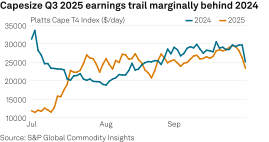
The Platts Capesize T4 Index, a global ton-mile weighted average index of four Capesize routes, averaged $23,394 per day in Q3 2025, experiencing a downswing compared to $25,032 per day from Q3 2024, according to S&P Global Energy data.
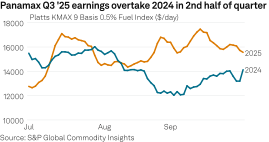
Meanwhile, the Platts KMAX9 Index, a global ton-mile weighted average of nine Panamax routes, averaged $15,562 per day in Q3, a decent improvement from $14,145 per day across the same period in 2024.
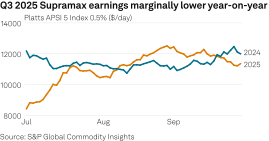
Similarly, the Platts APSI 5 Index, a ton-mile weighted average of five Supramax freight routes in Asia-Pacific, averaged $11,135 per day for Q3, a marginal dip from an average of $11,408 per day recorded in Q3 2024.
Optimism for Capesize market to sustain earnings
Capesize market sources predominantly expressed confidence and cautious optimism that average earnings in the upcoming quarter were likely to hold steady. "West Australian miners' iron ore export volumes have been constantly keeping up with expectations in the past quarter]," a shipowner source commented, suggesting that the Capesize market had found a footing after a fairly turbulent first half of 2025, where freight levels and export volumes were lagging behind the same period in 2024.
A second shipowner source echoed similar views that the Pacific market's performance had been relatively stable in Q3 2025 and export volumes improved from the previous quarter, suggesting that fundamentals in the Atlantic were key in dictating the fortunes of the Capesize segment for Q4. The same shipowner source singled out positive elements such as the Simandou iron ore mine project in Guinea, which is expected to commence its first export shipment in November and potentially provide an additional boost to Capesize earnings.
Moreover, Capesize shipping sources also widely expect Brazilian mining majors to actively export iron ore volumes in the earlier part of Q4, as some Brazilian iron ore miners were heard deferring their liftings in Q3 into Q4 and will likely have to ship them before the wet season commences in South America towards the end of the calendar year. "We will probably see fewer [Brazil iron ore requirements] with November and December laycans closer to the start of the rainy season," a shipbroker source quipped. As such, market participants hold a fairly positive outlook of the Atlantic Capesize market in the short run.
Firmer Panamax sector amid improved coal and grain demand
Despite the Panamax segment witnessing a significant improvement in rates starting from H2 August, driven by strong demand in both basins, uncertainty persists regarding grain movement in the final quarter of 2025.
"China has bought a lot of [soybeans] from Argentina for November and up to Q1 2026," a ship-operating source highlighted, suggesting the increase in Argentine-origin soybean shipments for Q4 2025 could potentially bolster rates in the South Atlantic market and therefore provide support for rates in the Pacific. North Pacific grain demand, however, remains a question mark due to the ongoing US-China tariff issues, the source added.
Towards the end of September, China purchased up to 40 soybean cargoes from Argentina after the latter suspended export taxes, and most of the cargoes were slated to be loaded in November.
However, a second ship-operating source expressed doubt over the impact of an increase in soybean cargoes loading from Argentina. "There will be more cargoes from East Coast South America (ECSA) in November but seasonally, the overall grain volumes [in the Atlantic] are still lower," the source quipped, noting that the increase in cargoes from Argentina would be insufficient to offset the lower ton-mile demand from US Gulf-China flows, which has resulted from US tariff tensions.
Minor bulk demand to potentially support Supramax rates
Similarly, market participants also expressed diverging views regarding the outlook for the Supramax segment in Q4. While some sources adopted a bearish outlook, believing that the Pacific market peaked in Q3 for 2025, others were of the opinion that the market could remain steady for the rest of the year.
"Minor bulk trades are still going strong in the Pacific and that alone might be sufficient to support current rates," a third ship-operating source opined.
According to S&P Global Commodities at Sea data, minor bulk shipments loading out of the Southeast Asia region on Supramax and Ultramax ships rose by around 11.25% year-over-year, from 34.94 million mt in Q3 2024 to 38.87 million mt in Q3 2025, underscoring robust demand for minor bulk cargoes such as clinker.
On the coal front, a coal analyst with a commodity trader noted that China-bound coal shipments, mostly for fulfilling winter restocking needs, were expected to be higher in Q4 compared to Q3 this year, although volumes would still be lower comparing to the same period last year. "There will also be supply side issues due to stringent checks at Chinese coal mines," the same source added, suggesting that domestic coal production in China could be limited due to the government's ongoing crackdown on major mining regions.
Conversely, a ship-chartering source expressed concerns over thermal coal demand for the rest of the year. They believed that demand in Q4 will not see a significant increase compared to Q3, primarily due to substantial headwinds facing the Chinese economy, which are dampening industrial coal consumption.

Editor: