


Energy Transition, Maritime & Shipping, Hydrogen, Renewables
September 29, 2025
WORLD HYDROGEN: Kandla port plans renewable methanol bunkering hub for Singapore-Rotterdam route
HIGHLIGHTS
Eyes 150,000 mt/year renewable methanol plant at Kandla
5.6 million mt/year renewable ammonia capacity in plan
Cross-subsidization strategy to match Singapore pricing
State-run Deendayal Port Authority is positioning Kandla port as a strategic renewable methanol bunkering hub to fuel vessels operating on the Singapore-Rotterdam corridor, as shipping lines prepare for stricter EU emissions regulations, according to Sushil Kumar Singh, chairman of the port authority.
The initiative targets around 200 methanol-compliant vessels expected to be deployed on the route, capitalizing on methanol's lower energy density compared to fossil fuels, which creates opportunities for mid-route refueling, according to Singh.
"Kandla port is already handling methanol as a cargo ... so now we are trying to reconfigure the whole infrastructure there, or the facilities there, to handle methanol as a bunker," Singh said on the sidelines of S&P Global Energy World Hydrogen India conference that concluded Sept. 26.
"We can start the bunkering trials immediately, as of now, in a controlled condition. So we have tankages. We have pipelines. We have the bunker infrastructure and the safety regulatory mechanisms in place for handling methanol as a bunker."
A gap analysis conducted by classification society DNV has assessed Kandla's readiness for methanol bunkering operations, rating the port between six and seven on the International Association of Ports and Harbors scale, according to Singh.
The authority is developing plans for a 150,000 metric tons/year eMethanol production facility, which Singh estimates will meet demand for the next five to six years. The port is actively engaging industry partners to establish an integrated plant for producing renewable hydrogen.
"Some of the industries have shown interest in investing money at Kandla to set up the facility, an integrated plant-kind-of-a-thing for eMethanol, which is the methanol, which is based on green hydrogen -- through the electrolysis route," he said.
"The demand is ... to make their projects bankable, they want an assured offtake."
Handling competition
Kandla port will face a competitive global bunker market, but Singh said it will find ways to gain a foothold in the environmentally friendly fuels industry as the energy transition progresses.
"In terms of viability, we have to ensure at Kandla that when we offer this methanol as a bunker, it should be cheaper or competitive or comparable -- done at a comparable pricing as is being offered at Singapore," he said.
"Even if our cost of procurement or cost of production is higher than Singapore, we will give that subsidy by cross-subsidizing and taking that differential on the cargo handling charges of the port," he said. "We'll try to keep the cost of methanol close to the cost being offered at Singapore or Rotterdam."
"If they come to our port, they will bring in some cargo also," he said. "We'll be offering bunker at a lower price, but we'll be taking the charges on the other operations also."
Deendayal Port Authority has a memorandum of understanding with the Port of Rotterdam to jointly develop matching dispatch and reception facilities for a renewable shipping corridor between Kandla and Rotterdam, according to Singh.
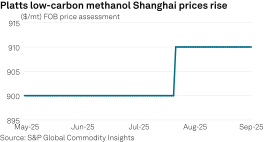
Platts, part of Energy, assessed low-carbon methanol FOB Shanghai stable from Sept. 26 at $910/mt on Sept. 29, on thin price discussions.
Platts assessed Shanghai delivered low-carbon methanol marine fuel unchanged from Sept. 26 at $930/mt on Sept. 29, on limited spot discussions.
Renewable hydrogen route
The port plans to also produce 5.6 million mt/year of renewable ammonia, using 1 million mt/year of electrolytic hydrogen by 2031, as an alternative fuel, in addition to renewable methanol, to have a basket of two fuels, he said.
"So they are ordering vessels which are dual-fuel compatible," he said, speaking of the new market in the making. "They can work on diesel or very low sulfur fuel oil, and they can work on alternative fuel like methanol also."
"If we are in a position to give [renewable] methanol about the same price as VLSFO, somehow bring it at $700/mt-$750/mt, they'll take it," he said.
However, the carbon will be a cost to the operators if they continue using VLSFO, as they'll be emitting more and will have to pay a penalty, so the first choice of fuel is likely to be renewable methanol, Singh said.
"The only decision that has to be taken is how to structure the offtake agreement, [and the] pricing part of it," Singh said, adding that the port was in active discussions with the buying parties.
Plug-and-play hub
The port authority is developing what Singh described as "plug-and-play kind of infrastructure," including a 300 million liters/day desalination plant to supply water for electrolysis, with other necessary infrastructure such as access to land and power.
"One of the constraints will be the renewable power that will have to be fed to these electrolyzers ... so around 4.5 GW has already been sanctioned," he said.
"We will require around 12 GW of power for 5.6 million mt/year of green ammonia ... that power is available in the grid. The approvals are in process."

Editor: