Maritime & Shipping, Refined Products, Wet Freight, Diesel-Gasoil
September 18, 2025
Ukraine hits Russia's Salavat refinery in new long-range drone strike

HIGHLIGHTS
Drones strike refinery 1,300 km from front line
First attack on Gazprom facility since May 2024
600,000 b/d capacity impacted by drones: JP Morgan
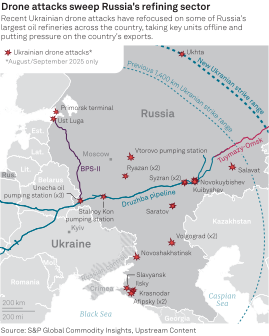
Ukrainian drones struck Russia's Salavat refinery in the Southern Urals for the first time in over a year Sept. 18, keeping energy facilities on high alert far from the front line.
A Telegram statement from Bashkortostan regional governor Radii Khabirov confirmed that two airplane-type drones attacked and set fire to the refinery. In an update around midday local time, he wrote that emergency services were working to extinguish the blaze and assessing potential damage.
Located between the Volga River and Russia's Ural Mountains, the 200,000 b/d Salavat refinery became one of the most audacious targets of Ukrainian drone attacks in May 2024, when it became the longest-distance casualties from escalating strikes.
In recent months, Kyiv has expanded its strike radius at least another 200 km to hit facilities roughly 1,500 km into Russian territory, but far-reaching attacks have remained relatively rare.
Ukraine's Special Operations Forces claimed in a separate Telegram statement Sept. 18 that its units had also struck the damaged Volgograd refinery, the largest in Southern Russia. Local authorities did not verify the attack.
Persistent air strikes have wrought havoc on Russia's fuel sector in recent months, targeting 19 different refineries, major export terminals and pipeline infrastructure.
On Aug. 11, drones travelled record distances to strike the 80,000 Ukhta refinery in the Komi Republic, northeastern Russia, while a recent assault on the major Primorsk oil terminal has triggered newfound concerns over Baltic oil exports.
The far-reaching attacks signal a new chapter in Ukrainian military strategy that once avoided export infrastructure, previously seen as a red line for Kyiv's Western arms suppliers.
Yet as a US-brokered peace process has ground to a standstill and threats of a major sanctions clampdown from the Trump administration have so far failed to materialize, the country has become more willing to overtly target energy facilities.
"The most effective sanctions -- the ones that work the fastest -- are strikes on Russian oil plants, terminals, and depots," said a statement from Ukrainian President Volodymyr Zelensky on Aug. 14.
An Aug. 16 research note from American investment bank JP Morgan estimated that recent drone attacks have taken 600,000 b/d of Russian refining capacity offline, taking estimated throughput volumes to their lowest since April 2022.
The flare-up in attacks comes during a period of peak summer gasoline demand and rising diesel use ahead of the Autumn harvest season, putting pressure on domestic prices.
"While some recovery is anticipated by early October, downside risks prevail as additional strikes could delay restarts and exacerbate structural damage," said the JP Morgan research note.
"This signals a strategic shift in Ukraine's approach to targeting Russian energy infrastructure, which could have implications for global energy markets," the report said.
Intensive drone attacks have supported gasoil benchmarks in recent weeks as export volumes have shown signs of stalling, fanning fears over wider supply shut-ins.
Platts, part of S&P Global Energy, assessed ICE Low Sulfur Gasoil M1 futures at $702.5/mt at 16:30 London time Sept. 18, up from $678.25/mt the previous week and a year-to-date average of $677.14/mt.

Editor: