


Coal, Maritime & Shipping, Agriculture, Metals & Mining Theme, Refined Products, Dry Freight, Grains, Ferrous, Non-Ferrous
July 07, 2025
DRY BULK QUARTERLY: Atlantic Supramax market maintains mixed notes amid uncertainty

HIGHLIGHTS
Minor bulk sector partly offsets weaker major bulk
Market uncertainty around shifting trade patterns
Protectionist policies, geopolitics key factors for H2
The Atlantic Supramax market witnessed minimal change in Q2 2025, with strong minor bulk shipments partially mitigating weaker coal, agribulk and iron ore shipments, while protectionist policies remained a key risk and geopolitical uncertainty persisted for the segment.
Supramax trade starting from the Atlantic Basin to both Atlantic and fronthaul Far East destinations increased marginally quarter-over-quarter, gaining 3% compared with Q1, and was up by 7% year-over-year, according to S&P Global Commodities at Sea data.
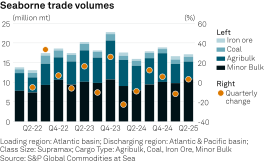
Minor bulk and agribulk cargo types accounted for 63% and 26% of the total volumes, respectively, while coal accounted for 7% and iron ore 4%, according to CAS data.
Compared to Q2 2024, minor bulk gained by 10% and agribulk cargo declined 8%, while coal increased by 7% and iron ore cargoes sank by 25%.
Meanwhile, the Atlantic Supramax weighted average index of the six key time-charter equivalent assessments on 0.5%S bunker fuel basis (ASI 6 Index 0.5% VLSFO TCE $/d) was up by 15% quarter-over-quarter compared to the Q1 average, and down by 27% year-over-year, according to Energy data.
USGC demand falls, Panama Canal transits rise
In the North Atlantic and the US Gulf Coast, the Supramax market continued to see increased transits through the Panama Canal for fronthaul trips, which had a negative impact on ton-mile demand. Transaction volumes heading through the canal accounted for 82% of the total, with the Cape of Good Hope making up the rest, according to CAS data.

In the USGC region, total seaborne volumes pushed down by 11% quarter-over-quarter in Q2, with agribulk and minor bulk transaction volumes dropping by 22% and 5% respectively, while coal cargoes nearly doubled, according to CAS data
Platts New Orleans to Kashima 50,000 mt grains route spot time-charter equivalent rates were marginally up by 6% quarter-over-quarter in Q2 2025 but down by 34% year-over-year compared to Q2 2024, according to Energy data.
"The market remained under pressure, with both charterers and owners engaged in a waiting game to determine whether the fundamentals will change. In some cases, the spot market kept mixed tones but also appeared increasingly positional," a source said.
South Atlantic grains volumes buoyed amid a rebound in trans-Atlantic business
In the South Atlantic, the grains market on the East Coast of South America saw demand in the second quarter amid seasonality while strong fundamentals persisted in the region and the trans-Atlantic business supported the segment.
Supramax loading in the ECSA region for trans-Atlantic trips accounted for 80% of the total volumes compared to fronthaul trips which represented by 20%, according to CAS data.
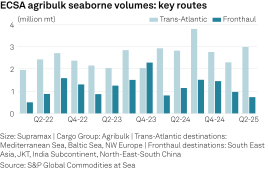
Volumes for trans-Atlantic trips increased by 30% compared to Q1 2025 while for fronthaul trips they were down by 24% on seasonality, according to CAS data. Year-on-year they were up by 6% for trans-Atlantic trips but down 36% for fronthaul.
"The market is exhibiting resilience by gradually absorbing the excess capacity, which has led to a relatively stable freight environment with signs of modest upward momentum," a shipbroker said.
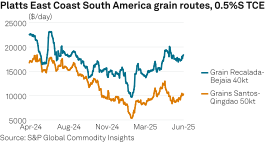
Platts Recalada to Bejaia 40,000 mt trans-Atlantic grains route time-charter equivalent assessments on 0.5%S bunker fuel basis was up by 27% quarter over quarter.
"South Atlantic grain routes consistently offer attractive average gains for owners who maintained their tonnage in the area," a second shipbroker said.
Continent and Baltic Sea scrap markets sluggish
The Supramax segment in the Continent and Baltic Sea regions was subdued with lower scrap demand, while strong fundamentals persisted amid imbalanced cargo demand and robust tonnage supply.
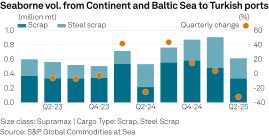
Scrap and steel scrap volumes from Northwest Europe & Baltic Sea to the Mediterranean Sea and Turkish ports was down by 32% compared to Q1 2025, though up by 15% year on year, according to CAS data.
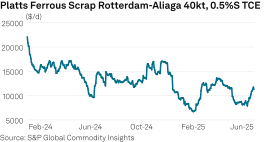
Platts Rotterdam to Aliaga 40,000 mt scrap route spot time-charter equivalent rates were up by 11% quarter-over-quarter in Q2.
"Even though scrap demand fell quarter over quarter, freight earnings rose, with demand-supply dynamics largely steady," a ship operator said. "The increase reflected higher operating costs, driven by rising bunker prices amid geopolitical uncertainty and added EU regulatory burdens, especially ETS [Emissions Trading System] compliance, forcing owners to push for firmer rates despite weaker trade flows."
Uncertainty around trade patterns persists
Geopolitical events, particularly in the Middle East, along with uncertainties related to trade tariffs, are likely to have a significant impact on trade dynamics and pose a direct risk to commercial shipping in the second half of 2025.
On a more optimistic note, sources suggested that enhanced production volumes and exports from the Black Sea region could provide a glimmer of hope for the segment.
"Volumes are anticipated to rise following extremely low shipment levels in 2025, although challenges persist due to increasing logistics expenses and overall logistical constraints," a source said.
"Overall, market sentiment remains cautious yet hopeful, as freight levels have been maintained thus far and vessels are avoiding the Red Sea, which is enhancing ton-miles. Furthermore, the second half of 2025 may offer seasonal support," another source noted.
